[Rohto Pharmaceutical releases "Fertility Treatment White Paper 2023"]
More than half of young unmarried men and women do not want children. Approximately one in four women are "preparing for fertility treatment," keeping the option of pregnancy and childbirth open.
~An animated video "Don't Give Up! Egg-chan!" conveying correct knowledge about fertility treatment has also been produced~
March 1, 2024
ROHTO Pharmaceutical Co., Ltd. (Headquarters: Osaka City, President: Masafumi Sugimoto) will release its latest awareness survey, "Fertility Treatment White Paper 2023," aimed at spreading knowledge and understanding about fertility treatment.
In this survey, now in its sixth year, the number of young, unmarried men and women who do not wish to have children continues to increase, now exceeding half. However, among women, approximately one in four expressed a desire to broaden their future options, stating that they "want to keep open the possibility of having children in case their views change in the future." Furthermore, the number of women struggling to balance pregnancy/childbirth with their careers in this rapidly changing era has increased, exceeding half of the respondents. At the same time, the survey revealed a lack of opportunities to obtain accurate information about fertility treatment and a strong demand for earlier education.
Rohto Pharmaceutical has been engaged in various initiatives, including research and development of products that support fertility treatment and dissemination of accurate information about pregnancy. Based on this background and the results of the recent survey, we have released a special animated video, "Don't Give Up, Egg-chan!", on Rohto Pharmaceutical's official YouTube channel, with the aim of making fertility treatment feel more accessible while providing accurate information. In this video, important knowledge about fertility treatment that you should know is conveyed through the daily life of our original character, "Egg-chan".
Main survey topics from the "Fertility Treatment White Paper 2023"
- More than half of young, unmarried men and women do not want children.
However, about one in four of these women hope to keep the option of having children open in case their feelings change in the future.
- For women who conceived through fertility treatment, the average time from the start of fertility treatment to actually becoming pregnant was 13.6 months.
Over 60% expressed a strong desire to have gained accurate knowledge about pregnancy and childbirth when they were younger.
- There is nearly a twofold difference between men and women in terms of knowledge about fertility treatment.
The prevailing trend is that women research information about pregnancy and childbirth online and then share it with their partners.
- Employed women with stable incomes tend to desire children more than other young people.
On the other hand, about half of women who have tried to conceive struggled with balancing work and their careers, and more than 70% struggled with balancing work and trying to conceive.
More than half of young, unmarried men and women do not want children. However, about one in four women want to keep the possibility of having children open in case their feelings change in the future.
When asked whether they wanted children, 55.2% of young, unmarried men and women responded that they did not want children now and did not want them in the future. Broken down by gender, 59.0% of men and 51.1% of women gave this answer, meaning that more than half of both sexes felt this way.
Of those surveyed, approximately one in five men and women said they wanted to maintain a physical condition that would allow them to conceive in the future, in case their plans changed. This percentage rose to about one in four among women, who face greater age-related constraints regarding pregnancy. This result reveals that a certain number of people want to keep the possibility of having children open and broaden their future options—the "fertility preparation group"—and this group is more prevalent among women.
Among women who are preparing for fertility treatment and answered, "I want to maintain a physical condition that allows me to become pregnant so that I can have children if my plans change in the future," about one in five responded that they are "interested in egg freezing." This shows the high level of interest in egg freezing, a hot topic these days, as a way to broaden future options.
For women who conceived through fertility treatment, the average time from starting fertility treatment to actually becoming pregnant was 13.6 months. More than 60% expressed a strong desire to have gained accurate knowledge about pregnancy and childbirth when they were younger.
68.8% of women who have actually conceived a child after trying to get pregnant responded that "getting pregnant is more difficult than they imagined before starting to try to get pregnant." 58.4 % responded that "it would have been better to start preparing for pregnancy or trying to get pregnant earlier." The percentage of those who answered both questions increased with the age of childbirth, and among those who gave birth in their late 30s, both exceeded 70%.
For women who have successfully conceived after trying to get pregnant, the average time it took from the start of trying to conceive until actually getting pregnant was 13.6 months. Looking at the results by age at the time of childbirth (*), it was 6.7 months for those aged 18-24, 10.3 months for those aged 25-29, 14.6 months for those aged 30-34, 16.4 months for those aged 35-39, and 19.5 months for those aged 40-44, showing a tendency for the period to lengthen with increasing age.
(*If you are currently pregnant)
65.0% of women who have conceived after trying to get pregnant said they "wish they had acquired accurate knowledge about pregnancy and childbirth when they were younger," and 67.5% said they "lacked opportunities to acquire knowledge about pregnancy," highlighting the importance of acquiring accurate knowledge from an early age.
There is nearly a twofold difference between men and women in terms of knowledge about fertility treatment.
The prevailing trend is that women research information about pregnancy and childbirth online and then share it with their partners.
For married men and women who hope to have children someday, the current sources of information regarding fertility treatment and childbirth are primarily internet searches for women (41.9%) and for men, primarily their partners (42.6%). It appears that in many cases, women first gather information online and then share that information with their partners while working on fertility treatment.
When asked what they knew about pregnancy and childbirth, for example, 39.3% of women and 13.3% of men were aware that "ovulation can be predicted using ovulation test strips," while 53.5% of women and 18.9% of men were aware that "it is important to actively consume nutrients such as folic acid and iron," showing a nearly twofold difference in awareness. This highlights the significant gap in knowledge about pregnancy and childbirth between men and women.
Employed women with stable incomes tend to desire children more than younger women. On the other hand, about half of women who have tried to conceive struggle to balance work and their careers, and more than 70% struggle to balance work and trying to conceive.
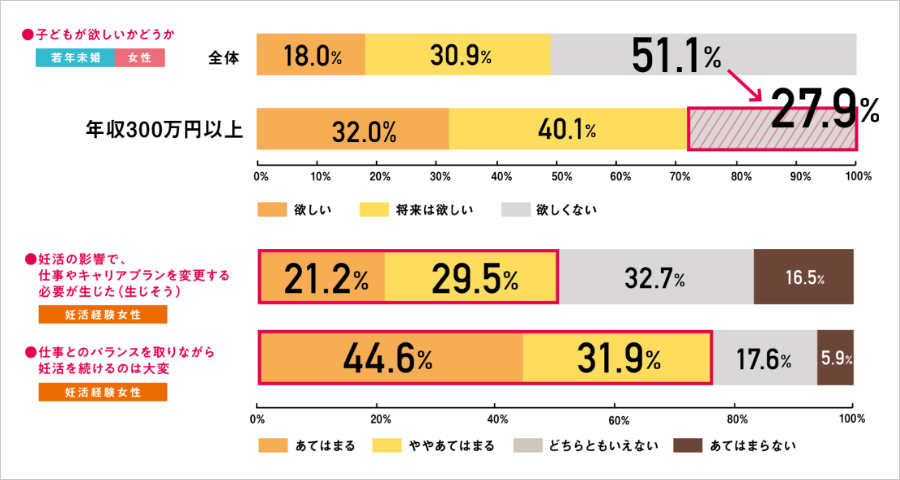
Among young, unmarried women, the percentage of those who do not want children dropped to 27.9% among those with an annual personal income of 3 million yen or more, exceeding the average annual income for women in their 20s. This suggests that women with stable incomes tend to desire children, even among younger generations.
While a certain number of working women desire children, 50.7% of women who have conceived after undergoing fertility treatment said that "fertility treatment necessitated changes to their work or career plans." Furthermore, 76.5% said that "it is difficult to continue fertility treatment while balancing work," highlighting the current struggles of women trying to balance their careers and fertility treatment.
These results suggest that, in this rapidly changing era, it is necessary for women to acquire accurate knowledge about pregnancy and childbirth early on in order to enable them to make free and authentic life choices regarding pregnancy, childbirth, and careers.
Regarding Rohto Pharmaceutical's "Fertility Treatment White Paper 2023"
Rohto Pharmaceutical has been supporting people's efforts to conceive by working alongside those who wish to have children, through product research and development and by disseminating accurate information about pregnancy. As one of these initiatives, since 2018 we have been publishing the "Fertility White Paper" with the aim of spreading knowledge and understanding about "fertility treatment."
The White Paper on Fertility Treatment addresses the social issue of fertility treatment, which is often perceived as something that women should take the lead in. It strives to amplify the voices of those who are currently undergoing or considering undergoing fertility treatment, including promoting "two-person fertility treatment," where partners work together to address the issue.
In the 2023 edition, the sixth year of the survey, many young women expressed a desire to prepare for future possibilities, saying, "Even if I don't want children now, I want to keep my options open in case my feelings change in the future and I want to have children." The voices of people who have actually gone through fertility treatments and been blessed with children highlighted the importance of acquiring correct knowledge from a young age.
For details of this survey, please download the link below.
"Fertility Treatment White Paper 2023"
Survey Overview
- Survey name: Rohto Pharmaceutical "Fertility Treatment White Paper 2023"
- Survey period: December 1st (Fri) - 4th (Mon), 2023
- Survey method: Internet survey
- Survey subjects: Men and women aged 18-49
- Target area: Nationwide
- Sample size: 22,453 people
About the special animated video "Don't Give Up, Egg Cell!"

The special animated video "Don't Give Up, Egg-chan!" is a story about eggs and sperm for anyone who wants to have a child someday. Through the daily life of the brave protagonist "Egg-chan," who eagerly awaits her reunion with "Sperm-kun," this web anime is an "edutainment" for fertility planning, where you can learn about the important knowledge of eggs for those trying to conceive.
The results of the "2023 Fertility Treatment White Paper" survey revealed that many people feel they have few opportunities to acquire accurate knowledge about fertility treatment and that they want to start learning early. Now that diverse values, careers, and lifestyles are commonplace, it is especially important to acquire accurate knowledge about your own and your partner's body in order to choose a life that is right for you. Rohto Pharmaceutical also wants to increase opportunities for people to easily and enjoyably acquire knowledge, not only for those who are thinking about fertility treatment, but also for young people who are thinking about their life plans, and for everyone, regardless of gender, who wants to have children someday. It was with this in mind that we created "Don't Give Up, Egg-chan!", a fertility treatment edutainment featuring eggs and sperm as the main characters.
Despite being a vital part of one's own or one's partner's body, the egg cell is often misunderstood and overlooked. This project aims to encourage more people to take an interest in their own and their partner's bodies by giving them a glimpse into the daily life of "Egg-chan," a character representing this somewhat poignant yet endearing existence.
"Don't give up, little egg!" video story
The story takes place inside a woman's body. The main characters are the "egg" and "sperm," which could be considered the protagonists of your own fertility journey.
This story follows "Egg-chan" as she longs for a rendezvous with "Sperm-kun," but is tossed about by various physical circumstances and her relationship with her partner. It's presented in a slightly melancholic yet endearing world.
Episode 1: "The day before ovulation is crucial for conceiving a child!"
The egg is in perfect condition right after ovulation. But no matter how long it waits for sperm, they just won't come... 24 hours later, the sperm finally arrive! But what happens to the egg at that moment...?
https://youtu.be/71thT7ZZKPY
Episode 2: "Ovulation only happens once a month!"
Egg-chan has made an appointment to meet Sperm-kun on her next ovulation day. However, on the day of the meeting, Sperm-kun is terribly late! As Sperm-kun rushes over in a panic, Egg-chan says something angry to him...!?
https://youtu.be/QkACz0CWUFA
Episode 3: "The number of eggs decreases with age!"
It looks like the egg cells are playing "Red Light, Green Light." But each time they turn around, the number of egg cells gradually decreases...!?
https://youtu.be/tU05Q6RpkUI
Episode 4: "Ovulation Day is About Two Weeks After Your Period Starts!"
One day, Egg-chan receives a call from Period-chan, who is in the Womb House! She makes an appointment with Sperm-kun in two weeks to head to the Womb House, which Period-chan has cleaned, but...!?
https://youtu.be/K4M-vq3-Pi8
"Don't give up, little egg cell!" Video Summary
- Release date: March 1, 2024 (Friday)
- Released on: Rohto Pharmaceutical's official YouTube channel
- Performer (voice only): Nanami Yoshimura
About do test LHII ovulation prediction test kit
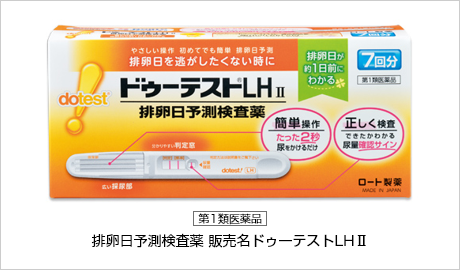
Please use this test kit only after receiving instructions from a pharmacist and carefully reading the "Precautions for Use."
One of the keywords in "Don't give up, little egg!" is "ovulation day".
The most fertile time for conception is "before or immediately after ovulation," so predicting ovulation in advance is very important.
"do test LHII" is a pregnancy test that detects changes in LH (luteinizing hormone) and predicts the most fertile period (ovulation day) about one day in advance.
Because the urine collection area is large, it's easy to apply urine and the design prevents splashing, so it reliably captures urine in just two seconds.
Going forward, Rohto Pharmaceutical will continue its activities while staying close to the feelings of customers who wish to conceive.
dotest official website