We are promoting initiatives to leverage the technologies we have cultivated to create new value. Within the company, we are making progress in utilizing the assets we own across various fields.
Furthermore, for technologies that we cannot fully utilize on our own, we engage in licensing activities for our patented technologies.
We are seeking partners to collaborate with us in developing products and services that will help us create a more well-being-oriented world. Please feel free to contact us for more information.
From eye drops to stomach medicine: "A refreshing and pleasant sensation"
Based on its research into the refreshing sensation of eye drops, Rohto Pharmaceutical developed "Smart Cool Tech®" (Patent No. 6687781, JP 2024-180505 A), a formulation technology that suppresses unpleasant irritation, and has applied it to many eye drop products.
We didn't stop at just incorporating these technologies into eye drops; we tried to extend our goal of "providing customers with a sense of comfort" to other fields. We applied the insights gained from analyzing the mechanism of refreshing sensation at the receptor level from eye drops to gastrointestinal medicines, a completely different field.
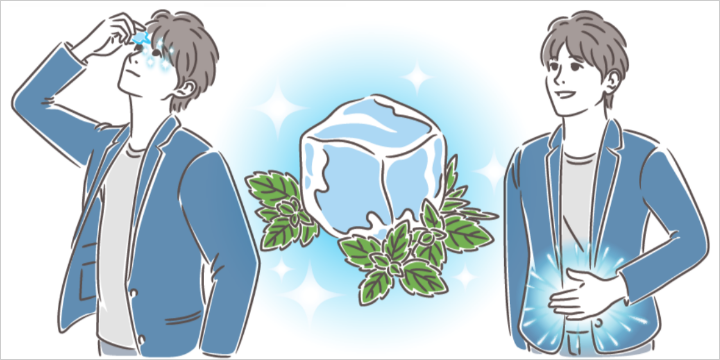
The key lies in the TRPA1 receptor, which senses pain and chemical irritation. While menthol produces a cooling sensation, it can also activate TRPA1, sometimes resulting in a stinging or irritating feeling. In our previous research on eye drops, we have found that menthone and α-pinene, found in peppermint oil, suppress TRPA1 activation.
To apply this idea of alleviating irritation to gastrointestinal medicine, we focused on limonene, a plant-derived component found in dried tangerine peel and ginseng, which are known as herbal medicine ingredients. We discovered that low concentrations of limonene suppress TRPA1 activation caused by menthol.
It is believed to provide a gentle cooling sensation by acting as a partial agonist.
This initiative has made it possible to design a new drug-taking experience—one that feels instantly refreshing upon ingestion—using receptor-level science. This is an example of extending the intellectual property technology, cultivated through a thorough commitment to usability in eye drops, to gastrointestinal medications.
Skincare technology that integrates skin and eyes
In recent years, it has become clear that inflammatory substances (SASP factors) secreted by senescent cells spread inflammation to surrounding normal cells, accelerating aging. Rohto Pharmaceutical calls this "aging inflammation" and is conducting research in the field of skincare.
In that study, we confirmed that a certain combination of ceramides suppresses the secretion of SASP factors and their mechanisms.
Furthermore, drawing on knowledge accumulated through research on eye drops and gastrointestinal medicines, we focused on guaiazulene sulfonate and established a technology that enhances its effect by adding two types of ceramides (Japanese Patent Publication No. 2024-152524).
By incorporating these ingredients into our products, we contribute to maintaining healthy skin by suppressing age-related inflammation and chronic inflammation.
We will continue to integrate research findings related to the eyes, gastrointestinal tract, skin, and other areas to develop our own unique technologies.
Tottori's marine resources are being effectively utilized in products like tsukudani (simmered seafood) and kimchi, contributing to regional revitalization.
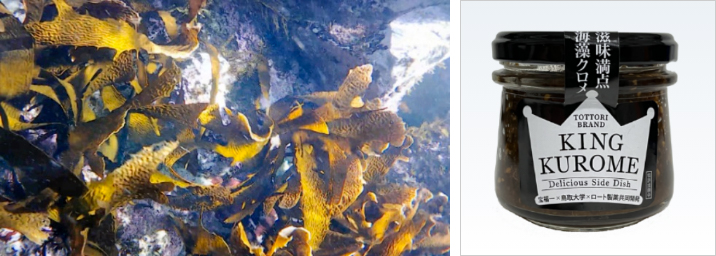
(Left) Seaweed kurome (Right) Tsukudani (simmered food) made with kurome "KING KUROME"
"Kurome," a brown algae that had not been utilized along the coast of Tottori Prefecture, was the focus of our collaboration with Tottori University. Through investigations into extraction conditions and component characteristics, we discovered the usefulness of Kurome, and as a result, we obtained a patent (Patent No. 7744640) for its composition and manufacturing method.
The research results were licensed to Hōfukuichi Co., Ltd., a food processing company in Kurayoshi City, Tottori Prefecture, and they launched "KINGKUROME," a tsukudani (simmered seaweed) product that highlights the appeal of kurome (a type of seaweed), thus contributing to the return of research results to the local community. "KINGKUROME" is a processed product that utilizes local resources and has also contributed to raising awareness of kurome.
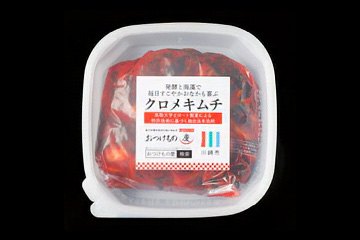
Furthermore, this initiative was not limited to Tottori Prefecture, but took on a new development through an intellectual property matching event hosted by Kawasaki Shinkin Bank.
Rohto Pharmaceutical introduced the potential applications of the technology, and the bank, from the perspective of promoting SDGs, matched them with "Otsukemono Kei," a kimchi specialty store in Kawasaki operated by Green Foods Atsumi Co., Ltd., a food manufacturer in Kawasaki City. A licensing agreement was concluded, which led to the development and sale of a new product, "Kurome Kimchi," by the company.
These initiatives are just one example of Rohto Pharmaceutical's use of intellectual property, contributing to regional revitalization and the creation of a sustainable society by enhancing the value of underutilized resources and promoting collaboration with local companies. We will continue to promote the use of intellectual property to circulate research results back into the community and society.