We have jointly developed a supportive voice dialogue AI with PKSHA and have begun verification for social implementation
– supporting the well-being of people who are isolated or feeling lonely.
October 24, 2024
ROHTO Pharmaceutical Co., Ltd. (Headquarters: Osaka City, Osaka Prefecture, President and Representative Director: Masashi Sugimoto) is pleased to announce that it has jointly developed a supportive voice dialogue AI with PKSHA Technology Co., Ltd. (Headquarters: Bunkyo-ku, Tokyo, President and CEO: Katsuya Uenoyama, hereinafter referred to as PKSHA) in cooperation with Dr. Yuzuru Kawashima (Child Psychiatrist) of Hanzomon Nobisuko Children's Clinic.
Background of Research and Development
Rohto Pharmaceutical's purpose is to energize the world by delivering "health" to people around the globe through our products and services, thereby leading all individuals and society around us to well-being. Based on health, which is the core value of our business, we have continued to challenge ourselves in new areas without hesitation, against the backdrop of social issues and changes in our customers.
The social issues surrounding children in Japan, such as poverty, educational disparities, abuse, and bullying, are becoming more diverse and serious. One survey found that 30% of children in Japan reported feeling lonely, a figure that stands out compared to other OECD countries. *1 Furthermore, Japan is facing a super-aging society, and loneliness and isolation among the elderly are also becoming issues.*2 In response to these circumstances, the Act on Promotion of Measures to Address Loneliness and Isolation came into effect on April 1, 2024, and concrete measures are now required.
Against this backdrop, we have been developing conversational AI in collaboration with PKSHA, a company with strengths in AI for communication, with the aim of supporting the well-being of children, young people, and the elderly, who are particularly susceptible to loneliness and isolation.
*1: UNICEF, Child poverty in perspective: An overview of child well-being in rich countries, Innocenti Report Card 7, 2007 UNICEF Innocenti Research Center, Florence.
*2: Cabinet Office survey
Features of a supportive voice dialogue AI
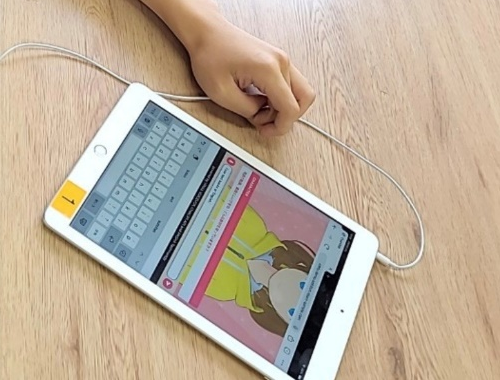
Image of interacting using a tablet
The empathetic voice dialogue AI is a system that responds to human speech with voice, and can be used on devices such as PCs and tablets. While based on generative AI, its distinguishing feature is its ability to engage in dialogue that is more specifically focused on "active listening." Specifically, instead of immediately providing answers to the user's questions, it listens attentively after understanding the content, removes expressions that may incite anxiety, and achieves an appropriate conversation speed that allows for natural dialogue. Through this type of dialogue, it supports self-reflection and promotes self-awareness through introspection and reflection.
Furthermore, it includes a consultation mode for delving deeper into specific topics and a chat mode for enjoying conversations. Users can easily seek advice on their problems or discuss topics that might be difficult to talk about with friends their own age, which is expected to have a positive psychological impact.
Verification efforts have begun in local governments and other organizations.
To prepare the product for social implementation, we conducted a trial with children who were unable to attend school for various reasons. The results of the post-trial survey showed that 33% of the 30 respondents found it "very enjoyable," and 66% found it "enjoyable." Comments included, "It felt like talking to a human, and it made me feel lighter," and "I was able to talk a lot about semiconductors, something I don't usually get to talk about." This confirmed that even without discussing their problems directly, sharing topics of interest improved their mood. Some also commented that they felt comfortable talking about their everyday worries without worrying about the other person's feelings, precisely because it was an AI.
Future outlook
This product was developed not for therapeutic purposes, but to help alleviate feelings of loneliness and isolation. Going forward, we will explore diverse use cases, not only for children, young people, and the elderly, but also in places where loneliness and isolation are common problems. We will collaborate with companies, government agencies, and other partners to expand the service.
For example, we are considering using AI to support employees working in factories who may find it difficult to talk to those around them while they are busy, addressing their worries and concerns during work. Our goal is to support the mental health of essential workers and create a workplace environment where diverse individuals can work and thrive with peace of mind.
About PKSHA Technology
With the mission of "shaping the software of the future," we develop and provide AI solutions and AI SaaS using our own proprietary machine learning/deep learning algorithms to create a better future relationship between companies and people. Based on a wide range of technologies, including automated responses using natural language processing, image/video recognition, and predictive models, we provide solutions tailored to our customers' challenges. In addition, by deploying AI SaaS that solve common problems, we comprehensively support the social implementation of software and aim for a prosperous society where people and software evolve together.
| Company Name |
PKSHA Technology Co., Ltd. |
| location |
4F, Hongo Segawa Building, 2-35-10 Hongo, Bunkyo-ku, Tokyo |
| representative |
Representative Director: Katsuya Uenoyama |
| Home page |
https://www.pkshatech.com/ |
About Hanzomon Nobisuko Children's Clinic
This clinic provides comprehensive care for children, addressing both their physical and mental health, with specialists in child medicine (pediatricians and child psychiatrists). We prioritize collaboration within the local community to support the healthy development of children.
| location |
Premiere Ichibancho 1F, 4-16 Ichibancho, Chiyoda-ku, Tokyo |
| Home page |
https://nobisuko.jp |