Let's use October 10th, "Eye Care Day," as an opportunity for parents and children to think about eye health.
Rohto Pharmaceutical and Taiyo Life Insurance Institute for Aging Society Conduct First Joint Survey
Approximately 60-70% of parents are conscious of their children's eye health.
- Expanding opportunities for society to consider children's eye health through cross-industry collaboration -
October 1, 2026
ROHTO Pharmaceutical Co., Ltd. (Headquarters: Osaka City, Osaka Prefecture; President: Hidetoshi Segi) and Taiyo Life Insurance Company, Ltd. (Headquarters: Chuo-ku, Tokyo; President: Yasuo Tamura), through its subsidiary Taiyo Life Research Institute for a Low Birthrate and Aging Society (Headquarters: Chuo-ku, Tokyo; President: Masatoshi Yasuda), jointly conducted a "Survey on Awareness Regarding Children's Eyes" targeting 1,500 parents of preschool and elementary school children nationwide, coinciding with "Eye Care Day" on October 10th.
The survey revealed that, according to parents, the most common opportunity for their children to have had an eye exam was the "3-year-old health checkup" for preschool children (57.0%) and "school eye exams" for elementary school children (73.3-83.8%). This indicates that health checkups and school eye exams are the primary opportunities for parents to learn about their children's vision.
Furthermore, among children who had received feedback about their vision from a doctor, during a health checkup, or during a school vision test, 44.4% had also had a vision test at an ophthalmologist's office. However, this survey did not examine the timing of the feedback about vision problems and the timing of the vision test at the ophthalmologist's office, nor did it examine the severity or content of the feedback. Therefore, this figure does not represent the rate of children who subsequently visited an ophthalmologist after receiving such feedback.
Health checkups and school vision tests are opportunities to learn about a child's eyesight and how they see. Through this survey, we aim to convey the importance of using health checkups and vision tests as opportunities to learn about a child's vision and consulting with a specialist when necessary.
Background and Objectives of the Survey
In recent years, childhood myopia has been on the rise, and the age of onset has also been observed to be getting younger. Myopia is not simply a matter of "difficulty seeing." If it progresses to high myopia, it is known to increase the risk of eye diseases such as cataracts, glaucoma, retinal detachment, and myopic maculopathy associated with pathological myopia in the future, making it increasingly important to protect eye health from childhood. *1
In this context, Rohto Pharmaceutical believes that taking an interest in one's own eyes and vision from childhood is the first step in considering lifelong eye health. We aim to support healthy "seeing" throughout life, from children to the elderly. Protecting eye health is not simply about maintaining vision; it's also connected to learning, working, connecting with others, and enjoying a richer life.
Based on this idea, Rohto Pharmaceutical, which has been working in the eye care field for many years, and Taiyo Life Insurance's Institute for Aging Society, which conducts research and disseminates information on the importance of extending healthy life expectancy and prevention, jointly conducted a "Survey on Parents' Awareness of Children's Eyes" to understand parents' awareness and actual practices regarding their children's eye health.
This survey investigated how well parents are aware of their children's eyesight, the opportunities they have to check their children's vision, experiences of being told about their children's vision, children's own complaints about their vision, and eye health initiatives practiced at home.
*1 Source: Holden BA, et al. Ophthalmology. 2016 May;123(5):1036-42. Li Y, et al. Taiwan J Ophthalmol. 2023 May 16;13(2):142–150.Pan W, et al. Lancet Reg Health West Pac. 2025 Jan 27:55:101484. Zhi Chen, et al. J Glob Health. 2023 Nov 9:13:04144. Kamei T, et al. Ophthalmol Sci. 2025 Feb 3;5(4):100729 Tomio Nozue et al. Japan Disease General Medical Journal 2025:21(5):172-175 Haarman AEG, et al. Invest Ophthalmol Vis Sci. 2020 Apr 29;61(4):49.
Survey Overview
| Survey subjects |
1,500 parents nationwide with children in preschool (ages 4-6*) and elementary school grades 1-6.
*For school-aged children aged 4-6: those born between April 2, 2020 and April 1, 2023 are eligible. |
| Survey period |
July 16th (Thursday) - July 21st (Tuesday), 2026 |
| Survey methodology |
Web Questionnaire Survey |
| Investigation Contracting Company |
MyVoiceCom Co., Ltd. |
Survey Result 1
60-70% of parents are conscious of their children's eye health.
On the other hand, 54.3% of parents of preschool children have some way of knowing their child's eyesight.
When combining the responses of parents who answered that they are "very conscious" or "somewhat conscious" of their children's eye health, the figures were 60.6% for preschool children, 68.3% for first and second graders, 74.0% for third and fourth graders, and 72.3% for fifth and sixth graders. This indicates that 60-70% of parents in each grade level are conscious of their children's eye health.
On the other hand, 54.3% of parents of preschool children answered that they were aware of their child's vision in some way, such as "knowing the visual acuity values for each eye," "knowing the results of health checkups," or "having a general idea of whether their vision is good or bad." Among elementary school children, more than 80% of parents in all grades were aware of their child's vision in some way, showing a difference in awareness between preschool children and elementary school children.
Survey Results 2
6.3% of preschool children have reported having difficulty seeing.
The tendency to increase as the grade level increases.
17.9% of respondents overall said their child often or sometimes says they have trouble seeing. Broken down by age group, the percentages were 6.3% for preschoolers, 14.0% for first and second graders, 21.3% for third and fourth graders, and 27.3% for fifth and sixth graders, showing a tendency for higher percentages in the upper grades. Regarding daily behavior, 3.3% of preschoolers, 5.8% of first and second graders, 9.5% of third and fourth graders, and 12.0% of fifth and sixth graders said their child sometimes squints to see things. 3.7%, 6.0%, 7.0%, and 7.0% respectively said their child has difficulty seeing the blackboard or things far away.
On the other hand, 54.3% of parents of preschool children responded that they "don't see anything particularly concerning."
It's important to check a child's vision not only based on their own complaints of difficulty seeing or their daily behavior, but also through health checkups and vision tests.
Featured Data
Children's behavior regarding the use of digital devices
Regarding the use of digital devices, the percentage of respondents who answered that they "use digital devices for long periods of time" was 5.3% for preschool children, 13.0% for first and second graders, 19.0% for third and fourth graders, and 22.0% for fifth and sixth graders. In addition, the percentage of those who "often look at screens with poor posture" was 8.0%, 14.8%, 16.5%, and 23.0%, respectively, showing a tendency for higher percentages among older grades. Approximately 30% of each age group "get close to the screen when watching TV, tablets, or game consoles."
Survey Result 3
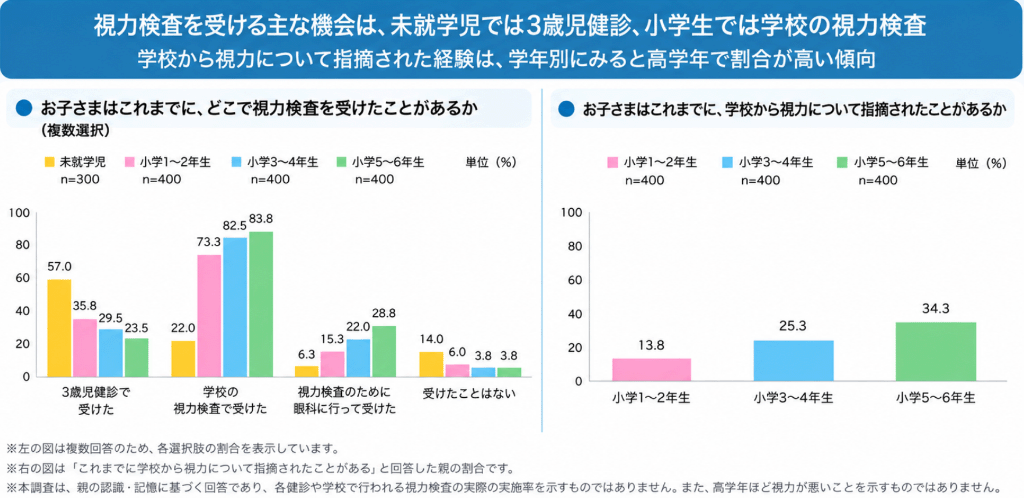
The main opportunities to check a child's eyesight are the 3-year-old health checkup for preschool children and the school vision test for elementary school students.
The experience of being told by school about eyesight issues tends to be more common among older elementary school students.
When asked about opportunities to have had their eyesight tested, 57.0% of preschool children said they had it done at their 3-year-old health checkup. Among elementary school students, 73.3% of first and second graders, 82.5% of third and fourth graders, and 83.8% of fifth and sixth graders said they had it done at school vision tests, indicating that health checkups and school vision tests are the main opportunities for parents to learn about their children's vision.
Furthermore, among parents who answered that their child's eyesight had been pointed out by the school, 13.8% of first and second graders, 25.3% of third and fourth graders, and 34.3% of fifth and sixth graders reported having received such feedback, showing a tendency for the percentage of those who had received such feedback to increase with the grade level.
Please note that this survey is based on parents' perceptions and memories, and does not represent the actual implementation rate of vision tests conducted at health checkups or schools. Also, the "experience of being told that one's eyesight was poor" is a cumulative experience, and therefore does not directly indicate that eyesight worsens with increasing grade level.
Survey Result 4
78.7% of parents are taking some kind of action to protect their child's eyesight.
The most common response was "being mindful of the distance from the screen" at 39.9%.
When asked what they consciously do to protect their children's eyes, the most common response was "making sure they keep a distance (around 30cm) from the screen" at 39.9%. This was followed by "paying attention to the brightness of the room" at 35.0%, "limiting the amount of time they spend using smartphones and tablets" at 34.1%, and "making sure they take breaks so they don't stare for too long" at 31.1%.
Additionally, 22.2% of respondents said they were "increasing the amount of time their children spend playing outside." 21.3% said they were "not doing anything in particular," meaning 78.7% of parents were taking some kind of action.
To protect children's eye health, it is important to be mindful of eye-care habits in daily life, and to have a thorough examination at an ophthalmologist if you notice anything concerning about your child's vision or if their eyesight is pointed out during a health checkup or at school.
Comment from Associate Professor Saeko Matsumura, Toho University Omori Medical Center
What we found particularly noteworthy in this survey was that while many parents are conscious of their children's eye health, there are actually many cases where they do not have a sufficient understanding of their child's vision, or where they do not have their child examined by an ophthalmologist even after being told that their child's vision is poor. In particular, among preschool children, only about half of the parents had some understanding of their child's vision, and even among children who had been told by their daycare or doctor that their child's vision was poor, a high percentage had never had their child's vision checked by an ophthalmologist.
Vision problems in preschool children aren't always caused by nearsightedness. Sometimes, amblyopia (lazy eye), where vision doesn't develop properly due to farsightedness or strabismus, is the underlying cause. There's a crucial period for visual development, and early detection and appropriate treatment of amblyopia are extremely important.
Furthermore, this survey revealed that 17.9% of children overall, and only 6.3% of preschool children, had ever reported having difficulty seeing. Children may think that having difficulty seeing is normal, or they may not be able to express it well in words. Therefore, instead of thinking, "It's okay because they don't say they have trouble seeing," health checkups and vision tests are important opportunities to notice abnormalities in children's eyes.
In Japan, there are opportunities to check the condition of children's eyes, such as the 3-year-old health checkup and school health checkups. It is important to make good use of these opportunities to first learn about your child's vision and how they see. If any issues are pointed out during a health checkup, we encourage you to use that as a starting point to have your child's eyes examined in more detail at an ophthalmologist's office.
Nowadays, ophthalmologists can do more than just "measure vision and make glasses." For nearsightedness, treatment to slow its progression can be considered as needed. We encourage you to start by "understanding your child's vision," and if you have any concerns, please feel free to consult an ophthalmologist.
Teacher Saeko Matsumura
Affiliation: Associate Professor, Toho University Omori Medical Center
Board Member of the Japanese Myopia Society, Board Member of the Japanese Society of Pediatric Ophthalmology, Board Member of the Myopia Research Society
Joined Toho University Medical Center Omori Hospital in 2002.
2004: Enrolled in the doctoral program at Toho University Graduate School.
Assistant Professor, Toho University Omori Medical Center, 2008
2008: Chief of Ophthalmology, Saiseikai Yokohama City Eastern Hospital
2017: Clinical Research Fellow, National Eye Centre, Singapore
Assistant Professor, Toho University Omori Medical Center, 2020
Lecturer, Toho University Omori Medical Center, 2023
Associate Professor, Toho University Omori Medical Center, 2026
Rohto Pharmaceutical's approach to eye care that protects your vision throughout your life
– Looking ahead to Well-being & Longevity in the AI and Digital Age –
Under its integrated management vision, "Connect for Well-being & Longevity," Rohto Pharmaceutical aims to support people in living healthy and fulfilling lives for as long as possible. In particular, we believe that "visibility" is one of the essential foundations that leads to learning, working, connecting with others, and enriching and enjoying daily life.
With the advancement of AI and digital technologies, the environment in which we access information, learn, work, and communicate is changing dramatically. In this era, Rohto Pharmaceutical believes that it is more important than ever to take an interest in one's own eyes and vision throughout one's life, from childhood to old age, and to address eye health, rather than simply considering eye health in terms of whether one can see or not at any given time.
This survey confirmed that health checkups for three-year-olds and vision tests at school provide opportunities to learn about children's eyesight and how they see. We believe that learning about one's own eyes and vision from a young age through these opportunities and developing an interest in eye health is the first step towards addressing eye health throughout one's life.
Rohto Pharmaceutical will continue to build upon the knowledge and science it has cultivated over many years in the field of eye care. Beyond simply providing products, we aim to create a society where everyone, from children to the elderly, can understand their own eyes and maintain healthy vision for a long time through research, education, and information dissemination. We will continue our efforts to provide eye care that protects vision throughout a lifetime, towards the realization of Well-being & Longevity.
Comment from Taiyo Life Insurance Institute for a Low Birthrate and Aging Society
"Through our unique research on the declining birthrate and aging society, we will create new value and contribute to society."
Amidst the declining birthrate and aging population, our institute considers "measures to address the declining birthrate" and "extending healthy life expectancy" as important social issues, and is engaged in research and studies from a medium- to long-term perspective. We aim to widely disseminate our research findings to society and connect them to social implementation and the resolution of social issues. Furthermore, we are creating new knowledge through collaborative research with researchers and companies, and are exploring its application to insurance products and various services.
In recent years, childhood myopia has been increasing and developing at younger ages. Since the progression of myopia can lead to an increased risk of eye diseases such as cataracts, glaucoma, and retinal detachment in the future, protecting children's eye health is becoming increasingly important.
Our research institute has focused on myopia as one of the important social issues related to extending healthy life expectancy, and has conducted research in collaboration with Rohto Pharmaceutical Co., Ltd., which has extensive knowledge in the field of eye care.
Our institute will continue to work towards creating new knowledge through collaboration with companies and research institutions possessing diverse areas of expertise.