Announcement Summary
Key points of the research
- We focused not only on the formulation itself, but also on the formulation after it has been applied to the skin. We captured the nanoscale structural changes that occur in the cream film over time and clarified its relationship to the duration of its moisturizing effect.
- As a new perspective for understanding moisturizing power, we focused on the "lifespan" of the water layer within the lamellar structure. By capturing the changes in the water layer over time after application, we found that its persistence corresponds to the stratum corneum moisture content and the duration of the feeling of hydration.
- We propose a simple evaluation model that reproduces the process of moisture evaporation after application to the skin using sample formulations with progressively adjusted water content. This suggests the potential for efficiently evaluating and screening the duration of moisturizing effects after application during the formulation development stage.
Research Background
Alpha gels used in moisturizing creams are known to have a lamellar structure that can retain moisture, leading to a high level of hydration and a pleasant feel. However, after the cream is applied to the skin, its structure gradually changes due to factors such as water evaporation.
Previous structural evaluations have been conducted using the formulation itself, but it was not sufficiently clear how the structure changes after application to the skin and how this relates to moisturizing effects and the perceived level of hydration. Therefore, we analyzed the cream film over time after actual application to the skin and verified the relationship between changes in film structure and sustained hydration.
Furthermore, analyzing the thin cream film after application over time requires measurements in a large facility equipped with powerful X-rays, posing challenges to its application in routine formulation development. Therefore, we also worked on developing a simple evaluation model that reproduces the water evaporation and structural changes occurring in the coated film using sample formulations with adjusted water content.
result
Result 1: Three-dimensional visualization of particle dispersion state in coating film using X-ray CT – evaluation of structures difficult to capture with conventional microscopy.
By observing the coating film of cosmetic formulations using X-ray CT, we were able to visualize in three dimensions the dispersion state of particles inside the coating film, which is difficult to grasp with conventional microscopic observation due to the overlapping appearance of oil droplets (particles). This made it possible to evaluate the structure of the coating film in a way that more closely reflects its actual state.
In this study, we evaluated lamellar structure creams (CP) using cetyl phosphate as a surfactant and lamellar structure creams (PS60) using polysorbate 60 as a surfactant. At the micrometer scale, CP, with its smaller particle size and uniform dispersion, was predicted to be superior in terms of formulation stability and moisturizing performance.
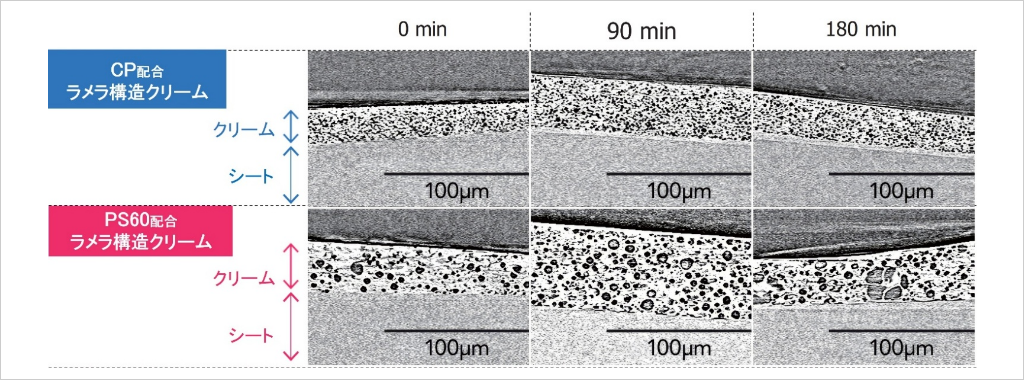
Figure 1: Changes in X-ray CT images of the coating cross-section over time
<Testing Method>
CP and PS60 were uniformly applied onto a polyurethane sheet using an applicator. The prepared coating was left to stand on a heater set to 32°C, which is close to the temperature of human skin.
The changes in the internal structure and particle dispersion state of the coating film over time were observed by X-ray CT at the **3 GeV high-brightness synchrotron radiation facility NanoTerasu**.
Result 2: The difference in moisturizing duration perceived by humans was elucidated from the persistence of the water layer thickness in the lamellar structure within the coating film.
In clinical trials, when CP and PS60 were applied to the skin, PS60 showed higher moisturizing duration than CP, contrary to the results predicted from the micrometer-scale particle dispersion state.
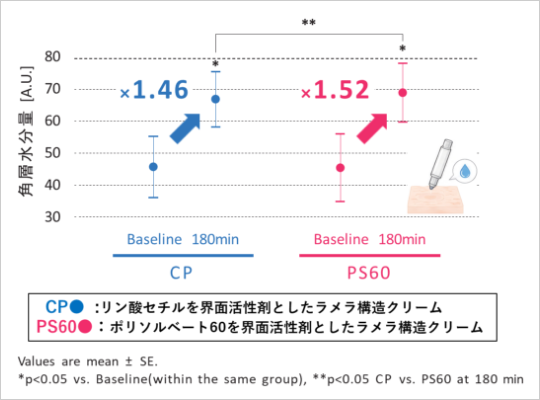
Figure 2: Test of changes in stratum corneum water content in human clinical trials
<Testing Method>
A subject-blinded, randomized, left-right comparative trial was conducted with 23 healthy women aged 20 to 60 years.
CP and PS60 were applied once to the left and right cheeks of each subject. Stratum corneum moisture content was measured before application and 180 minutes after application using a Corneometer® CM 825 (Courage + Khazaka, Germany).
Exam period: March 23rd - March 27th, 2026
Implementing company: DERMAPRO Ltd.
Next, we analyzed the nanometer-scale structure of the coating film, which was designed for actual use, over time. We confirmed that there was a difference in the persistence of the water layer in the lamellar structure formed within the coating film between CP and PS60. While the water layer in the lamellar structure was thick immediately after application with CP, it was shown that the high moisturizing effect perceived by humans is not due to the thickness of the water layer immediately after application, but rather to the fact that its thickness is maintained for a long period after application, as with PS60.
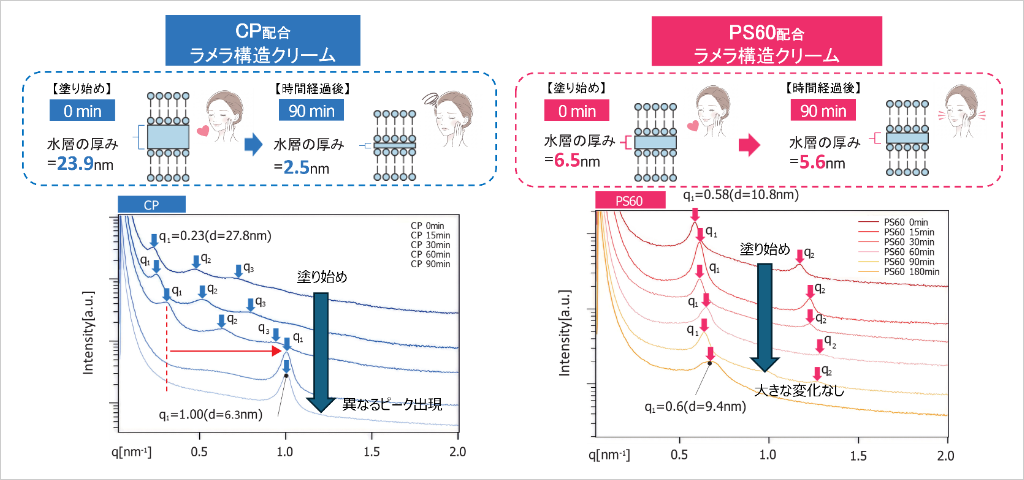
Figure 3: Relationship between the change in water layer thickness of the lamellar structure in the coating film over time and the moisture retention capacity.
<Testing Method>
CP and PS60 were uniformly applied to polyurethane sheets using an applicator, and the resulting coatings were left standing on a heater set to 32°C, close to human skin surface temperature. Measurements were taken from 0 to 150 minutes after application. The time-dependent changes in the lamellar structure formed in the coating were evaluated by SAXS (small-angle X-ray scattering) measurements at the **3 GeV high-brightness synchrotron radiation facility NanoTerasu**. The repeating period of the lamellar structure (lamellar period) was determined from the SAXS peaks, and the thickness of the water layer within the lamellar structure was calculated by subtracting the thickness of the lipid layer from this period. The time-dependent changes in the thickness of the water layer for CP and PS60 were compared to evaluate the nanometer-scale structural changes of the coating.
This study captures the long-lasting moisturizing ability of a formulation, which cannot be fully understood by conventional micrometer-scale evaluations such as particle size and dispersion state, from a nanometer-scale perspective, specifically by examining the temporal changes in the water layer within the lamellar structure of the coating film. Because this result could not be determined by evaluating the formulation in the container or immediately after application, it became clear that evaluating changes in the nanostructure within the coating film is crucial for developing products that provide superior moisturizing effects during actual use.
Result 3: A simple model was developed to reproduce changes in nanostructure in response to changes in moisture content after application – with potential applications in efficient screening of moisturizing formulations.
When cosmetics are applied to the skin, the moisture content and structure of the coating film change over time. Evaluating these changes in lamellar structure during actual use using SAXS (small-angle X-ray scattering) sometimes requires measurements at high-intensity X-ray facilities or preparation of the coating film during measurement, which has presented challenges to its introduction into routine formulation development.
Therefore, in this study, we constructed a simple evaluation model using sample formulations with progressively adjusted water content to simulate the decrease in moisture content after coating. Measurements using SAXS confirmed nanometer-scale structural changes similar to those observed in actual coating films (Figures 3 and 4).
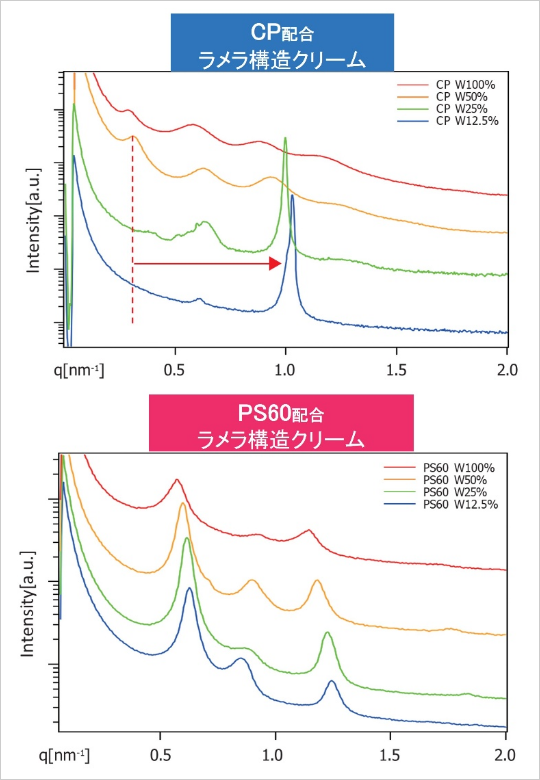
Figure 4: SAXS profiles of bulk samples with gradually adjusted moisture content (validation of the new model)
<Testing Method>
To easily reproduce the changes in moisture content in the coating film after application, bulk samples were prepared by gradually adjusting the moisture content of the formulation.
For CP and PS60, samples were prepared with a moisture content of 100% (W100%) during preparation, and then adjusted to moisture content of 50% (W50%), 25% (W25%), and 12.5% (W12.5%).
To compare and verify the results with those of coating film measurements, the lamellar structure of each sample was evaluated by SAXS (small-angle X-ray scattering) measurement at the **3 GeV high-brightness synchrotron radiation facility NanoTerasu**.
This evaluation model simulates nanometer-scale structural changes that occur in coatings after application by measuring bulk samples with different moisture content, without fabricating coatings on-site. In the future, if evaluation can be performed using a low-intensity SAXS device that can be installed in a laboratory, it is expected to be useful for formulation screening, enabling efficient comparison and selection of diverse formulations.
Future outlook
This study revealed that the nanometer-scale structural changes over time in cosmetic formulations after application correlate with the moisturizing effect observed in clinical trials. Furthermore, a simple evaluation model was constructed to simulate water evaporation and structural changes after application using sample formulations with adjusted water content.
Going forward, in addition to evaluating conventional formulations themselves, we will utilize this model in formulation design that takes into account the film structure after application to the skin, aiming to develop skincare products that provide longer-lasting hydration and offer superior usability and satisfaction.