World's first discovery of a "cellular age reversal switch" that works according to skin softness
- A new approach to controlling aging cells using algae-derived phytoexosomes *1 and Houttuynia cordata extract -
November 17, 2026
ROHTO Pharmaceutical Co., Ltd. (Headquarters: Osaka City, President: Hidetoshi Segi) is engaged in research on "phytoexosomes" *2, which are exosome-like extracellular vesicles derived from plants, microorganisms, algae, etc.
In this collaborative research with Professor Mariko Okada of the Institute for Protein Research, Osaka University, we have revealed that the softness of the culture environment surrounding cells influences the state of aged skin fibroblasts *3. Furthermore, we identified the "cell age reversal switch *4 (YAP/TEAD *5)" involved in this mechanism and discovered a combination of Houttuynia cordata extract and algae-derived phytoexosomes that enhances the function of the switch. This research demonstrates the possibility of a new approach that reverses the aging state of cells by optimizing the surrounding environment, rather than removing senescent cells.
The results of this research were presented at the International Federation of Societies of Cosmetic Chemists (IFSCC) academic conference "IFSCC 2026," held in Perth, Australia from September 28 to October 1, 2026, and received the Podium Fundamental Research Top 10 Finalist award.
Key points of the research
- Focusing on the hardening of the skin environment with age, we discovered that the softer the environment surrounding cells, the lower the proportion of cells that strongly exhibit characteristics of aging.
- World's first discovery of a "cell age reversal switch (YAP/TEAD)" that switches the state of aging cells.
- From 320 types of cosmetic ingredients, it was confirmed that a combination of algae-derived phytoexosomes and Houttuynia cordata extract enhances the function of the cellular age reversal switch (YAP), leading to a decrease in aging markers and an increase in collagen and elastin.
Research Background
One of the factors that accelerates skin aging is the accumulation of senescent cells. Senescent cells are cells that have stopped dividing, and they increase in number in the skin with age. They are also called zombie cells because they secrete factors that promote inflammation and disrupt the surrounding environment. They are also involved in changes such as thinning of the dermis and decreased maturation of the epidermis, and are considered to be one of the causes of skin aging, such as loss of firmness and wrinkles.
Until now, research has focused on methods to combat senescent cells, such as removing them or suppressing the harmful factors they secrete. However, senescent cells also play beneficial roles in the body, such as wound repair, so removing them is not always the best solution. Therefore, our company has devised a new approach: instead of removing senescent cells, we aim to utilize and improve them.
However, it's not just cells that change with age. Our previous research has confirmed that skin tends to harden with age, and that the harder the skin, the more wrinkles there tend to be. In other words, it is thought that the environment surrounding aging cells hardens with age. If aging cells change their surrounding environment, then conversely, wouldn't it be possible to change the state of aging cells by changing their surrounding environment? Based on this hypothesis, we conducted research focusing on the "softness" of the environment surrounding aging cells.
Furthermore, as an approach to the mechanism we discovered, in addition to studying the components, we considered utilizing research on "phytoexosomes," which focuses on the inherent functions of skin cells and the mechanisms by which cells communicate with each other.
Related releases
result
Result 1: In a soft cell culture environment, cells exhibiting strong aging characteristics decreased.
We cultured young and aged cells in a soft environment that mimicked young skin and a hard environment that mimicked aged skin, and then analyzed the state of each individual cell.
As a result, the percentage of cells exhibiting strong aging characteristics was 72% in a rigid environment, compared to 17% in a soft environment (Figure 1), revealing that senescent cells not only influence their surrounding environment, but their own aging state also changes depending on the softness of the culture environment.
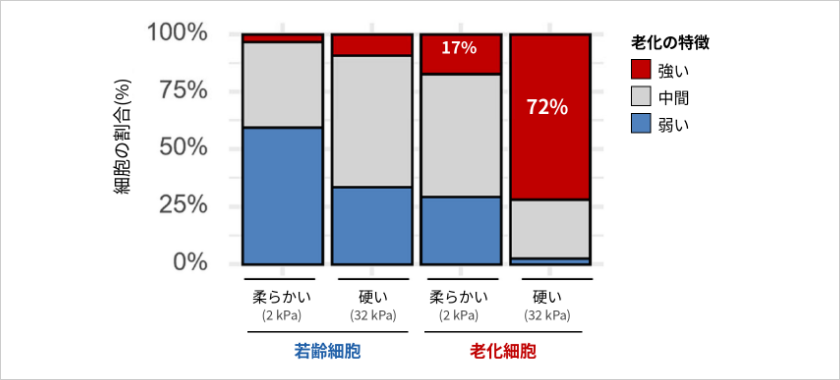
Figure 1: Percentage of cells by culture environment hardness and the severity of aging characteristics
<Testing Method>
Human dermal fibroblasts (young and senescent cells) were cultured for 48 hours on culture plates with different stiffnesses (soft: 2 kPa, hard: 32 kPa), and single-cell multi-ohm analysis was performed using scRNA-seq and scATAC-seq simultaneously. 194 genes were defined from overlaps between aging-related genes in publicly available databases and genes whose expression increases due to aging caused by replication stress in dermal fibroblasts. The scores for these genes were calculated as cell age, and the cells were classified into three groups.
(Conducted at Rohto Pharmaceutical Research Institute)
Result 2: Discovery of a "cell age reversal switch (YAP/TEAD)" that switches the state of senescent cells.
When comparing cells exhibiting strong and weak aging characteristics, it was suggested that YAP/TEAD, which is involved in the mechanism by which cells sense the hardness of their surrounding environment, may be an important factor in altering the state of senescent cells.
In fact, we found that YAP activity was high in soft environments and decreased in hard environments in senescent cells (Figure 2). Furthermore, when YAP activity was regulated using drugs, suppressing YAP activity in young cells reduced the gene expression of a protein (Lamin B1 *6) that decreases with aging. On the other hand, in senescent cells, increasing YAP activity restored its expression (Figure 3). These results indicate that YAP/TEAD acts as a "cellular age reversal switch" that switches the state of senescent cells in accordance with the softness of the environment surrounding the cells.
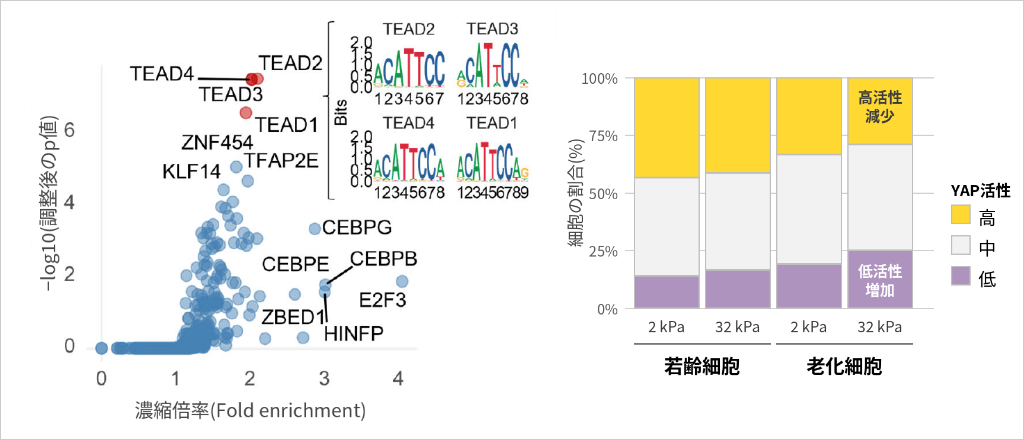
Figure 2: (Left) Transcription factor binding sequences open in cells exhibiting strong aging characteristics; (Right) Stiffness of the culture environment and the function of YAP.
<Testing Method>
Enrichment analysis of transcription factor binding motif sequences was performed from scATAC-seq data in groups exhibiting strong and weak aging characteristics. In addition, YAP-related activity was estimated from scRNA-seq data based on the YAP target gene group, and cells were classified into three states: high, medium, and low.
(Conducted at Rohto Pharmaceutical Research Institute)
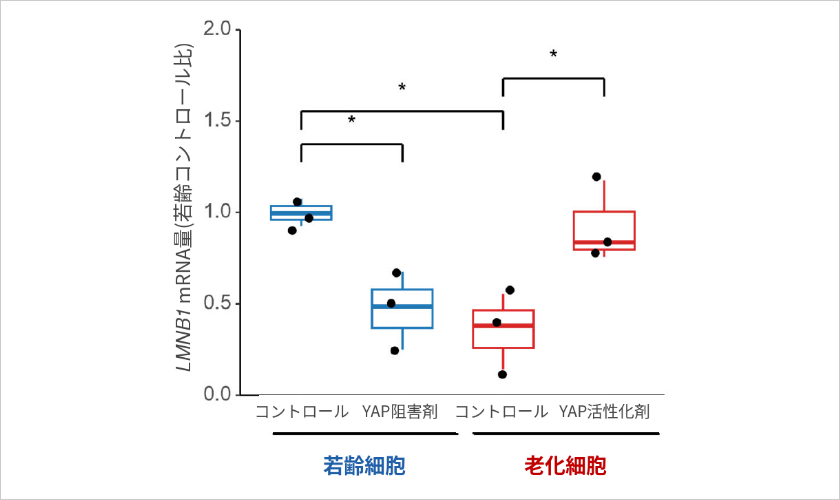
Figure 3: Changes in LMNB1 expression due to regulation of YAP function
YAP inhibitor: verteporfin, YAP activator: TDI-011536
<Testing Method>
Young and senescent fibroblasts were treated with a YAP inhibitor (verteporfin, 1 μM) or a YAP activator (TDI-011536, 1 μM) for 24 hours, and LMNB1 mRNA expression levels were measured by real-time PCR (N=3, Tukey's HSD test, p<0.05).
(Conducted at Rohto Pharmaceutical Research Institute)
Result 3: Confirmed that the combination of Houttuynia cordata extract and algae-derived phytoexosomes enhances the activity of the cell age reversal switch.
Since YAP acts as a switch to reverse cellular age, we considered whether its activity could be enhanced by cosmetic ingredients, and evaluated 320 types of cosmetic ingredients using aged skin fibroblasts.
As a result, we confirmed that combining Houttuynia cordata extract with algae-derived phytoexosomes caused YAP in senescent cells to move into the nucleus, increasing the proportion of cells with high YAP activity. This change brought the cells closer to the state observed in the soft environment of senescent cells, suggesting the possibility of enhancing YAP activity through the combination of cosmetic materials (Figure 4).
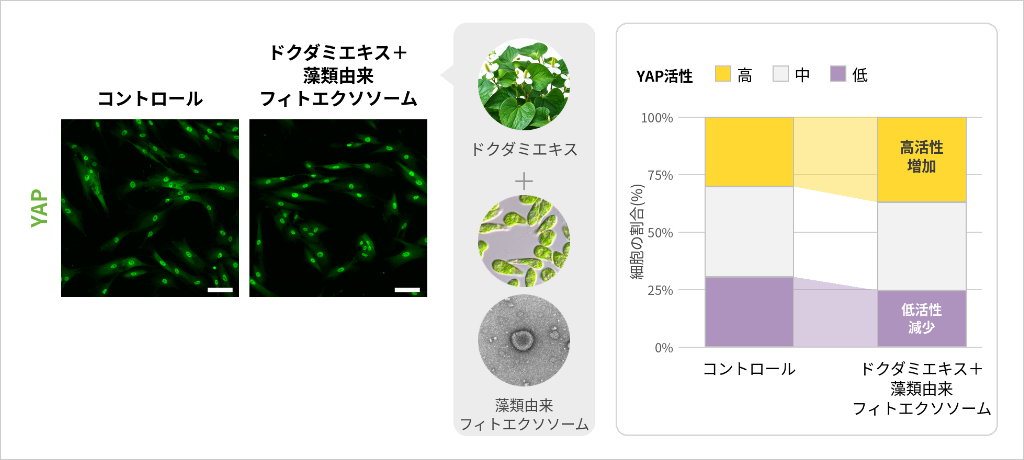
Figure 4: Changes in YAP (green) in senescent cells after Houttuynia cordata extract + algae-derived phytoexosomes
<Testing Method>
Senescent fibroblasts were treated with 0.1% Houttuynia cordata extract and 0.1% algal phytoexosomes for 30 minutes, and YAP was immunofluorescently stained. Based on the fluorescence intensity of YAP in the nucleus, the cells were classified into three states: high, medium, and low.
(Conducted at Rohto Pharmaceutical Research Institute)
Result 4: The combination of Houttuynia cordata extract and algae-derived phytoexosomes reduced aging markers and increased collagen and elastin.
We investigated the effects of a combination of Houttuynia cordata extract and algae-derived phytoexosomes on the state of senescent cells themselves.
As a result, in senescent cells, staining for SA-β-gal *7, an indicator of aging, and p21 *8, which has the function of stopping cell division, were increased. However, when this combination was added, both decreased to levels close to those of young cells (Figure 5). Furthermore, when collagen and elastin, which support the firmness and elasticity of the skin, were evaluated, both fibers, which were decreased in senescent cells, increased with this combination, and the formation of thicker and stronger fibers was also confirmed (Figure 6).
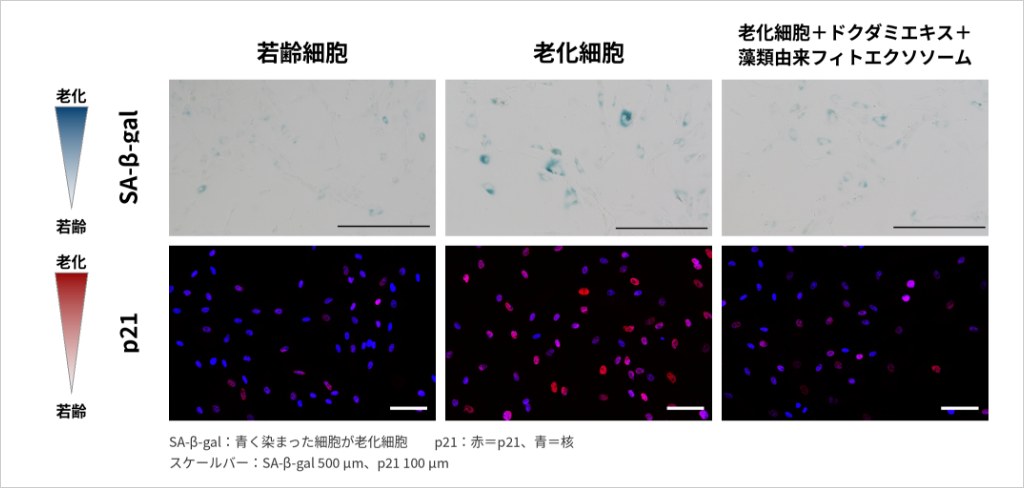
Figure 5: Changes in aging markers (SA-β-gal, p21) after Houttuynia cordata extract + algae-derived phytoexosomes
<Testing Method>
Young and senescent fibroblasts were cultured for 3 days after being treated with a combination of Houttuynia cordata extract and algae-derived phytoexosomes (concentration 0.01%). Evaluation was performed by SA-β-gal staining and p21 immunofluorescence staining.
(Conducted at Rohto Pharmaceutical Research Institute)
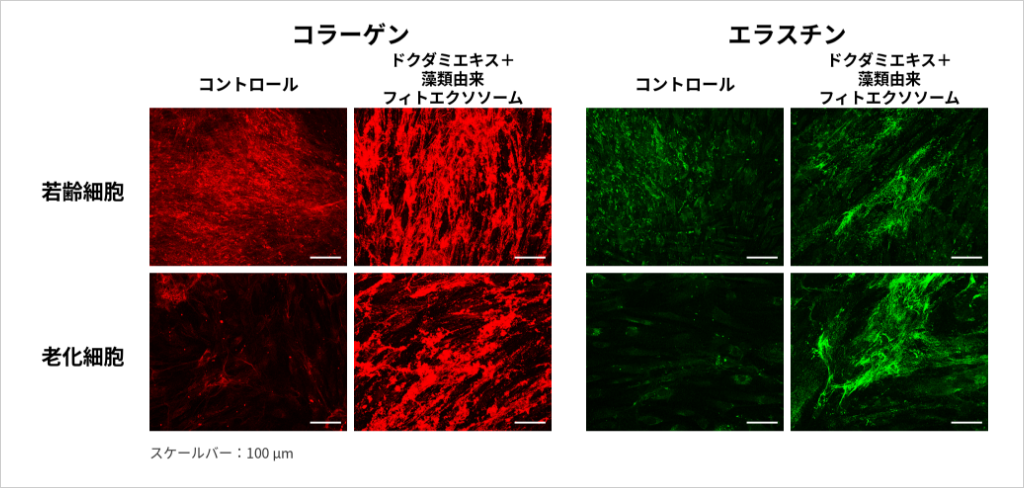
Figure 6: Changes in collagen (red) and elastin (green) due to Houttuynia cordata extract + algae-derived phytoexosomes.
<Testing Method>
Young and senescent fibroblasts were treated with a combination of Houttuynia cordata extract (0.01% concentration) and algae-derived phytoexosomes (1% concentration). Collagen was cultured for one week, and elastin for two weeks. Collagen and elastin were then immunofluorescently stained and observed.
(Conducted at Rohto Pharmaceutical Research Institute)
Consideration
This study suggests that aged skin fibroblasts are not irreversibly aged as previously thought, but rather their aging state may change depending on the hardness of the surrounding environment. Skin hardening with age is not only a consequence of skin aging, but also a factor that further accelerates cellular aging via YAP/TEAD.
Furthermore, the combination of Houttuynia cordata extract and algae-derived phytoexosomes enhanced the function of the cell age reversal switch, resulting in a decrease in aging markers and an increase in collagen and elastin. These results suggest that an approach that focuses on the environment surrounding cells may also contribute to maintaining skin structure.
The impact of these research findings on society
Instead of removing senescent cells, this research aims to alter the aging process by influencing the surrounding environment. This new approach demonstrates its potential and is expected to lead to the development of technologies for maintaining healthy skin even as we age. Moving forward, we will further explore the interaction between the surrounding environment and senescent cells through the use of three-dimensional skin models that more closely resemble actual skin, as well as in-vivo verification.
Furthermore, we will implement "Longevity" science in skincare, and based on this research, we will advance technological development for quality evaluation of materials and stable production, and deliver the research results to society.
Phytoexosome research
Under the guidance of Professor Takahiro Ochitani of Tokyo Medical University, our company has been promoting research on "phytoexosomes," which are exosome-like vesicles derived from plants, algae, microorganisms, and other organisms.
Special Notes
The results of this research were presented on September 29th at "IFSCC 2026," which was held in Perth, Australia from September 28th to October 1st, 2026.
Title: “The Softer the Better: A Soft Environment Surrounding Senescent Cells can Reversibly Rejuvenate Dermal Fibroblasts”
Authors: Masatoshi Haga, Hiroaki Takeuchi, Michiru Kuroki, Atsushi Sakuma, Mariko Okada and Noriko Suenobu
Terminology
*1: Algal phytoexosomes: Extracellular vesicles (tiny membrane vesicles released by cells) derived from the alga Pavlovagirans.
*2: Naturally occurring lipid bilayer vesicles from plants, microorganisms, algae, etc., excluding animals.
*3: Skin fibroblasts: Cells that produce collagen and elastin in the inner layer of the skin (dermis), supporting the firmness and elasticity of the skin.
*4: Cellular age reversal switch: The function of YAP/TEAD, which switches the state of senescent cells according to the softness of the environment.
*5: YAP/TEAD: YAP is a factor that plays a central role in cells sensing mechanical stimuli such as the stiffness of their surroundings and regulating gene function. TEAD is a transcription factor that works in conjunction with YAP to switch on genes.
*6: Lamin B1: A protein that supports the shape of the cell nucleus from the inside. It decreases as cells age, so it is used as an indicator of aging.
*7: SA-β-gal (aging-related β-galactosidase): An enzyme whose activity increases in aged cells. When stained, aged cells turn blue, and it is used as a representative indicator of cellular senescence.
*8: p21: A protein that acts as a brake to stop cell division. It increases in aged cells and is therefore used as an indicator of aging.