[Rohto Pharmaceutical Releases "Fertility Treatment White Paper 2024"]
Signs of an increase in "fertility treatment men" who are proactive in fertility treatment.
While more than half of young unmarried men and women do not want children, the rate of young men taking fertility treatment actions is about 1.5 times higher than that of all men who have taken fertility treatments.
Rohto Pharmaceutical analyzes the diverse attitudes and realities of young people, and proposes "5 Types of Fertility Treatment in the Reiwa Era" in search of hints for the future.
March 4, 2025
ROHTO Pharmaceutical Co., Ltd. (Headquarters: Osaka City, President: Masafumi Sugimoto) will release its latest awareness survey, "Fertility Treatment White Paper 2024," aimed at spreading knowledge and understanding about fertility treatment.
In this year's survey, the seventh of its kind, the number of young unmarried men and women who do not wish to have children reached a record high and is increasing year by year. However, the survey also revealed that attitudes towards fertility are changing, with approximately 50% of those who have undergone fertility treatment and are currently positive about having children having shifted from being passive to positive. In today's world of diversifying lifestyles, it has become clear that attitudes towards fertility treatment itself and having children are diversifying, rather than being a dichotomy of "wanting children" or "not wanting children." In this year's White Paper on Fertility, we have analyzed the diverse attitudes and realities of young people and created "5 Types of Fertility Treatment in the Reiwa Era," classifying current attitudes towards fertility treatment. We will provide a diagnostic chart to help you determine which type you belong to, and suggest "recommended first steps" tailored to each type.
Furthermore, Rohto Pharmaceutical has been engaged in various initiatives, including research and development of products that support fertility treatment and dissemination of accurate information about pregnancy. With the hope that mothers will serve as relatable role models and inspire people to think about their own life plans, we are now releasing a new series of short videos called "Mama Musu Talk," featuring conversations between mothers and their daughters or sons, on Rohto Pharmaceutical's official YouTube channel.
Main Survey Topics from the "Fertility Treatment White Paper 2024"
- 56.6% of young, unmarried men and women believe they do not want children now or in the future.
The number of people who want to keep their chances of having children open and are "preparing for fertility treatment" has slightly increased compared to last year, with a particularly noticeable increase among men.
- The rate of married men and women engaging in fertility treatment has increased over the past three years. Furthermore, the rate of young men engaging in fertility treatment is approximately 1.5 times higher than that of all men with prior experience. They tend to be more proactive in fertility treatment, showing concern for their partners' health and discussing it with other men.
- Among those who are currently actively trying to conceive, approximately 50% have changed from being reluctant to having children to being actively seeking them. This clearly shows that attitudes towards wanting children are easily shifted.
- We have released "The Five Types of Fertility Treatment in the Reiwa Era," which categorizes and analyzes attitudes and approaches towards fertility treatment.
This guide includes a diagnostic chart to help you discover your type and suggests recommended "first steps" for each type.
56.6% of young, unmarried men and women believe they do not want children now or in the future. However, the number of those who want to keep the possibility of having children open and are "preparing for fertility treatment" has slightly increased compared to last year, with a particularly noticeable increase among men.
In response to the question, "Do you want children?", 56.6% of young unmarried men and women (18-29 years old) answered, "I do not want children now, nor in the future," the highest percentage ever recorded. Broken down by gender, 59.9% of men and 53.1% of women gave this answer, indicating that a higher percentage of men than women do not want children.
Among unmarried men and women who said they did not want children, approximately one in four (men and women combined) responded that they "want to maintain a physical ability to conceive so that they can have children if their feelings change in the future." Compared to last year, this group of people preparing for fertility treatment has slightly increased, with a particularly noticeable rise in men preparing for fertility treatment. Even though the number of people who want children has decreased, the number of people preparing for fertility treatment has increased.
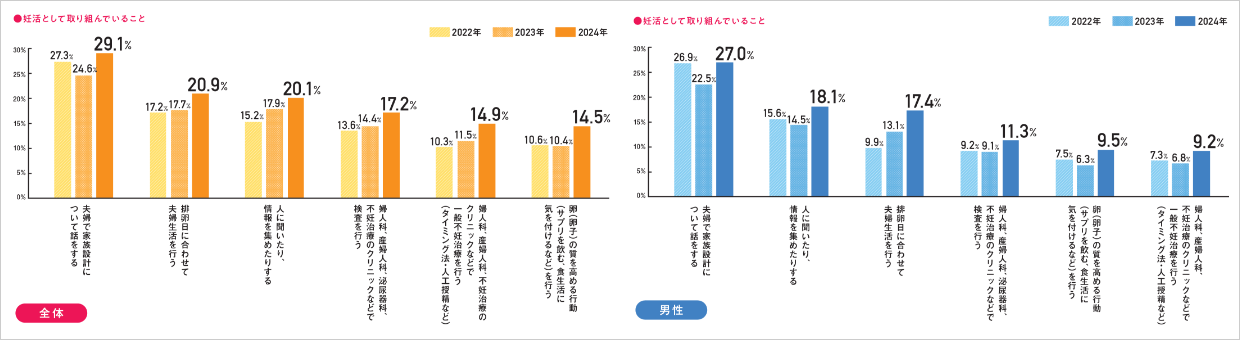
The rate of married men and women engaging in fertility treatment has increased over the past three years. Furthermore, the rate of young men engaging in fertility treatment is approximately 1.5 times higher than that of all men with prior experience. They tend to be more proactive in fertility treatment, showing concern for their partners' health and discussing it with other men.
When married men and women were asked about what they were doing to try to conceive, there was an increasing trend in responses over the past three years, such as "talking about family planning with my spouse," "having intercourse on the day of ovulation," "asking others for information," "getting tests at a gynecology clinic or other medical facility/undergoing general infertility treatment," and "taking actions to improve egg quality." This increasing trend was seen in both men and women, suggesting that more people are becoming interested in trying to conceive.
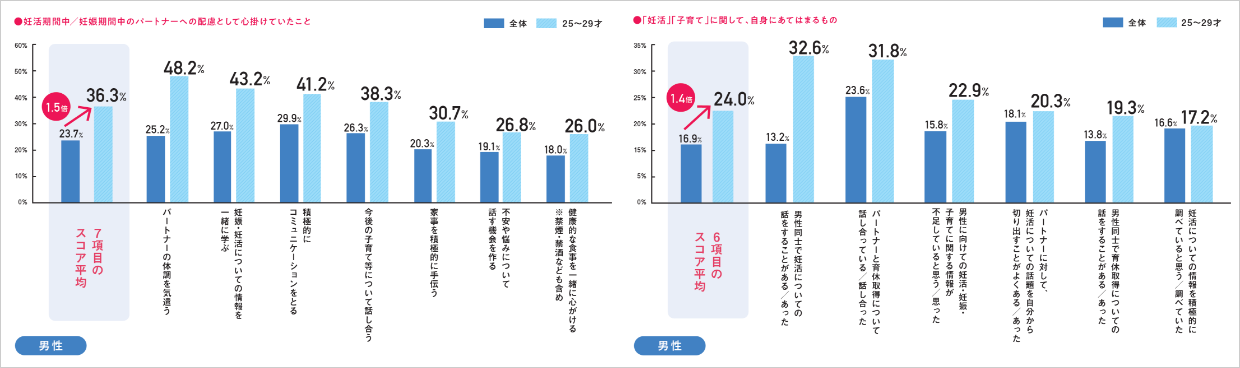
Furthermore, in a question asking men with fertility treatment experience about the considerations they made for their partners during the fertility treatment/pregnancy period, the results showed that young men aged 25-29 had a fertility treatment activity rate approximately 1.5 times higher than the average score for all men with fertility treatment experience across seven items. The percentage of young men who answered that they made considerations for their partners during the fertility treatment/pregnancy period was approximately 1.9 times higher than the average for all men with fertility treatment experience, and the percentage of young men who answered that they "sometimes/have talked about fertility treatment with other men" as something that applied to them regarding "fertility treatment" and "child-rearing" was approximately 2.5 times higher than the average for all men with fertility treatment experience. Among men with fertility treatment experience, young men were proactively working on fertility treatment together with their partners, and they also appeared to be open about fertility treatment and gathering information from a wide range of people, such as by discussing it with other men.
Furthermore, according to the Ministry of Health, Labour and Welfare's "Basic Survey on Employment Equality in FY2023" *, among men whose spouses gave birth between October 1, 2021, and September 30, 2022, 30.1% started childcare leave by October 1, 2023, an increase of 13 percentage points from 2022. This reveals that men are also actively participating in fertility treatment and childcare leave, which were previously considered primarily women's activities.
*Source: "Basic Survey on Employment Equality in FY2023" (Ministry of Health, Labour and Welfare)
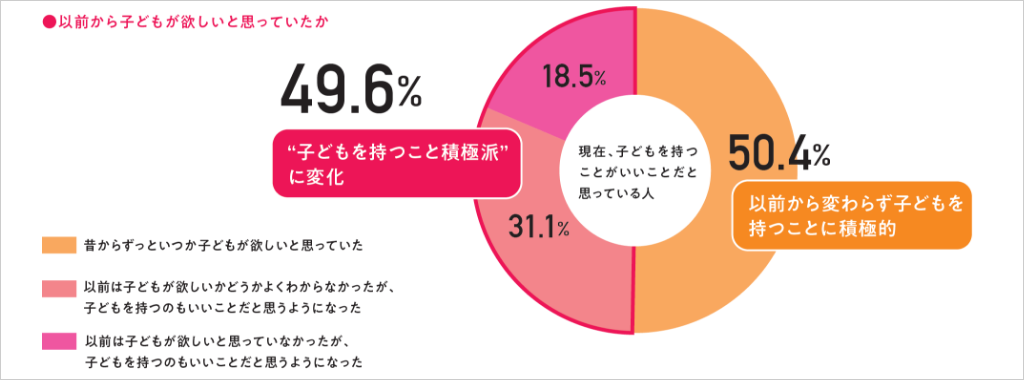
Among those who have tried to conceive and are currently actively seeking children, about 50% have changed from being reluctant to having children to being actively seeking them. This clearly shows that attitudes towards wanting children are easily changeable.
This year saw the highest number of young, unmarried men and women who say they "don't want children now or in the future." However, among those who currently think having children is a good thing, 49.6% answered that they "weren't sure if they wanted children before" or "didn't want children before." This result clearly shows that attitudes towards having children are easily changed.
When we asked men and women who had tried to conceive and whose views on having children had changed, about 30% of women said their age or their married life had made them more positive about having children. On the other hand, about 30% of men said they began to consider having children while dating their spouse. The top times when women started to think positively about having children were "their age" and "after marriage," while for men it was "during dating." This shows that women start thinking about having children based on "their own circumstances," and men based on "their relationship with their partner."
In today's world, where life plans are becoming increasingly diverse, approaches to fertility treatment are also becoming more varied. To help people approach fertility treatment with knowledge from an early stage, Rohto Pharmaceutical has created five types of approaches to fertility treatment and proposes the "recommended first step" that suits each individual.
"Five Types of Fertility Treatment in the Reiwa Era"
Attitudes towards having children are easily changed, and perspectives are becoming increasingly diverse. To understand attitudes towards fertility treatment, we categorized men and women without children into five types based on their level of practice in fertility treatment and preconception care, as well as the strength of their desire to have children.
The five types are: "steady fertility treatment," where people actively work on fertility treatment with their partner and desire to have and raise children; "gradual fertility treatment," where people want to have and raise children someday but prioritize their relationship with their partner; "roundabout fertility treatment," where people are highly motivated to conceive but feel there are obstacles due to various reasons such as their relationship with their partner and their financial situation; "future fertility treatment," where people want to keep the possibility of having children open but currently prioritize their own time and hobbies; and "casual fertility treatment," where people haven't yet started thinking realistically about having children and want to cherish their current career and personal time. The reality is that there is a wide range of situations, from people who are highly motivated to conceive to those who are hesitant about having children. There were also significant differences in the amount of knowledge and information access regarding fertility treatment, as well as in their views on life plans, and the nature of their anxieties varied from person to person.
Therefore, in the "Fertility Treatment White Paper 2024," we have listed the characteristics of five types. By answering the questions on the chart, you can find out your type and learn the "recommended first steps" for each type.
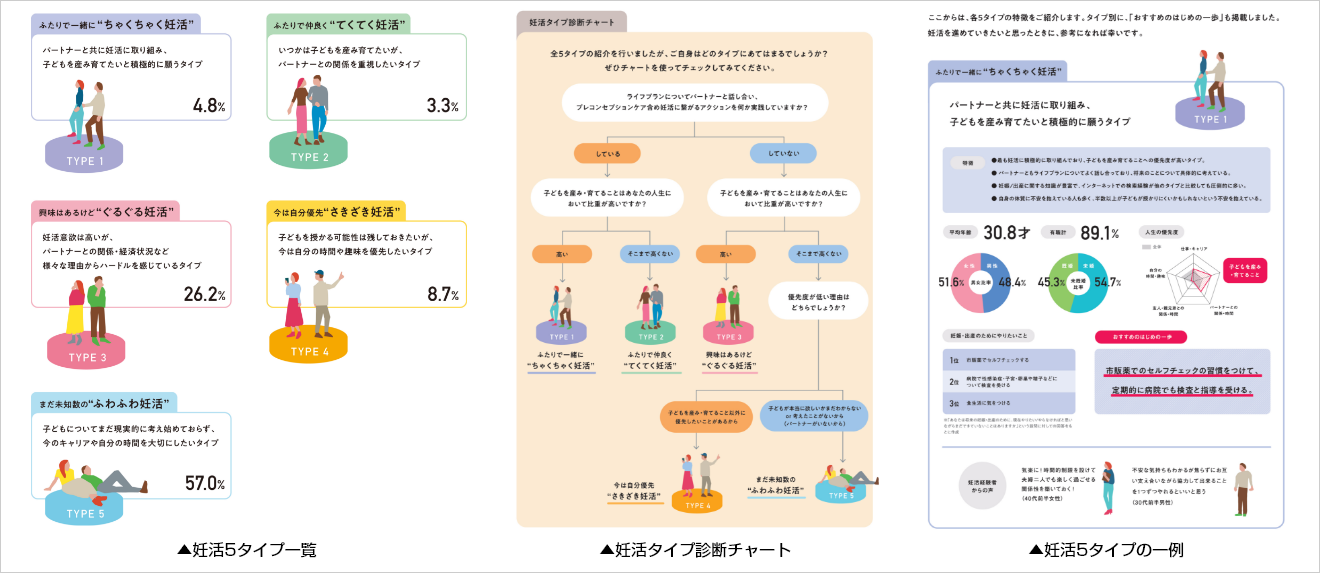
Summary of the "Fertility Treatment White Paper 2024"
Comments from Rohto employees
At Rohto Pharmaceutical, men actually take paternity leave, and they support each other as a couple while working and thriving in their careers.
Here are some comments from male employees who are actively trying to conceive.
A male employee (33 years old) who is proactively working on fertility treatment.
| February 2022 |
Starting to try to conceive
I started using ovulation test strips and began timing intercourse before going to the hospital. |
| September 2022 |
First visit to a gynecologist for a consultation
Starting this month, I will be undergoing timed intercourse (with tests and medication prescriptions) while attending outpatient appointments for approximately one year.
Since we didn't conceive using the timed intercourse method, we moved on to artificial insemination. |
| May 2024 |
I got a positive result on a pregnancy test. |
| January 2025 |
childbirth |
After 1 year and 8 months of infertility treatment, their first child was born in 2025.
Initially, we tried to conceive by timing intercourse using commercially available ovulation test strips. Because there was a possibility of difficulty conceiving even before we started trying, we began visiting a gynecologist six months after starting to try to conceive and began the timing method. Later, we moved on to artificial insemination. Simultaneously, we researched and implemented changes in nutrition and diet, which ultimately led to our conception.
Regarding paternity leave, I took four weeks initially, and then five weeks in total because the baby was born a week earlier than expected. After the birth, my wife had a hard time getting enough sleep due to breastfeeding, so I took on the housework and diaper changes during the day. The baby slept relatively well, so it wasn't too difficult, and we divided the work so that I could get a good night's sleep. I was mainly in charge of bathing the baby, so I'm worried about whether my wife will have trouble when she returns from paternity leave. It's frustrating that I can't take over everything even though I want to, and I'm always struggling with this.
One change in my work style is that I've developed a sense of needing to get home earlier at night. Previously, I would leave home at 7 a.m. and usually leave work around 6 or 7 p.m. Since returning from maternity leave, I've been getting home 30 minutes to an hour earlier and sharing household chores and childcare as much as possible. Of course, first-time parenting has its challenges, but I'm glad I was able to have a child.
What's it like to be a parent? A short video, "MamaMusu Talk," has been released.
Taking the generation of mothers who became pregnant and gave birth around the time the "Childcare Leave Law" was enacted in 1992—a time when values regarding work styles and family structures changed dramatically—as role models, we created short videos in which they talk with their daughters and sons about "becoming a parent." We hope to offer today's daughters and sons valuable hints for thinking about their own life plans.
"Mama Musu Talk" video summary
About Rohto Pharmaceutical's "Fertility Treatment White Paper 2024"
Rohto Pharmaceutical has been supporting people's efforts to conceive by working alongside those who wish to have children, through product research and development and by disseminating accurate information about pregnancy. As one of these initiatives, since 2018 we have been publishing the "Fertility White Paper" with the aim of spreading knowledge and understanding about "fertility treatment."
The White Paper on Fertility Treatment addresses the social issue of fertility treatment, which is often perceived as something that women should take the lead in. It strives to amplify the voices of those who are currently undergoing or considering undergoing fertility treatment, including promoting "two-person fertility treatment," where partners work together to address the issue.
"Fertility Treatment White Paper 2024"
Survey Overview
- Survey name: Rohto Pharmaceutical's "Fertility Treatment White Paper 2024"
- Survey period: November 22 (Fri) - December 2 (Mon), 2024
- Survey method: Internet survey
- Survey subjects: Men and women aged 18-44. *Survey conducted without filtering by marital status or whether or not they have children.
- Survey area: Nationwide
- Sample size: 37,231 people