New findings on vitamin C in the skin:
Mechanism of epidermal keratinocyte proliferation via DNA demethylation elucidated
April 30, 2025
ROHTO Pharmaceutical Co., Ltd. (Head office: Osaka City; President: Masashi Sugimoto) is conducting research to elucidate the in vivo functions of vitamin C in order to realize the Rohto Group's Comprehensive Management Vision 2030, "Connect for Well-being." In this latest joint research project with Akito Ishigami, Deputy Director of the Tokyo Metropolitan Institute of Gerontology, Researcher Ayami Sato (currently Associate Professor at Toyo University), and Associate Professor Yasunori Sato of the Hokuriku University School of Pharmaceutical Sciences, we have uncovered a new mechanism by which vitamin C (L-ascorbic acid) promotes epidermal cell proliferation and increases epidermal thickness through DNA demethylation.
The results of this study were published in the April 20, 2025 edition of the Journal of Investigative Dermatology, a prestigious American journal in the field of dermatology.
Key points of the research
- Confirmation that vitamin C promotes the proliferation of epidermal keratinocytes and contributes to the thickness of the epidermal cell layer
- It was discovered that vitamin C promotes the proliferation of epidermal keratinocytes through DNA demethylation *1 of genes related to cell proliferation.
- The role of vitamin C in the skin has been expanded to include "cell proliferation through epigenetic regulation," suggesting the possibility of a new intervention method for skin aging.
What is epigenetics?
Epigenetics is a mechanism that controls which genes function without changing the sequence of DNA. Cells use this mechanism to maintain their own characteristics and respond flexibly to their environment. In recent years, it has become clear that it is also deeply involved in aging and disease.
Research Background
Vitamin C (L-ascorbic acid) is widely known for its antioxidant properties, collagen synthesis promotion (Reference 1), and UV damage reduction (Reference 2), and has been widely used in skin care products. It protects cells from UV rays and environmental stress, particularly in the epidermis, where it is known to accumulate at higher concentrations than in the blood (References 3, 4). This suggests that vitamin C plays an important role in maintaining skin homeostasis.
In recent years, it has been reported that vitamin C acts as a cofactor for DNA demethylase (TET: Ten-eleven translocation), and this has attracted attention in various fields, including stem cell reprogramming and cancer research (Reference 5). However, the epigenetic role of vitamin C in human epidermal keratinocytes has remained largely unknown.
Therefore, in this study, we aimed to use a human three-dimensional cultured epidermal model and comprehensive analytical techniques to clarify how vitamin C affects epidermal keratinocytes and how the underlying epigenetic changes are involved.
result
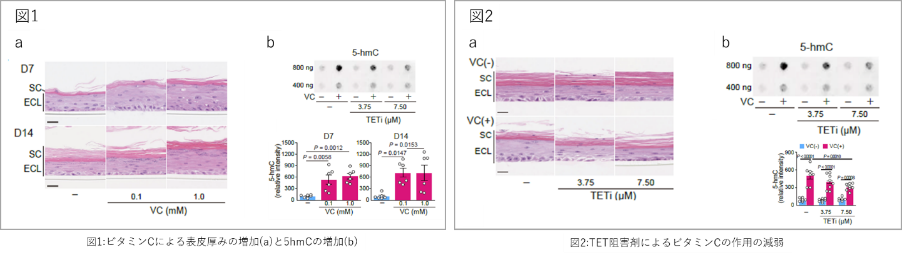
We constructed a three-dimensional cultured human epidermal model mimicking the human epidermis and investigated the role of vitamin C in epigenetic regulation in epidermal keratinocytes. The results showed that vitamin C uptake into the cells increased epidermal thickness, cell proliferation, and 5-hydroxymethylcytosine (5-hmc), an indicator of DNA demethylation (Figure 1). Furthermore, this effect was attenuated by a DNA demethylase inhibitor (Figure 2). These results demonstrated that vitamin C promotes DNA demethylation in a TET-dependent manner.
Furthermore, to investigate how vitamin C regulates genes, we performed microarray analysis *2 and whole-genome bisulfite sequencing (WGBS) analysis *3. The results showed that vitamin C increased the expression of 12 genes related to cell proliferation.
<Test Method>
A human three-dimensional cultured epidermal model was constructed and cultured for 7 or 14 days in medium containing vitamin C (VC) sodium salt at concentrations of 0, 0.1, or 1.0 mM. After culture, paraffin sections were prepared from the model and stained with hematoxylin and eosin (HE). (Figure 1a)
A human 3D epidermal model was cultured for 7 or 14 days in the presence of VC (0, 0.1, 1.0 mM), and DNA was extracted. 5-hmC (5-hydroxymethylcytosine) dot blots were performed. After detection with an anti-5-hmC antibody, signal intensity was quantified using image analysis software (n=6, Tukey's test) (Figure 1b).
A human 3D cultured epidermal model was cultured for 14 days with VC (1.0 mM) alone or in combination with a TET enzyme inhibitor (Bobcat339) at 3.75 μM or 7.50 μM. After culture, DNA was extracted and subjected to dot blotting for 5-hmC. DNA samples were spotted onto a membrane and detected with an anti-5-hmC antibody. The resulting signal images were quantified using image analysis software and compared between the VC-only treatment group and the VC + TET inhibitor treatment group (n = 7–8, Tukey's test) (Fig. 2a). After culture, paraffin sections were prepared and stained with HE staining to observe the tissue structure. The thickness of the epidermal cell layer (ECL) was measured using image analysis software based on images taken under a microscope and compared between the VC-only treatment group and the VC + TET inhibitor treatment group (n = 6–8, Tukey's test) (Fig. 2b).
(Implemented by Hokuriku University)
Consideration
This research suggests that vitamin C promotes DNA demethylation via the TET enzyme, thereby increasing epidermal cell proliferation and the thickness of the epidermal structure. Furthermore, the demethylation and promotion of expression of proliferation-related genes was demonstrated, revealing a new significance of vitamin C in the epidermis from the perspective of epigenetics. This research goes beyond the antioxidant effect of vitamin C and focuses on a new function that may occur in the body known as "epigenetic regulation," which may lead to fundamental approaches to issues such as skin aging and a decline in barrier function.
Impact of this research result on society (significance of this research result)
This study comprehensively demonstrated the effects of vitamin C on the epidermis through a reversible gene regulation mechanism known as epigenetics. Epigenetic changes spatiotemporally control the fate of various cells in the skin, and because they are reversible, they are attracting attention as a means of reconstructing age-related changes in cell function. This study suggests the possibility of clinical applications and new strategies for skin care that utilize epigenetic regulation by vitamin C, which is expected to improve quality of life (QOL) and contribute to the realization of a healthy, long-lived society where people are healthy both physically and mentally.
Special Notes
The results of this research were published in the online version of the American scientific journal "Journal of Investigative Dermatology" on April 20, 2025.
Title: Vitamin C promotes epidermal proliferation by promoting DNA demethylation of proliferation-related genes in human epidermal equivalents
Authors: Yasunori Sato, Ayami Sato, Florence, Akari Kuwano, Yasunari Sato, Tsuyoshi Ishii, Akihito Ishigami, et al.
This research was supported by JSPS KAKENHI Grant Number 19K05902, and was carried out in collaboration with Akito Ishigami, Deputy Director of the Tokyo Metropolitan Institute of Gerontology, Ayami Sato, Researcher (currently Associate Professor at Toyo University), and Yasunori Sato, Associate Professor at Hokuriku University.
References
- Masaki H. Role of antioxidants in the skin: Anti-aging effects. J Dermatol Sci 2010;58(2):85-90.
- Kawashima S, Funakoshi T, Sato Y, Saito N, Ohsawa H, Kurita K, et al. Protective effect of pre- and post-vitamin C treatments on UVB-irradiation-induced skin damage. Sci Rep 2018;8(1):16199.
- Padayatty SJ, Sun H, Wang Y, Riordan HD, Hewitt SM, Katz A, et al. Vitamin C pharmacokinetics: implications for oral and intravenous use. Ann Intern Med 2004;140(7):533-7.
- Pullar JM, Carr AC, Vissers MCM. The roles of vitamin C in skin health. Nutrients 2017;9(8).
- Lee Chong T, Ahearn EL, Cimmino L. Reprogramming the epigenome with vitamin C. Front Cell Dev Biol 2019;7:128.
Terminology
*1: DNA demethylation
This refers to a change in which the methyl group (CH3 group) attached to cytosine, one of the bases in DNA, is removed, making it easier for gene function (transcription) to be promoted. Methylated cytosine is usually called 5-methylcytosine (5-mC), which plays a role in keeping genes in an "off" state.
With the help of vitamin C and other factors, this 5-mC is converted by the TET enzyme into 5-hydroxymethylcytosine (5-hmC), which removes the methylation (demethylation) and prepares the gene to be "turned on" again.
Thus, 5-hmC is also known as a marker of DNA demethylation.
*2: Microarray analysis
This is an analytical method that can simultaneously measure the expression levels of thousands to tens of thousands of genes. By comprehensively examining increases and decreases in gene expression, it is possible to visualize the effects of specific treatments (e.g., adding vitamin C) on cells.
*3: WGBS analysis (Whole Genome Bisulfite Sequencing)
This method comprehensively analyzes the methylation status of the entire DNA at the base level. Methylated sites are identified by bisulfite treatment, and the methylation pattern across the genome is visualized.