Contributing to improving medication safety for those with swallowing concerns, as well as the elderly and children.
New method for evaluating the swallowability of orally disintegrating tablets developed
- Results of joint research between the University of Shizuoka and Qualitech Pharma, a member of the Rohto Pharmaceutical Group.
May 26, 2025
Qualitech Pharma Co., Ltd. ROHTO Pharmaceutical Co., Ltd. (Head office: Minato-ku, Tokyo; President: Nobuhiro Yamamoto), a group company of Rohto Pharmaceutical Co., Ltd. (Head office: Osaka City; President: Masashi Sugimoto), is conducting research into improving the ease of oral medications in order to realize the Rohto Group's Comprehensive Management Vision 2030, "Connect for Well-being." In collaboration with Professor Kei Kondo of the Department of Drug Discovery Science, Faculty of Pharmaceutical Sciences, University of Shizuoka (Location: Shizuoka City; President: Yasuyuki Imai), Qualitech Pharma has developed a method to efficiently evaluate the ease of swallowing orally disintegrating tablets *1 (hereinafter referred to as OD tablets) and their constituent ingredients.
This new technology will reveal information about formulations that lead to easier swallowing, which is expected to lead to the development of oral formulations that are easier to take for patients and customers with swallowing concerns. A patent has been applied for the results of this research, and the results were presented at the 40th Annual Meeting of the Japanese Society of Pharmaceutical Sciences, held from May 22nd to 24th, 2025.
Key points of the research
- A new formulation technology that enables efficient selection of ingredients that improve the ease of swallowing of formulations
- Developing a quantitative swallowing ease assessment that does not rely on sensory evaluation
- Toward application in formulation design of OD tablets
Research Background
While OD tablets are generally well-known as an easy-to-take dosage form, their effectiveness is limited for patients with swallowing difficulties. Furthermore, the use of swallowing aids requires separate preparation, which places a financial and workload burden on caregivers. Furthermore, tablet disintegration and hardness are in a trade-off relationship, making it difficult to simultaneously achieve both. Designing a formulation is challenging. By resolving these issues and providing OD tablets with enhanced swallowability, it is expected that medication adherence *2 will be improved. However, there is insufficient information regarding the relationship between the powder properties that make up OD tablets and their swallowability, and the development of innovative formulation technologies is needed. In this study, we focused on the state of the wet powder mixture formed when OD tablets disintegrate in the oral cavity, evaluated their dynamic viscoelasticity *3 and texture *4, and aimed to develop formulation technology that can efficiently select ingredients that improve swallowability.
Results and Discussion
Evaluating the dynamic viscoelasticity and texture of premixed excipients for OD tablets
The dynamic viscoelasticity and texture of the wet mixed powders, which were formed by adding water, were evaluated for the following two premixed excipients commonly used in OD tablets.
- Additive A (D-mannitol, crospovidone, polyvinyl acetate, povidone, hereinafter referred to as pmA)
- Additive B (D-mannitol, crystalline cellulose, crospovidone, magnesium aluminometasilicate, xylitol, hereinafter referred to as pmB)
The state in which water is distributed throughout the material and it deforms without cracking when subjected to force (moist state) is called the plastic limit (PL), and the state in which water fills the spaces between the powder particles (sticky state) is called the liquefaction limit (LL).
For OD tablets, PL is considered to be the point at which disintegration begins, and LL is considered to be the point at which disintegration ends (when swallowing begins).
Dynamic viscoelasticity can be measured by observing the response when a stimulus is applied to a sample at a certain frequency, and expressed using the storage modulus (G'), which reflects the elastic (solid) properties, the loss modulus (G"), which reflects the viscous (liquid) properties, and the loss tangent (tanδ, the ratio of G" to G') (Figure 1).

Figure 1: Morphological changes and dynamic viscoelasticity measurements of wet mixed powders
It was found that the dynamic viscoelasticity of pmA and pmB is significantly different. This shows that by measuring the dynamic viscoelasticity of wet mixed powders, it is possible to clarify the properties of the excipients that make up the tablet, and this is useful for selecting and evaluating excipients that are suitable for differentiation and ease of swallowing (Figure 2). → Explanation 1
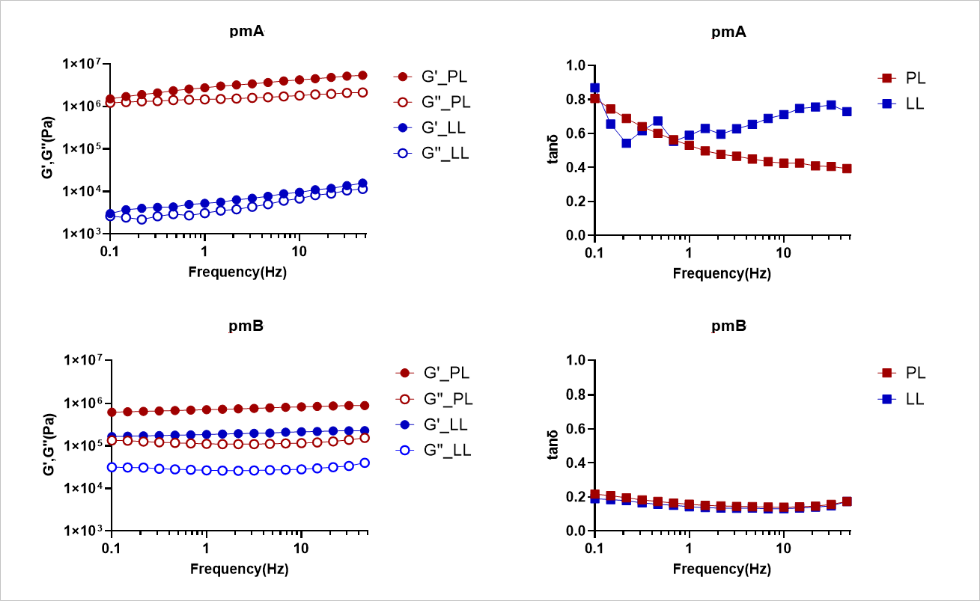
Figure 2: Dynamic viscoelasticity measurements of pmA and pmB
Texture is known as a useful measurement method for evaluating the texture of food in development, but its application to evaluating the swallowing experience of pharmaceuticals is limited. In particular, there has been no research on the swallowing ease of orally disintegrating tablets.
Texture measurements provide three parameters: maximum load, cohesiveness, and adhesiveness, with cohesiveness being the most important parameter for swallowing orally disintegrating tablets (Figure 3).
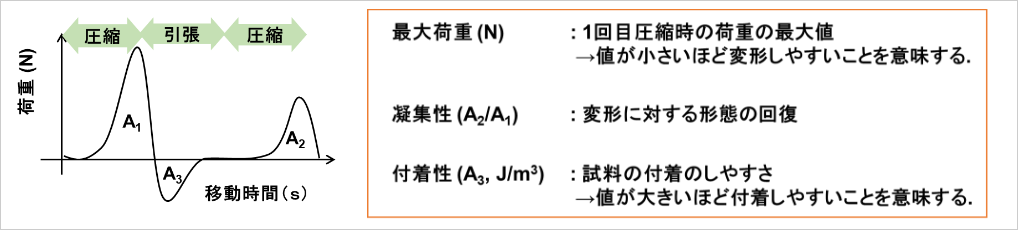
Figure 3: Evaluation items for texture measurement
It was shown that adding 2% of additive X significantly changed the cohesiveness, making it easier for the tablet to come together when swallowed (Figure 4).
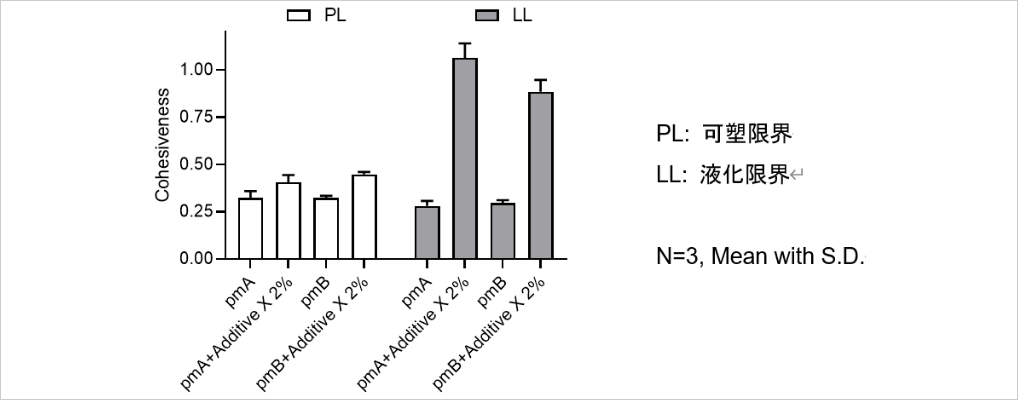
Figure 4: Texture (cohesiveness) measurements of pmA and pmB
By combining dynamic viscoelasticity measurement and texture measurement, we have established a method for efficiently evaluating and selecting additives based on their properties and ease of swallowing.
Based on this new technology, we are currently investigating the addition of various active ingredients and excipients, gaining knowledge that will be useful in the formulation of OD tablets, and striving to further improve our formulation technology.
Impact of this research result on society (significance of this research result)
We believe that the results of this research will contribute to the following areas in many areas:
- Improving the efficiency of pharmaceutical formulation design, especially for OD tablets
- Improving medication adherence and ultimately quality of life for people with swallowing difficulties
- Application to foods and supplements other than pharmaceuticals
Explanation 1: Dynamic viscoelasticity measurement
If G' is larger than G", the material exhibits predominantly elastic (solid-like) properties. Also, as tan δ increases, the contribution of viscosity (liquid) increases.
Looking at the measurement results (Figure 2), for pmA, G' was larger than G" for both PL and LL, but the difference was small. Comparing PL and LL, PL showed values for both G' and G" that were more than 100 times larger. tanδ was larger for LL than for PL in the high frequency range of 1 Hz or higher. It is thought that as the amount of liquid added increased from PL to LL, the wet mixed powder became softer, and the viscous components became dominant, making it easier to deform. On the other hand, for pmB, G' was larger than G" for both PL and LL, but the difference was larger than for pmA. Furthermore, no difference in tanδ was observed between PL and LL. This is thought to be because pmB contains crystalline cellulose, which is insoluble in water, and even when the amount of liquid added increased, the elastic components remained dominant so that the crystalline cellulose could maintain its shape.
Explanation 2: Texture measurement
Cohesion indicates the ease with which a tablet clumps together when swallowed; high cohesion means it will not break apart when swallowed. Because water does not clump together, it can be choked when swallowed, so it is not difficult to imagine that cohesion leads to easier swallowing. The results of this measurement (Figure 4) showed that the cohesion of pmA and pmB was similar in both PL and LL. When additive X was added at 2%, the cohesion of pmA and pmB increased in both PL and LL. While the increase was slight in PL, it increased by approximately three-fold in LL. If we assume that PL is the point at which the tablet begins to disintegrate in the mouth and LL is the point at which disintegration has ended (the start of swallowing), adding additive X may help the wet mixed powder to clump together when swallowed.
Terminology
*1 Orally disintegrating tablets (OD tablets): These tablets are composed of active ingredients, excipients, binders, disintegrants, coating agents, etc., and are pharmaceutically designed to disintegrate within 30 seconds.
*2 Medication adherence: Patients understanding treatment and cooperating to take medication. This includes the concepts of initiative and positivity, as opposed to passive compliance, where patients simply follow instructions.
*3 Dynamic viscoelasticity: The viscous and elastic properties exhibited by a sample when it is deformed by applying force.
*4 Texture: An element used to describe the texture of a sample. Hardness, adhesiveness, cohesiveness, etc. are used.
Qualitech Pharma Co., Ltd. Company Profile
Qualitech Pharma Co., Ltd. was formerly Meguro Kako Co., Ltd., which became a group company of Rohto Pharmaceutical Co., Ltd. in 2007, and changed its name to its current name in 2014. Since then, the company has expanded its business from a CMO (contract manufacturing organization) to a CDMO (contract development and manufacturing organization), and completed construction of the CMC Development Center Kakegawa Lab in 2022. This has strengthened its support for resolving quality issues in pharmaceutical manufacturing and its ability to respond to formulation development.
Furthermore, with the aim of further improving our development capabilities, we are actively engaged in joint research with academia and in-house technology development.Qualitec Pharma continues to evolve every day as a company that provides total solutions for pharmaceutical development.