Pioneering new possibilities in anti-aging research using Mie Prefecture's unused resource (lemongrass leaves)
- A joint research project between Mie University and Rohto Pharmaceutical
August 19, 2025
ROHTO Pharmaceutical Co., Ltd. (Headquarters: Osaka City; President: Hidetoshi Segi) is promoting the utilization of local resources with the aim of realizing a sustainable, well-being society under ROHTO Group Comprehensive Management Vision 2030 As part of this initiative, the company has been conducting a project to study the usefulness of discarded natural resources in Mie Prefecture. Recently, in a joint research project with Mie University (Location: Tsu City, Mie Prefecture; President: Masaaki Ito), a national university corporation (Principal Investigator: Professor Norihiro Nishimura, Graduate School of Regional Innovation Studies; Researcher: Lecturer Yasuto Shimada, Graduate School of Medicine, Zebrafish Research Center), the company discovered that lemongrass leaves, an unused resource that is discarded without being distributed to the market, possess anti-aging properties. The results of this research were presented in a poster presentation at the 9th Annual Meeting of the Japanese Society of Geriatric Medicine (June 27-29, 2025).
Key points of the research
- Following an introduction from the Food Innovation Division of the Mie Prefecture Department of Agriculture, Forestry and Fisheries, we verified the functionality of lemongrass leaves, an unused resource.
- As the increase in sarcopenia, a condition in which muscle mass decreases and muscle strength and physical ability decline, becomes a social problem, the anti-aging effects of lemongrass leaf extract have been confirmed using senescence-induced myoblast and senescence zebrafish models.
- The results of this research will be used to develop products and services that utilize local resources to help people build healthy bodies.
Research Background
Mie Prefecture is blessed with a warm climate and fertile soil, producing a wide variety of agricultural products. However, at the same time, utilizing unused resources that are not distributed on the market is a challenge. It is believed that effective utilization of these resources can contribute to revitalizing the local economy. In this study, we evaluated the functionality of unused natural resources and aimed to create new health value. In recent years, "sarcopenia," which refers to the state of muscle weakness caused by aging, has become an important issue in extending healthy lifespan in a super-aging society. Therefore, after receiving an introduction of materials from the Food Innovation Division of the Mie Prefecture Department of Agriculture, Forestry and Fisheries, we conducted collaborative research with Mie University to evaluate the muscle anti-aging effects using cells and zebrafish.
result
Zebrafish are a model organism widely used in the fields of medicine, physiology, and pharmacology. Because they have an aging process similar to that of mammals, they are known as a useful model organism for studying aging at the individual level and for exploring anti-aging materials. In this study, we confirmed that an ethanol extract of lemongrass leaves suppressed the expression of senescence-associated β-galactosidase (SA-βgal), which is specifically present in senescent cells, in senescent-induced myoblast and aging zebrafish models. These results suggest that lemongrass leaves may have anti-aging effects on muscle.
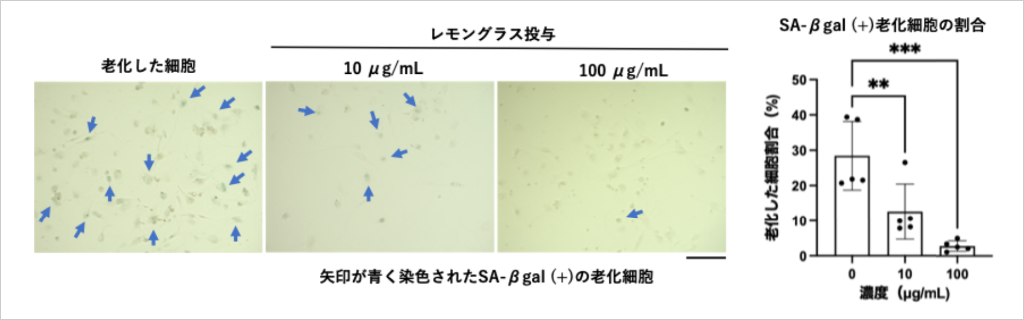
Figure 1: Suppression of SA-βgal expression in senescent cells by ethanol extract of lemongrass leaves
<Test Method>
Senescence was induced in mouse C2C12 myoblast cells using the anticancer drug etoposide (Nature. 2023;613:168-178). At the same time, the cells were exposed to an ethanol extract of lemongrass for three days, and SA-βgal staining was performed. The percentage of blue-stained cells was calculated from the obtained microscopic images. Statistical analysis was performed using one-way analysis of variance, and significant differences (**p < 0.01, ****p < 0.001) were calculated. (Conducted by Mie University)
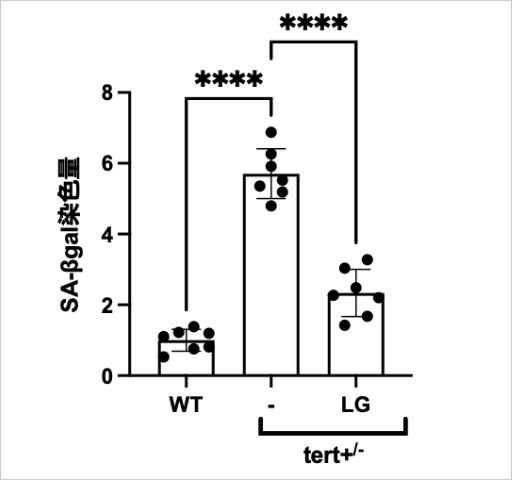
Figure 2: Suppression of SA-βgal expression in aging zebrafish model by lemongrass leaf extract and its active fraction
<Test Method>
Zebrafish heterozygously deficient in the telomerase transcriptase gene (tert) exhibit accelerated aging (Aging Cell. 2025;e7007). Lemongrass leaf extract (LG) was administered to these individuals as a suspension in their water (50 μg/mL), and SA-βgal staining was performed. The intensity (darkness) of the blue-stained area was quantified using ImageJ software from the microscopic images obtained. Seven individuals were used in each group, and quantification was performed in comparison with the wild-type group (WT). Statistical analysis was performed using one-way analysis of variance, and significant differences (****p < 0.001) were calculated. (Conducted by Mie University)
Impact of this research result on society (significance of this research result)
The anti-aging properties of Mie Prefecture's unused resource (lemongrass leaves) revealed in this research will be utilized to develop products and services that help prevent muscle loss and age-related diseases, thereby contributing to improving the well-being of the local community.
Background of this research
This research is one of the results of a joint research agreement concluded between Mie University and Rohto Pharmaceutical in 2018. This research stems from efforts to solve social issues and utilize resources in collaboration with the local community, and aims to achieve both local contribution and well-being by creating material value based on scientific evidence.
Past research results releases
Special Notes
The results of this research were presented in a poster at the 9th Annual Meeting of the Japanese Society of Geriatrics Pharmacy, held from June 27th to 29th, 2025.
Title: "Discovery of the anti-aging effects of lemongrass extract using senescent cells and zebrafish"
Authors: Yasuto Shimada1), 2), Misa Nakai3), Tsuyoshi Watanabe4), Liqing Zang2), 3), Ichigo Fukada2), 5), Hirotaka Katsuzaki2), 4), Norihiro Nishimura2), 3)
1) Department of Integrative Pharmacology, Graduate School of Medicine, Mie University, 2) Zebrafish Research Center, Mie University, 3) Graduate School of Regional Innovation Studies, Mie University, 4) Graduate School of Bioresources, Mie University, 5) ROHTO Pharmaceutical Co., Ltd.