The combination of vitamin C and azelaic acid suppresses the expression of the inflammatory factor IL-8 gene induced by stearic acid contained in human sebum.
January 14, 2026
ROHTO Pharmaceutical Co., Ltd. (Headquarters: Osaka City; President: Hidetoshi Segi) regards the skin as the largest human organ and is conducting research into the mechanisms of skin inflammation based on the idea that "true beauty lies beyond health." As part of this research, the company has been conducting research into the relationship between sebum and skin inflammation. This research confirmed a significant positive correlation between the amount of major free fatty acids in human sebum and the number of inflammatory comedos. It also found that stearic acid, contained in human sebum, increases the gene expression of IL-8 (*1), an inflammatory factor, in human epidermal keratinocytes. Furthermore, it was revealed that the combination of vitamin C (ascorbic acid) and azelaic acid significantly suppresses IL-8 gene expression. These findings will be utilized in future product development.
Key points of the research
- A significant positive correlation was confirmed between the amount of major free fatty acids in human sebum and the number of inflammatory comedones.
- Stearic acid contained in human sebum increases IL-8 gene expression in human epidermal keratinocytes.
- The combination of vitamin C and azelaic acid significantly suppressed induced IL-8 gene expression compared to vitamin C alone.
Research Background
Sebum contributes to skin moisturization, but excessive production and secretion of free fatty acids, one of its components, has been reported to be associated with inflammation in the skin (including pores). However, because sebum contains a wide variety of free fatty acids, the free fatty acids associated with inflammation have not been fully elucidated. Therefore, in this study, we investigated (1) the relationship between the amount of free fatty acids in human sebum and the number of inflammatory comedos, (2) the inflammatory response (IL-8 gene expression) induced by free fatty acids in human epidermal keratinocytes, and (3) the inhibitory effect of a combination of vitamin C and azelaic acid on this response.
result
Result 1: Confirmation that the amount of major free fatty acids in human sebum is positively correlated with the number of inflammatory comedones
To clarify the relationship between inflammatory comedones and free fatty acids derived from human sebum, we measured the number of inflammatory comedones on the faces of 50 Japanese women and analyzed the free fatty acids.The results confirmed that the total amount of the major free fatty acids myristic acid, palmitic acid, and stearic acid was significantly positively correlated with the number of inflammatory comedones.
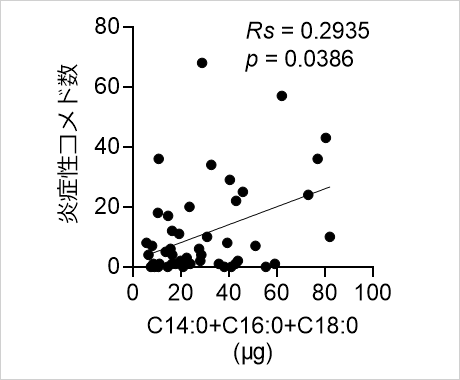
Figure 1: Correlation between the total amount of major free fatty acids (myristic acid, palmitic acid, stearic acid) and the number of inflammatory comedones
<Test Method>
Sebum was collected from the forehead of 50 Japanese women, and the amount of free fatty acids was measured using a gas chromatograph mass spectrometer. The number of inflammatory comedos was assessed by a dermatologist certified Japanese Dermatological Association. The correlation between the amount of each free fatty acid and the number of inflammatory comedos was analyzed using Spearman's rank correlation coefficient.
(Conducted by an external testing institution)
Result 2: Stearic acid contained in human sebum increased IL-8 gene expression in human epidermal keratinocytes
Since a correlation was demonstrated in Result 1, we next examined the effects of myristic acid, palmitic acid, and stearic acid on skin cells. These free fatty acids were added to human epidermal keratinocytes, and the gene expression of IL-8, an inflammatory factor, was evaluated. The results revealed that stearic acid significantly increased the gene expression of IL-8.
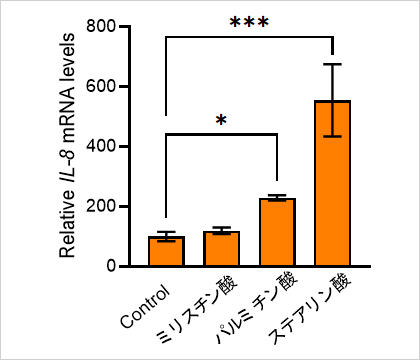
Figure 2: Effect of myristic acid, palmitic acid, and stearic acid on IL-8 gene expression
<Test Method>
After adding the same concentrations of myristic acid, palmitic acid, and stearic acid to human epidermal keratinocytes, IL-8 gene expression was confirmed by real-time PCR (n=3; mean±SD, Dunnett's test. *p<0.05, ***p<0.001).
(Conducted at Rohto Pharmaceutical Research Institute)
Result 3: The combination of vitamin C and azelaic acid suppressed IL-8 gene expression induced by stearic acid compared to vitamin C alone.
Using stearic acid, which showed high IL-8 gene expression in Result 2, as a model free fatty acid, we evaluated the effects of vitamin C and azelaic acid on IL-8 gene expression induced by stearic acid.The results confirmed that the combination of vitamin C and azelaic acid significantly suppressed IL-8 gene expression induced by stearic acid compared to vitamin C alone.
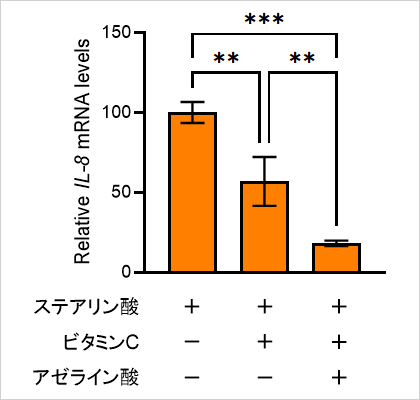
Figure 3: Inhibitory effect of vitamin C and azelaic acid on stearic acid-induced IL-8 gene expression
<Test Method>
After adding stearic acid alone, stearic acid and vitamin C, or stearic acid and vitamin C/azelaic acid to human epidermal keratinocytes, IL-8 gene expression was confirmed using real-time PCR (n=3; mean±SD, Tukey-Kramer test. **p<0.01, ***p<0.001).
(Conducted at Rohto Pharmaceutical Research Institute)
Considerations and future prospects
This study demonstrated that the major free fatty acids in human sebum are associated with inflammation (inflammatory comedones) in the skin (including pores). Furthermore, it was revealed that in human epidermal keratinocytes, the combination of vitamin C and azelaic acid significantly suppressed IL-8 gene expression induced by stearic acid in human sebum compared to vitamin C alone.
We will continue to deepen our basic research into skin care, and continue to advance skin care research that brings greater effectiveness and tangible value.
Terminology
*1: IL-8 (interleukin 8)
It is a substance secreted when inflammation or irritation occurs in the body, and has the role of attracting immune cells. In the skin, it is known to be related to inflammation, redness, and skin problems.