Cordyceps sinensis extract improves the function of epidermal cells with reduced metabolism
- Skincare research supporting recovery after cosmetic procedures and for aging skin -
June 23, 2026
ROHTO Pharmaceutical Co., Ltd. (Headquarters: Osaka City, President: Hidetoshi Segi) is working on "Longevity" science based on cell research to realize "Connect for Well-being & Longevity." Furthermore, the company is promoting the "Phytoscience Concept," which scientifically elucidates the power of nature and delivers it to modern society as new value. As part of this, we have focused on Cordyceps sinensis, which has been used as a vitality-maintaining material since ancient times. Using Cordyceps sinensis extract with carefully selected components, we investigated its effects on epidermal cells in which a state of reduced energy metabolism was induced, as well as on epidermal cells derived from aging donors. As a result, it was shown that Cordyceps sinensis extract has the potential to improve intracellular ATP levels and stratum corneum barrier function. This research result will be utilized in future product development as a new skincare technology to support the recovery of skin after cosmetic procedures, skin damaged by daily life, and skin whose function tends to decline with age.
Key points of the research
- Cordyceps sinensis extract may be involved in maintaining the vitality of epidermal cells with reduced energy metabolism.
- Cordyceps sinensis extract has been shown to increase the expression of ceramides and filaggrin, which support moisture and barrier function, in epidermal cells where functional changes associated with aging are expected.
- Metabolomic analysis of Cordyceps sinensis extract revealed the component profiles involved in ATP improvement and the increase of stratum corneum barrier-related factors.
Research Background
In recent years, there has been growing interest in cosmetic medical treatments and anti-aging cosmetics that enhance skin's perceived firmness, moisture, and smoothness. To maintain healthy skin after such care, it is considered essential to support the skin's natural regenerative power and barrier function.
Maintaining skin moisture and barrier function requires epidermal cells to function with sufficient energy. However, factors such as aging, UV radiation, dryness, inflammation, and lifestyle can impair the production of ATP, an energy source, potentially leading to a state of reduced energy metabolism. A decrease in ATP can negatively impact skin regeneration, stratum corneum formation, and the skin's moisture and barrier function.
Therefore, as a new approach to supporting the energy state of epidermal cells, we focused on Cordyceps sinensis, which contains multiple metabolites and amino acids. In this study, we investigated how Cordyceps sinensis extract affects intracellular ATP state and skin moisture and barrier function using epidermal cells derived from donors with reduced energy metabolism and aging.
result
Result 1: Confirmed that intracellular ATP levels increase in epidermal cells in a state of reduced energy metabolism.
In this study, neonatal-derived epidermal cells were cultured under low-glucose conditions to simulate a state of reduced energy metabolism. The effects of Cordyceps sinensis extract on intracellular ATP levels were evaluated using ATP-Red staining, which visualizes intracellular ATP.
As a result, the addition of Cordyceps sinensis extract was observed to increase the ATP-Red signal, suggesting its potential involvement in maintaining and improving ATP levels in a state of reduced energy metabolism (Figure 1 left). Therefore, metabolome analysis of the Cordyceps sinensis extract used in this study was performed, and 116 metabolites were detected, including 13 components known as low-molecular-weight components that support cellular energy metabolism (Figure 1 right). These results suggest that Cordyceps sinensis extract contains a complex of energy metabolism-related components and may support the maintenance and improvement of ATP levels in epidermal cells in a state of reduced energy metabolism.
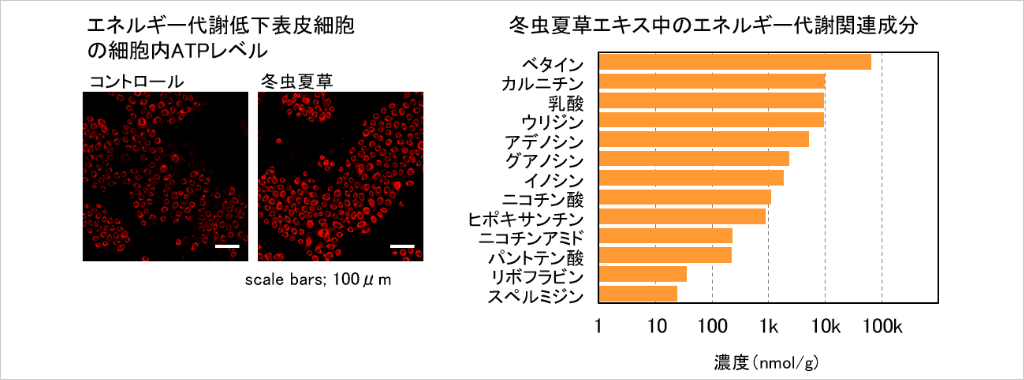
Figure 1: Effects of Cordyceps sinensis extract on epidermal cells in a state of reduced energy metabolism and analysis of ATP production-promoting components contained in Cordyceps sinensis extract.
<Testing Method>
Intracellular ATP levels were evaluated using neonatal-derived epidermal cells and ATP-Red staining. (Conducted by Rohto Pharmaceutical Research Institute)
Energy metabolism-related components in Cordyceps sinensis extract were analyzed using CE-TOFMS. (External testing laboratory conducted)
Result 2: Confirmed that Cordyceps sinensis extract increases factors involved in stratum corneum barrier formation.
We evaluated the effects of Cordyceps sinensis extract on skin moisture and barrier function using neonatal-derived epidermal cells and aged donor-derived epidermal cells. As a result, even in aged donor-derived epidermal cells, where changes in energy metabolism associated with aging are expected, the expression levels of ceramide and filaggrin increased with the addition of Cordyceps sinensis extract (Figure 2 left). Furthermore, metabolome analysis of Cordyceps sinensis extract, similar to Result 1, identified nine NMF-related components that are precursors to filaggrin (Figure 2 right). These results suggest that Cordyceps sinensis extract contains a complex amount of NMF and may support skin moisture and barrier function.
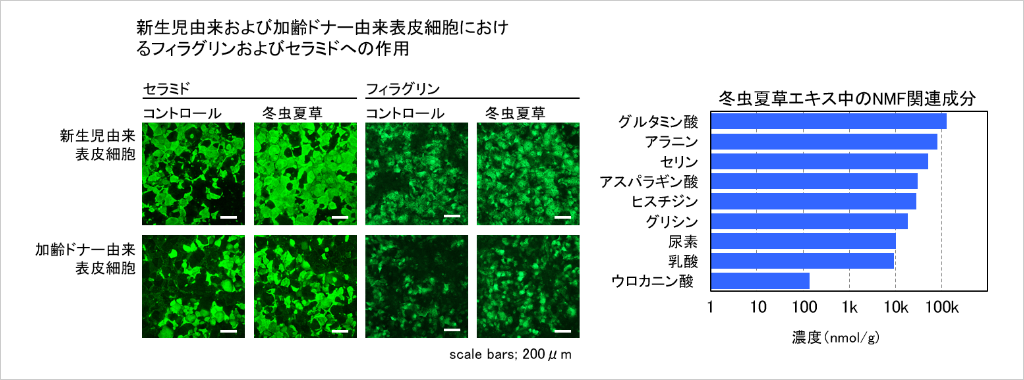
Figure 2: Effects of Cordyceps sinensis extract on ceramides and filaggrin in epidermal cells and analysis of NMF-related components contained in Cordyceps sinensis extract
<Testing Method>
Epidermal cells derived from neonatal and aged donors were cultured with Cordyceps sinensis extract during the differentiation period. Ceramide and filaggrin were stained by immunofluorescence staining on day 5 of differentiation. (Conducted by Rohto Pharmaceutical Research Institute)
NMF-related components in Cordyceps sinensis extract were analyzed using CE-TOFMS. (External testing laboratory conducted)
Future outlook
These results suggest that Cordyceps sinensis extract may contribute to maintaining and restoring skin moisture and barrier function by supporting intracellular energy metabolism. Furthermore, it exhibits a component profile containing a complex of energy metabolism-related low molecules, and its effects were observed in both a state of reduced energy metabolism and in aging donor-derived epidermal cells. Therefore, it is expected to be applied as a foundational approach to support the recovery of skin that tends to decline in function with age, as well as skin that has undergone cosmetic procedures or suffered daily damage.
Going forward, we will apply the results of this research to skincare products and continue our research and product development to provide care that keeps skin healthy after cosmetic procedures, as well as address skin conditions that are prone to change due to dryness, UV rays, aging, and other factors.
Terminology
- Cordyceps sinensis
This material is known as a type of fungus that parasitizes insects. It has a long history of being used as a health ingredient, and in recent years, research has been progressing on its relationship with energy metabolism and biological functions.
- State of reduced energy metabolism
A state in which cells lack the energy necessary to maintain their function. In this release, we assume a skin condition where energy metabolism has decreased due to age, daily damage, etc., and refer to a state in which the intracellular ATP level is likely to decrease because there is insufficient glucose available to epidermal cells.
- ATP
Adenosine triphosphate is an abbreviation. It is a molecule that delivers the energy necessary for cell activity and is involved in various life activities that support healthy skin function, such as cell maintenance and repair.
- Ceramide
These are the main lipid components found in the stratum corneum. They support the skin's barrier function, protecting it from external irritants and dryness.
- filaggrin
Proteins produced in the stratum corneum of the skin. When broken down, they become components of natural moisturizing factors (NMF) that maintain skin moisture, and are involved in retaining moisture in the stratum corneum.
- Natural Moisturizing Factor (NMF)
This is a general term for components present in the stratum corneum that have the function of retaining moisture. It includes amino acids and plays an important role in maintaining skin hydration.
- Metabolome analysis
This technique comprehensively measures and analyzes various metabolites (components) contained in living organisms and materials. It is used to understand what components are present and their relationship to metabolism.