How does the desire to "want to use it again" arise?
Exploring the process of becoming addicted to lip balm through continued use
—focusing on the initial anticipation and the expanding user experience over time.
October 15, 2026
ROHTO Pharmaceutical Co., Ltd. (Headquarters: Osaka City, President: Hidetoshi Segi) is advancing skincare research based on a customer-centric approach in order to realize the Rohto Group's overall management vision, "Connect for Well-being & Longevity."
Up until now, our company has been conducting sensory research to scientifically unravel the feelings of "liking" and "wanting to use again," and to use this research to create products that people will want to cherish for a long time. This time, using "Melty Cream Lip" as the subject, we analyzed the relationship between the feeling of use, changes in expectations of the product with continued use, and the intention to continue using it, and examined the process of forming an addictive usage experience that makes people want to use it again and again.
The results of this research were presented at the 28th Annual Meeting of the Japan Society for Kansei Engineering, held from September 16th to 18th, 2026.
Key points of the research
- Melty Cream Lip showed that from the first use, the feeling of "likability" was associated with the desire to "use it again," suggesting the potential for it to become addictive.
- For those whose expectations increased with continued use, not only did their evaluation of one aspect of usability improve, but their evaluation of various aspects of usability also improved.
- After repeated use, we confirmed that "comfort" is also related to the feeling of "wanting to use it again," and that this could be an important keyword when considering the addictive user experience of Melty Cream Lip
Research Background
For cosmetics used on a daily basis, in addition to functionalities such as moisturizing, the "feel" of the product, including its texture and comfort when applied, is also thought to influence whether a user wants to use the product again.
To deepen our understanding of this user experience, we have conducted sensory evaluation studies targeting users of our "Melty Cream Lip" which features a melting texture, and have reported on the possibility of obtaining satisfaction, fulfillment, and "comfort" during use *1. However, these studies were conducted on people who were already loyal users of the product, and the next challenge was to capture the process by which people who do not usually use the product come to feel that they "want to use it again" after their first use.
Therefore, this time, we investigated how the addictive user experience that makes people want to use it again and again is formed, targeting people who do not usually use Melty Cream Lip.
*1: Uncovering the addictive secrets of Mentholatum® "Melty Cream Lip" through data.
result
Result 1: Melty Cream Lip received high marks for "usability" and "expectations" from the first use, and continued to receive even higher ratings with continued use.
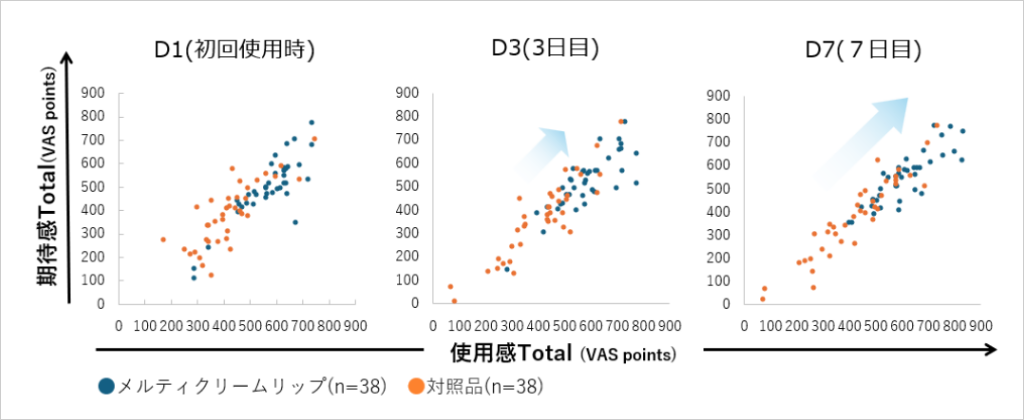
[Figure 1] Changes over time in total score for usability and total score for expectations in Melty Cream Lip and the control product.
<Testing Method>
In a study involving 38 women aged 20-39, participants used two test products—Melty Cream Lip with a distinctive texture and a control product with a different texture—in a different order for 7 days.
On the first use (D1), the third day (D3), and the seventh day (D7), the user experience (11 items including moisturizing effect, ease of application, and comfort) and expectations (8 items including whether continued use would prevent dryness and peeling, and whether the condition of the lips would improve) were evaluated.
For the user experience and expectations, the scores for each evaluation item were totaled to calculate the total score. Each point in the figure represents the score of each individual, and the distribution and changes in scores with continued use are shown for both Melty Cream Lip and the control product.
Many users of Melty Cream Lip gave high ratings to both "feel" and "expectations" from the very first use. Furthermore, with continued use, both ratings rose to even higher levels, showing a different trend compared to the control product.
Result 2: For those who have high expectations for Melty Cream Lip, various benefits also increase with continued use.
To examine the changes in expectations and evaluations of Melty Cream Lip, we divided participants into two groups: one whose expectations increased and another whose expectations decreased from day 1 to day 7 of use, and compared the changes in each evaluation of the user experience. As a result, we confirmed that the group whose expectations increased showed significantly larger changes in evaluations of "moisture," "blending feel," and "shine," as well as "comfort" and "sense of security," compared to the group whose expectations decreased. These results indicate that increased expectations for a product are related not only to changes in specific user experience but also to changes in the overall user experience (evaluation), including comfort and a sense of security.
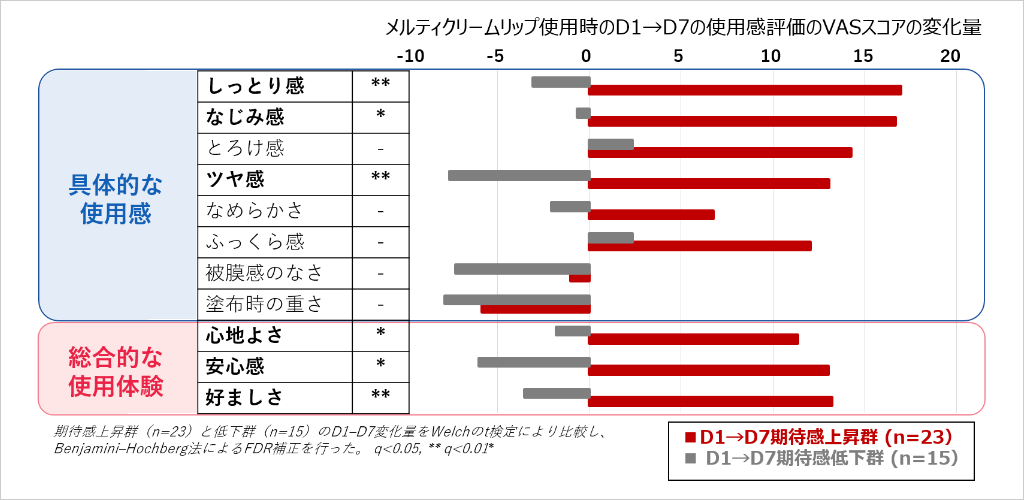
[Figure 2] Changes in various "good points" associated with changes in expectations for Melty Cream Lip
<Testing Method>
The change in each usability item of Melty Creep Lip from D1 to D7 was calculated and compared between the two groups. Welch's t-test was used for the intergroup comparison, and FDR correction using the Benjamini-Hochberg method was performed to account for the effects of multiple comparisons (*q < 0.05).
This classification is intended to investigate how the user experience changes in response to shifts in expectations, and is not based on whether or not the product becomes addictive.
Result 3: As you continue to use the product, the feeling of wanting to use it again changes.
We analyzed the relationship between the desire to "want to use it again" (intention to continue using the product) and the evaluation of user experience using graphical modeling.
As a result, with Melty Cream Lip, "likability" was directly related to the intention to continue using the product at the time of first use, on the third day, and on the seventh day. Direct correlations with "familiarity" were also observed on the third day, and with "comfort" on the seventh day. These results suggest that the user experience related to the intention to continue using the product may change with continued use.
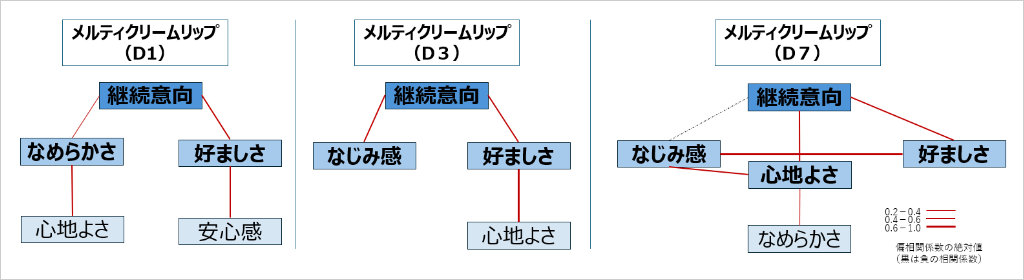
[Figure 3] Changes in the relationship between intention to continue using Melty Cream Lip and user experience while continuing to use the product (first use (D1), day 3 (D3), day 7 (D7))
Furthermore, when comparing the analysis results on day 7 with the control product, Melty Cream Lip showed a direct positive correlation between "likability" and "comfort" and intention to continue using the product, while the control product mainly showed a direct positive correlation with "likability." This suggests that products with different textures may also have different textures that are associated with the desire to "use again" after continued use.
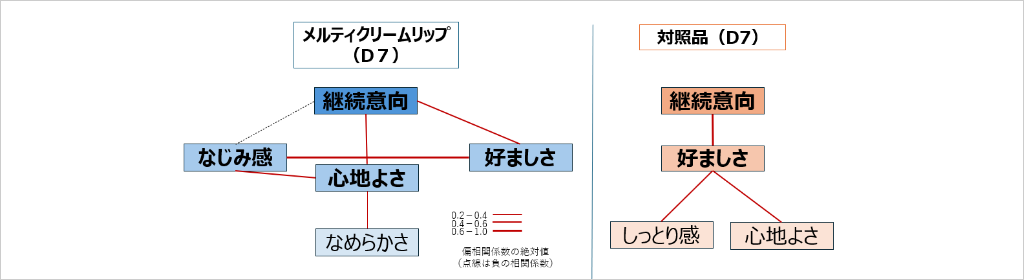
[Figure 4] Relationship between intention to continue use and user experience after 7 days of use (Melty Cream Lip (D7) is the same as in Figure 3)
How to interpret graphical modeling diagrams
The items connected by lines show a relationship; red lines indicate a positive relationship, and black lines indicate a negative relationship. Thicker lines indicate a stronger relationship. Note that the lines do not indicate causality. (The image is an excerpt from the top of the results.)
Consideration
In this study, in addition to "likability," which was associated with the intention to continue using Melty Cream Lip from the first use, a direct association with "comfort" was also observed on day 7. Furthermore, it was confirmed that the group whose expectations increased showed greater changes in multiple user experience evaluations, including comfort and reassurance, compared to the group whose expectations decreased.
These results suggest that, in order to understand the addictive user experience that makes people want to use the product repeatedly, it is important to consider not only the evaluation at the time of first use, but also the relationship between changes in evaluation with continued use and the intention to continue using the product. In particular, with Melty Cream Lip, it was shown that the evaluation of "comfort" after continued use was related to the feeling of "wanting to use it again."
Future outlook
Going forward, our company will continue to analyze the user experience from initial use to continued use on a "time axis," deepening our research into changes in user experience, expectations for the product, intention to continue using the product, and the relationships between these factors.
Leveraging the knowledge gained, we will pursue functionality and the initial user experience, while also creating products that offer new advantages as you continue to use them, making you naturally want to pick them up again.