Creating new value in skincare with a new approach that "unleashes the inherent power of cells"
—Announcing research results on three types of phytoexosomes *1, promoting scientific quality evaluation and expert collaboration—
November 17, 2026
ROHTO Pharmaceutical Co., Ltd. (Headquarters: Osaka City, President: Hidetoshi Segi) is working towards the social implementation of "Longevity" science, based on the policy announced in May 2026. As the first step, the company has focused on "phytoexosomes" *1, which are exosome-like extracellular vesicles derived from plants, microorganisms, and algae. By adding the perspective of "drawing out the inherent power of cells" that supports healthy skin to skincare, which selects ingredients according to skin concerns, the company is advancing applied research in the skincare field with the aim of creating new value and markets. On this day, the company will release four press releases on research results regarding skin cells with three different types of phytoexosomes derived from Pavlova (microalgae), rice ferment, and lactic acid bacteria.
We aim to cultivate the potential of phytoexosomes into new value in skincare, based on solid science. To achieve this, we prioritize scientifically unraveling the functions of the materials and thoroughly pursuing their quality and stability in formulations. Furthermore, we will continue to engage in discussions with experts and publish our research findings, working towards the development of technology supported by scientific evidence and reliability.
Bringing "Longevity" to everyday value: Rohto's determination to tackle phytoexosomes.
On May 29, 2026, our company announced its policy toward the social implementation of "Longevity" science. We aim to contribute to people being able to live longer, healthier, and more fulfilling lives by connecting the knowledge of cell science we have cultivated to everyday value.
Our company has conducted extensive research in cell science across a wide range of fields, including pharmaceuticals, skincare, and Regenerative medicine, while also exploring the properties and potential of natural materials such as plants, microorganisms, and algae. In 2025, we established the "Phytoscience Research Institute" to scientifically unravel the potential of the life information contained in plants and algae. As a core technology, we focused on "phytoexosomes," exosome-like extracellular vesicles derived from plants, microorganisms, and algae. By connecting cell science and natural material research, we are striving to create value in skincare with a new approach that "unleashes the inherent power of cells" to support healthy skin.
Furthermore, interest in cell-based beauty products is growing, and in Nikkei Trendy's 2027 Hit Prediction Ranking, "cell tech cosmetics" were selected as one of the top 30 and the industry-specific grand prize winner (beauty), with our phytoexosome research being featured as an example. To meet these expectations and cultivate new technologies into values that take root in society, it is important to accurately communicate not only their potential but also what has been scientifically revealed and the challenges ahead. We have launched a dedicated website to disseminate information on our research and quality. In addition, to deepen scientific verification from a multifaceted perspective including academia and clinical settings, we have established the "Phytoexosome Research Group," which includes researchers, doctors, and corporate researchers. We are engaging in discussions with experts on the definition and evaluation methods of materials, quality, and safety, with a view to applying them to products that customers actually use, aiming for the development of technology supported by solid science.
Phytoexosomes: Opening Up New Possibilities by Gaining a Multifaceted Perspective on Skin Function
In recent years, research into intercellular communication—the exchange of information between cells—has been attracting attention in the fields of medicine and beauty. One of the key players in this communication is "extracellular vesicles," including exosomes. These are tiny particles enclosed in a lipid bilayer released from cells, containing RNA, proteins, lipids, and other substances, and are being studied for their ability to influence the function of recipient cells.
Research into these extracellular vesicles is expanding beyond animals such as humans to include plants, microorganisms, and algae. At our company, we refer to naturally occurring exosome-like extracellular vesicles (excluding those from animals) as "phytoexosomes," and we have been exploring their potential by focusing on the unique characteristics of various organisms.
Healthy skin isn't supported by the function of just one gene. Skin functions such as moisture retention and barrier function are supported by the coordinated action of many genes. Our company has focused on the characteristics of diverse organisms and broadly analyzed phytoexosomes derived from them to confirm their impact on changes in gene groups related to skin function. In addition to conventional skincare research that pursues the function of ingredients for individual skin concerns, we aim to create new skincare value by approaching gene groups related to skin function using the characteristics of each originating organism as a clue, and drawing out the inherent power of cells.
Three types of phytoexosome research findings: Different origins, different perspectives.
Our company has been exploring the potential of exosome-like extracellular vesicles of different origins, such as plants, microorganisms, and algae, and has been researching the characteristics of each material and their effects on skin cells. Focusing on organisms that coexist with Japanese local communities and industries, we discovered three materials: Pavlova (microalgae), rice fermentation product, and lactic acid bacteria. Inspired by the characteristics of each origin, we conducted research and gained new insights into their effects on skin cells, including their impact on gene groups involved in skin function. Through this research, we have seen diverse possibilities for supporting healthy skin, using the different characteristics of each origin as a clue.
| Research subject |
Focus on materials |
Research findings on skin function |
image |
Algae-derived
Phytoexosomes *2 |
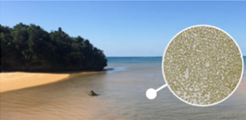
These microalgae inhabit the mangrove areas of Okinawa and are exposed to strong ultraviolet rays. |
Skin cell responses involved in inflammation and aging, and changes in related gene groups. |
 |
Derived from fermented rice
Phytoexosomes *3 |
A fermented product discovered during the sake brewing process. |
Changes in cellular functions related to skin moisture and associated gene groups. |
 |
Lactic acid bacteria-derived
Phytoexosomes *4 |
Lactic acid bacteria discovered in a miso brewery with a long history. |
Mechanisms involved in the response of aging epidermal cells and the skin's barrier function. |
 |
Bringing research findings to everyday skincare: Further understanding and pursuit of quality.
There are still many things to be elucidated about phytoexosomes, and challenges that need to be addressed before they can be implemented in society. Moving forward, we will continue to investigate the relationship between the characteristics of the organisms from which they originate and the function of the vesicles, as well as the mechanism of action on skin cells, while also working on developing technologies for quality evaluation and stable production.
Through this research, we scientifically explore the potential of diverse organisms, connecting cell research, natural material exploration and raw material development, formulation and production technologies to the business foundation of skincare brands that reach a wide range of consumers. We aim to implement "Longevity" science into society by applying research results to daily care.
Phytoexosome research
Under the guidance of Professor Takahiro Ochitani of Tokyo Medical University, our company has been promoting research on "phytoexosomes," which are exosome-like vesicles derived from plants, algae, microorganisms, and other organisms.
Terminology
*1: Phytoexosomes: Naturally occurring lipid bilayer vesicles from plants, microorganisms, algae, etc., excluding animals.
*2: Algae-derived phytoexosomes: Phytoexosomes derived from the microalga Pavlova sp., which inhabits Okinawa.
*3: Rice fermentation-derived phytoexosomes: Phytoexosomes derived from "shubo" (sake starter) obtained during the sake fermentation process.
*4: Lactic acid bacteria-derived phytoexosomes: Phytoexosomes derived from lactic acid bacteria (Tetragenococcus halophilus) used in the fermentation process of miso and soy sauce.