With the launch of Mentholatum in 1975, we made a full-scale entry into the field of topical pharmaceuticals, and have been working to provide fundamental skin care while addressing our customers' skin problems.
Our research and development, aimed at regenerating the skin's natural abilities, is leading not only to the development of pharmaceuticals but also to the development of cosmetics for those who aspire to healthy and ideal skin.
We established our Dermatology Laboratory in 1995 and began evidence-based skin research, leveraging our knowledge of the eyes.
Since then, we have continued to collaborate and co-create with partners both domestically and internationally, and currently, we are challenging ourselves to explore cutting-edge science, centered around our core research facility, Research Village Kyoto.
At its core, it's driven by a genuine desire to offer something new to our customers, based on the feedback of even just one customer, and with a sense of excitement and enthusiasm ourselves.
Moving forward, our diverse team members will continue to share values, forming a strong organization that works on our customers' skin's natural functions and provides solutions that lead to healthy skin.
Research Case Studies
Formulation development focused on achieving efficacy
Commitment to Vitamin C and Hyaluronic Acid
We focus on the skin's natural functions and continue to challenge ourselves to develop products that enable skin to regenerate itself into healthy skin. To achieve this, it is essential to deliver the necessary amount of product to the areas where those functions can be effectively utilized.
For example, L-ascorbic acid is an essential component for collagen production in the body and has various effects such as anti-inflammatory, anti-aging, and antioxidant effects. It has also been found that these effects increase in a concentration-dependent manner.
On the other hand, L-ascorbic acid is sensitive to light, heat, and air, making it extremely difficult to formulate at high concentrations and stably. Therefore, we challenged ourselves to formulate high concentrations of L-ascorbic acid while striving to achieve both effectiveness and product stability, and we succeeded.
Furthermore, hyaluronic acid is an ingredient with high water-retention capacity, said to be able to hold as much as 6 liters of water per gram, and there are various types depending on the size and properties of the molecule. We have revealed that hyaluronic acid suppresses inflammation caused by ultraviolet rays, among other things.
Click here for more details.
Aiming for cutting-edge skin research
Research on elastic fibers involved in wrinkles and sagging
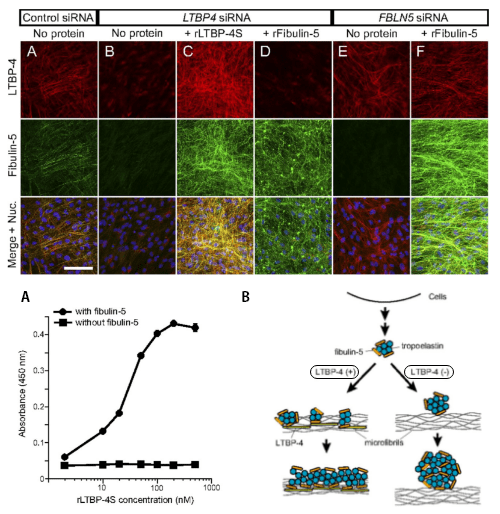
The role of LTBP-4 in elastic fibers
The extracellular matrix, specifically elastic fibers, is what gives the body its flexibility. Tissues where flexibility is important, such as the lungs, arteries, and skin, contain a large amount of elastic fibers.
As we age, our skin sags and our arteries harden because elastic fibers deteriorate and fail to regenerate.
We have long recognized the importance of elastic fibers in the skin and have continued our research on this topic.
Through collaborative research with Kansai Medical University, we discovered that not only elastin but also a protein called LTBP-4 is essential for the formation of elastic fibers, and that adding LTBP-4 to cultured human dermal fibroblasts enhances elastic fiber formation.
We believe we have elucidated a part of the complex process of elastic fiber formation and have found a clue to regenerating elastic fibers.
Subsequently, we discovered ingredients from plant extracts and seaweed extracts that can be incorporated into cosmetics, which promote LTBP-4 production and enhance elastic fiber formation, and applied these to skincare development.
Going forward, we will continue to research elastic fibers, which are essential for studying wrinkles and sagging skin, from various angles.
Click here for more details.
Research on atopic dermatitis
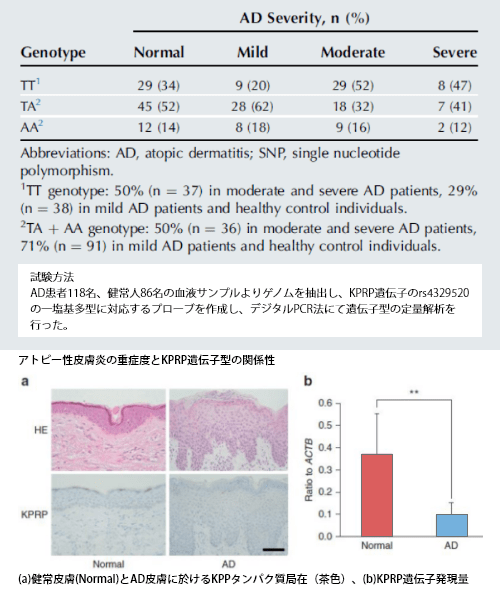
Atopic dermatitis and the KPRP gene/KPRP protein
Atopic dermatitis is a skin disease that affects more than 20% of people, and is characterized by an overreaction of the skin barrier function and immune cells. Genetic predisposition and environmental factors are thought to play a role in the onset and exacerbation of the disease, but the "skin barrier function" is thought to be significantly involved in both.
In an analysis of the correlation between genetic predisposition and the severity of atopic dermatitis, we found that a gene called KPRP was involved.
It was found that when KPRP expression levels decrease, inflammatory responses to external stimuli occur more quickly, and once inflammation occurs, it takes longer to subside.
Furthermore, it was revealed that increasing KPRP expression in a dermatitis model can suppress the amount of external factors that penetrate the skin.
The skin barrier function plays a very important role in maintaining skin homeostasis.
We hope to apply this knowledge to skincare products and contribute to skin health, including the prevention of skin diseases.
Click here for more details.
Whitening research inspired by the latest cosmetic medical treatments
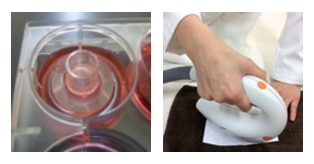
Three-dimensional cultured skin/IPL irradiation machine
In order to conduct research based on the latest cosmetic procedures, we began a joint research project with Aoharu Clinic (Roppongi, Minato-ku, Tokyo; Director: Dr. Eriko Koyanagi) in November 2016.
We first focused on IPL (Intense Pulsed Light) treatment, which has been shown to be highly effective against blemishes and dullness, but whose whitening mechanism had not been clarified.
We focused on making the process as close to the actual treatment as possible, so instead of using monolayer cells, we prepared a 3D cultured skin model, and we also conducted experiments on pre-treatment for IPL irradiation in accordance with the methods used in clinics.
We used a skin model after irradiation to examine changes in various gene expression related to hyperpigmentation.
While it was previously believed that the skin-whitening effect of IPL treatment was due to thermal denaturation of melanin-containing cells and accelerated cell turnover, this study revealed a new finding: the expression of the genes OCA2 and SLC45A2, which are involved in melanin synthesis, is decreased within melanocytes.
In in vitro studies, we confirmed that suppressing the expression of these two genes significantly reduced melanin biosynthesis.
We will continue our collaborative research to unravel the mechanisms of the latest cosmetic medicines and apply this knowledge to the development of new products.
Click here for more details.
Taking on problems that have been unsolvable until now
Research on changes in body odor due to aging
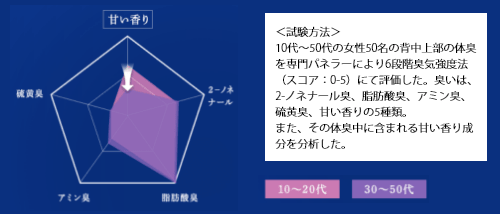
It has been confirmed that body odor changes with age.
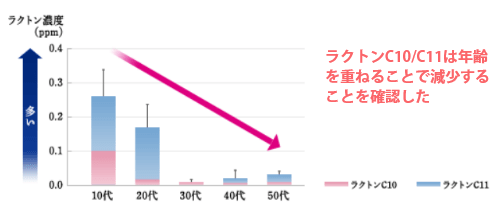
I discovered the sweet scent of my youth.
We have always strived to understand our customers' concerns and continuously think about how we can solve them. For example, sweat and body odor are common concerns for both men and women as they age.
In men, 2-nonenal, the cause of age-related body odor, is difficult to remove with water alone and is strongly noticeable even in small amounts. Therefore, it was necessary to completely remove 2-nonenal using cleansing agents such as shampoo.
The research revealed that during shampooing, there are ingredients that inhibit the adsorption of 2-nonenal to hair, as well as ingredients that promote this adsorption.
Building on insights gained from research on male body odor, we expanded our research to women and discovered that women in their teens and twenties have a strong sweet scent. We found that this scent is due to components called lactone C10/lactone C11, which are lost with age. Furthermore, we conducted research on scalp odor and made new discoveries.
We continue to conduct various research, including studies on lactone C10/lactone C11 and new approaches to combating body odor.
Click here for more details.
Product development tailored to women
Development of topical medications for women's deep-seated health concerns
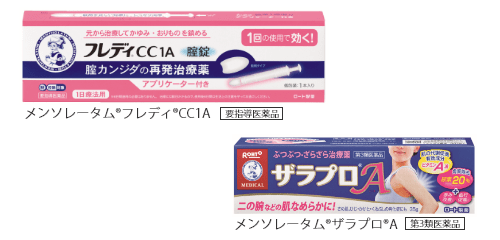
Skin medications for women's health concerns
We were among the first to focus on women's health, and we have particularly addressed the deep-seated concerns of women that they may find difficult to discuss with others.
In particular, vaginal candidiasis, which is said to affect one in five women (according to a 2007 survey by Rohto Pharmaceutical Co., Ltd.), is a disease that is often recurrent, and it is thought that a weakened immune system due to excessive stress, fatigue, or irregular lifestyle habits may be one of the contributing factors.
Under such circumstances, frequent hospital visits and medication can lead to even more stress.
To make it easier for busy modern women to use, we have launched "Mentholatum® Flady (a prescription-only drug), the first over-the-counter (OTC) medication for treating recurrent vaginal candidiasis, which provides sufficient effect with just one tablet per dose and comes with an applicator that makes it easy to insert the tablet in the correct position.
Furthermore, the rough texture on the upper arms that women are concerned about when wearing sleeveless tops is often not recognized as a medical condition because it does not cause pain or itching, and many women have given up on finding a solution. Recognizing that this symptom is keratosis pilaris, and despite opposition from within the company, the enthusiasm of female employees who strongly felt the need for such a product led to the launch of "Mentholatum® Zarapro® A" (a Category 3 pharmaceutical product).
We want women who are struggling with problems to feel like they've found "a cure just for them." With that in mind, we continue to refine our development process.