Rohto Pharmaceutical's eye care began with "ROHTO Eye Drops," which were created in 1909, and for over 100 years, we have been sincerely committed to the eye health of people.
Throughout this long journey, we have stayed close to the diverse eye problems that have diversified with the times, creating new value through a wide range of products, including not only eye drops, but also eye washes, contact lenses and their care products, and supplements.
While we live in an era where people are expected to live to 100, maintaining eye health throughout one's life is not easy, as the eyes are affected by various factors including aging, the digital environment, lifestyle habits, and external stimuli.
To address these challenges, we collaborate with external experts and are developing products that enable everyone to maintain healthy vision, based on research that delves into the structure, function, and cellular level of the eye. In recent years, we have expanded our scope to include the research and development of medical eye drops and devices.
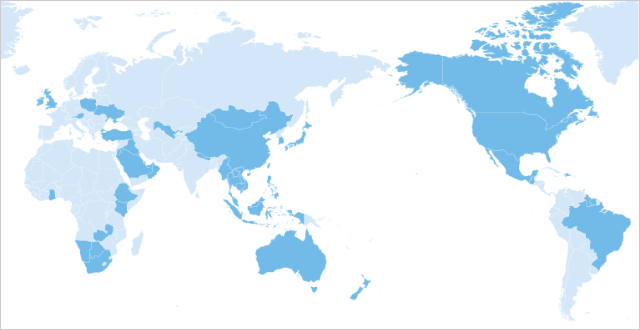
Countries where eye drops are sold (as of May 2026)
Currently, Rohto Pharmaceutical's eye drops are distributed in over 40 countries worldwide, and their reach is expanding year by year. We carefully comply with regulations in each country, supporting the eye health of people around the world.
Moving forward, we will continue to evolve as a comprehensive eye care provider that supports the world's vision, by developing solutions that encompass prevention, early detection, and treatment, based on scientifically-backed research and technology.
[Case Study]
Moisture, protection, and regeneration: The cutting edge of ocular surface research, from tears to stem cells.
A challenge that defies conventional wisdom: How to create new value while respecting pharmaceutical regulations
A next-generation approach that creates new value: Eye care × XXXX!
Moisture, protection, and regeneration: The cutting edge of ocular surface research, from tears to stem cells.
An approach to dry eyes born from research into tears
In recent years, the number of people complaining of dry eyes has increased due to factors such as prolonged use of digital devices, regular contact lens wear, and aging. This is often due to "tear problems," where the quantity and quality of tears are disrupted.
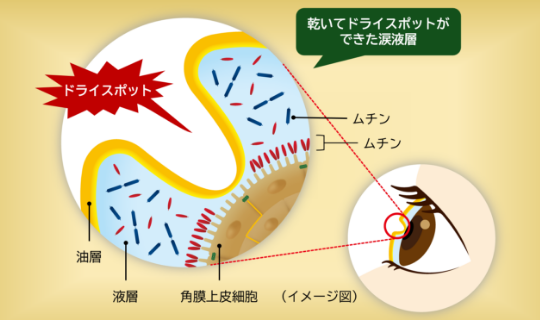
This is an illustration of a condition where dry spots occur due to a decrease in tear quality, resulting in the tear film not properly covering the surface of the eye.
Tears primarily serve two functions. The first is to "cover the surface of the eye and protect it from dryness and irritation." When the balance between the fluid layer (water + mucin) that moistens the surface of the eye and the oil layer that inhibits water evaporation and helps spread tears is disrupted, the quality of tears deteriorates, leading to dryness and blurred vision.
Focusing on this mechanism, we conducted extensive research into formulation technologies to stabilize the liquid and oil layers, and as a result, we discovered the optimal type and ratio of surfactants to protect the corneal surface while suppressing tear evaporation.
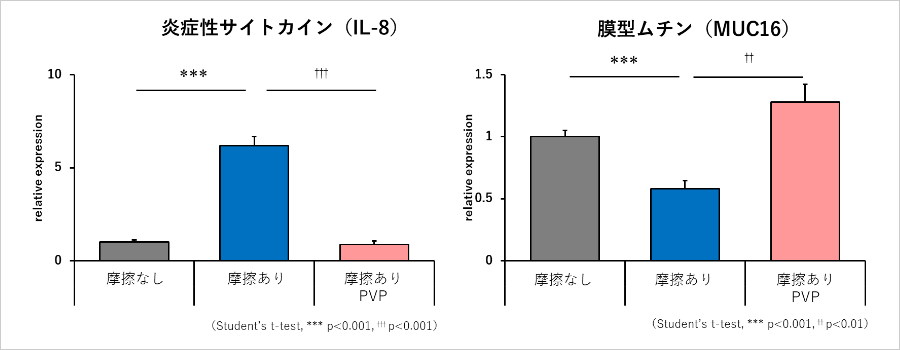
Changes in IL-8 mRNA expression levels/MUC16 mRNA expression levels due to frictional stimulation of cells and the effects of povidone (PVP)
Another function of tears is as a "lubricant" that makes blinking smoother. We blink about 20,000 times a day. When the quality of tears deteriorates, friction between the eyelids and the surface of the eyes increases, leading to discomfort and a feeling of a foreign object in the eye.
Through our research on corneal epithelial cells, we found that friction increases the inflammatory cytokine IL-8 and decreases the expression of MUC16, a membrane-bound mucin important for tear retention, and that povidone, an active ingredient in eye drops, suppresses these effects.
Based on this research, we will continue to refine our technology to address tear-related problems and deliver more comfortable vision to people all over the world.
Return to the list of case studies
Unraveling the previously unknown properties of chondroitin sulfate sodium at the molecular level.
In today's increasingly digital age, our eyes are under immense strain. The cornea and conjunctiva, in particular, experience significant stress on their barrier function (the mechanism by which cells are tightly packed together to protect against irritation) and their ability to maintain moisture.
Sodium chondroitin sulfate (CS) is an ingredient that has long been used in ophthalmic clinical practice for corneal protection and other purposes, and has been widely studied due to its high safety and biocompatibility. Based on this knowledge, we are conducting research that delves into the "molecular properties" of CS.
What we particularly focused on was the fact that "CS changes its properties depending on differences in structure and molecular weight."
For example, by comparing CS with different molecular weights, we found that high molecular weight CS exhibits a superior protective effect on corneal epithelial cells. We also found that high molecular weight CS promotes the expression of the cell adhesion molecule OCLN and the membrane-bound mucin MUC16, which are factors involved in eye moisture and protection. Furthermore, we have confirmed that the structure and molecular weight of CS change depending on the manufacturing raw materials and manufacturing methods, and that these differences can affect its effects. *1
-
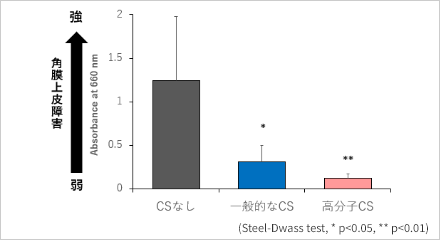
The effect of CS on corneal epithelial damage (corneal protective effect)
-
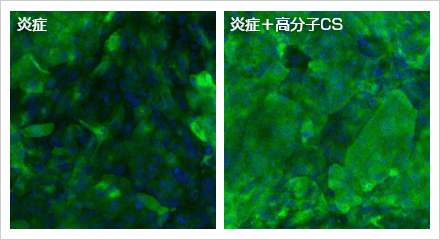
Effect of high molecular weight CS on mucin (MUC16, green in the figure) expression in corneal epithelial cells
Thus, Rohto Pharmaceutical's research on chemical substances (CS) is shifting from the framework of "CS = single material" to a new perspective of "selectively using CS with different molecular weights and structures according to the purpose." We will continue our research to further deepen our knowledge and develop eye care technologies with even greater value. *2
Return to the list of case studies
World's first! Induction of functional lacrimal gland organoids from pluripotent stem cells.
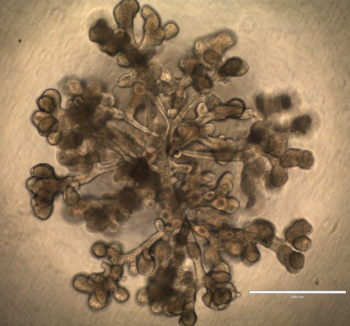
Microscopic images of human lacrimal gland organoids
Tears protect our eyes. When the tear glands that produce tears are damaged, it can lead to severe dry eye, causing dryness, pain, and blurred vision. Current treatments mainly focus on alleviating symptoms, and there are very few methods to cure the condition at its root.
Rohto Pharmaceutical has been conducting research on Regenerative medicine with Osaka University since the 2010s. In that research, we have been involved in creating "lacrimal gland organoids," which are small, three-dimensional tissues of the lacrimal gland, from human induced pluripotent stem cells (iPS cells), and have played a part in achieving results in this research, as it has the potential to fundamentally cure this troublesome symptom.
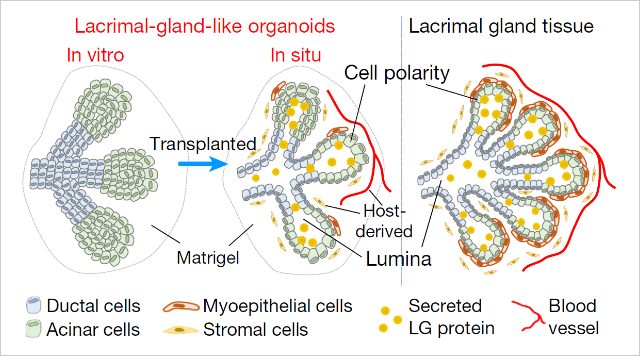
Schematic diagram of human iPS cell-derived lacrimal gland organoids and human lacrimal gland tissue.
These lacrimal gland organoids grow in a culture medium, with tubules extending and branching, just like real lacrimal glands. Furthermore, we have confirmed that they express proteins and other substances found in tears when transplanted into animals.
This Regenerative medicine technology brings closer to a dream-like treatment in the future: "transplanting newly created tear glands to replace those with impaired function." It has the potential to bring new hope to many people suffering from dry eyes.
Moving forward, we will continue to explore new possibilities in Regenerative medicine through research utilizing organoids and other tissues, and refine technologies that will lead to future eye care.
Source: Hayashi R. Nishida K. et al., "Generation of 3D lacrimal gland organoids from human pluripotent stem cells," Nature, 2022.
©Springer Nature. This image is reproduced with permission from Springer Nature.
(Original paper: https://www.nature.com/articles/s41586-022-04613-4)
Reference: Osaka University's research-only portal site
Provided by: Koji Nishida, Professor, Department of Neurosurgery and Sensory Organ Surgery, Ophthalmology, Osaka University
https://resou.osaka-u.ac.jp/ja/research/2022/20220421_1
Return to the list of case studies
A challenge that defies conventional wisdom: How to create new value while respecting pharmaceutical regulations
First in Japan! Development of eye drops to relieve itching that can be used while wearing soft contact lenses.
Since the 1990s, with the spread of soft contact lenses (SCLs), there has been a growing demand for comfort during wear. Amidst this, it has become clear that many wearers suffer not only from dry eyes but also from itching caused by pollen and other allergens.
However, under the regulations at the time, SCL-compatible eye drops were limited to those targeting "dry eyes," and the inclusion of "ingredients to suppress itching" was not permitted.
Therefore, we decided to confront this challenge head-on and take on the challenge of reviewing the regulations.
In formula development, we thoroughly tested the adsorption of ingredients and their impact on lenses for all SCLs available on the market, achieving a balance between safety and efficacy. As this product opened up new possibilities for SCL-compatible eye drops, we also carefully addressed industry-wide challenges such as measures to prevent misuse and the establishment of an information provision system, and in 2009, we obtained approval as "Rohto Alguard Contact (Category 3 Pharmaceutical Product)."
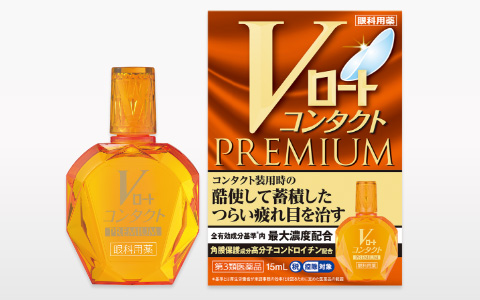
V Rohto Contact Premium (Category 3 Pharmaceutical Product)
This challenge, which created a new option for SCL wearers, led to the evolution of SCL-compatible eye drops, which had previously focused primarily on "dry eyes," to meet a wider range of needs. Currently, we offer products such as "V Rohto Contact Premium" (a Category 3 pharmaceutical product) that address various concerns of SCL wearers.
We will continue to refine our research and technology, and propose new eye care solutions with unconventional ideas.
Return to the list of case studies
Development of the Alguard® series: Challenging new possibilities for over-the-counter medicines
Over-the-counter (OTC) drugs allow for the use of a wide variety of active ingredients in product offerings. However, if there is no precedent for such a combination, a process to confirm efficacy and safety is necessary. Careful consideration, including conducting clinical trials as needed, is essential.
Since launching Rohto Alguard eye drops in 1987, we have been conducting research on hay fever and itchy eyes for over 30 years.
In 2009, we launched the anti-inflammatory ingredient pranoprofen as an over-the-counter (OTC) product, followed by the anti-allergic ingredient tranilast in 2013. However, in order to address multiple symptoms such as itching and redness caused by hay fever, we subsequently challenged ourselves to develop eye drops containing both ingredients simultaneously *3. As this was an unprecedented combination, we conducted clinical trials again, enabling us to offer a new option as an OTC product.
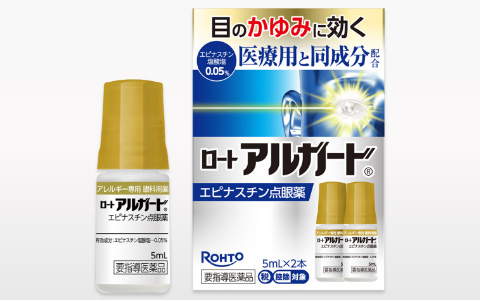
Rohto Alguard Epinastine Eye Drops (Prescription-only drug)
Furthermore, in 2026, Rohto will launch "Rohto Alguard Epinastine Eye Drops (Prescription-Only Drug)," which contains the same active ingredient and amount of epinastine hydrochloride, an anti-allergic component that was switched from a prescription drug, as the prescription drug. *4 The Alguard brand has evolved into a lineup that meets a wider range of needs.
This brand, which has long been supported as "Alguard for itchy eyes," maintains a high market share thanks to its proven effectiveness and commitment to user experience.
We will continue to deepen our research in the field of allergies, overcome pharmaceutical regulations, and work to create products that deliver new value.
*3: Rohto Alguard Clinical Shot (Class 2 pharmaceutical product)
*4: Epinastine hydrochloride 0.05%
Return to the list of case studies
A next-generation approach that creates new value: Eye care × XXXX!
The relationship between lifestyle habits and eye health, as revealed by data from Expo visitors.
We aim to create a future where each individual can understand the condition of their own eyes and choose appropriate care and lifestyle habits. To achieve this, we are developing a new eye care system that "visualizes" the condition of the eyes by utilizing AI-powered image analysis and personal health records (PHR).
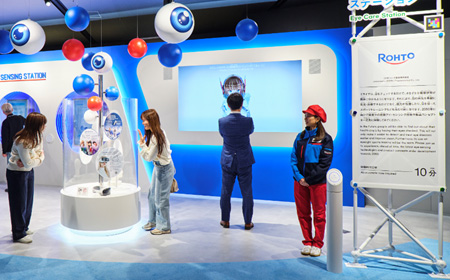
As part of this initiative, at the Osaka Healthcare Pavilion of the Osaka-Kansai Expo to be held in 2025, we conducted a "Self-Eye Check Experience" that estimates the age of your eyes *5 from a facial photograph in a non-contact manner, providing visitors with the opportunity to check the condition of their own eyes.
Furthermore, analysis of big data on the eyes of over 100,000 participants, conducted as part of the booth experience, revealed a tendency for those with younger-than-actual eye ages to spend less time looking at monitors, while among those in their 40s to 60s, the longer the monitor viewing time, the more their eye ages tended to be in line with or exceeding their actual age. These results suggest that daily lifestyles may significantly influence the condition of one's eyes.
This experience was significant not only because it allowed attendees to understand the condition of their own eyes, but also because it provided new insights into the relationship between lifestyle habits and eye health.
These insights will form the foundation for realizing personalized care in the future and have the potential to advance eye care research to a new stage.
Moving forward, we will continue to explore the future of eye care through an approach that combines technology and medicine, and deliver value that supports eye health to the world.
*5: Estimated apparent age based on analysis of image data of the surface of the eye and the skin surface around the eye.
Return to the list of case studies