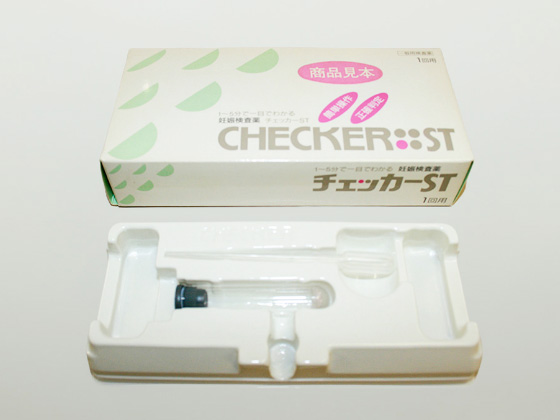
Checker was launched in 1993 as Japan's first over-the-counter medicine.
In Japan in the 1980s, pregnancy tests were not approved as over-the-counter medications, making it difficult for women to confirm their pregnancy themselves. In 1985, the medical-grade pregnancy test "Checker" was imported from the United States and began to be sold in pharmacies and drugstores.
Rohto Pharmaceutical has consistently advocated for the importance of "women knowing their own bodies," and has also participated in discussions about making pregnancy tests available over-the-counter (OTC). In 1992, they obtained approval for and launched "Checker ST," Japan's first general-use pregnancy test.
Initially, there was a lot of lack of knowledge and prejudice, but through the establishment of consultation services and awareness campaigns, understanding spread, contributing to the widespread adoption of early pregnancy confirmation.
Since then, we have continued to improve our diagnostic tests, including pregnancy tests. These antibody technologies and manufacturing know-how are now being applied to infectious disease diagnostic tests for influenza viruses, COVID-19, and other viruses, forming the foundation of Rohto Pharmaceutical's diagnostic test development.
Furthermore, as a first step for men to engage in fertility treatment, we have also developed a product that checks the concentration of motile sperm.
Technological innovations in diagnostic reagent development
A key characteristic of Rohto Pharmaceutical's technological innovation in diagnostic reagent development is that they handle everything in-house, from antibody production to product commercialization.
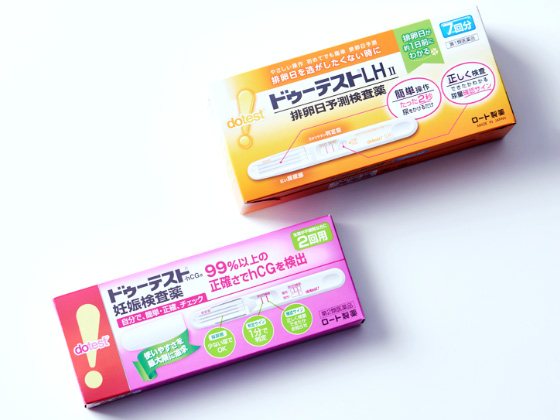
The "do test" brand of pregnancy and ovulation prediction tests as of 2026.
Since 1987, in order to detect hCG, a hormone found in pregnancy urine, with high sensitivity and specificity in pregnancy tests, we have redesigned the antigen using genetic engineering technology and challenged ourselves to develop our own antibodies. After much trial and error, we established an antibody that clearly reacts only to the target hCG, and worked to commercialize it as a one-step immunochromatographic test that can be used simply by applying urine.
As a result, in 1993, we launched "do test hCG," our first in-house developed and manufactured over-the-counter pregnancy test.
Furthermore, to make the pregnancy test easy for anyone to use, we focused on shortening the test time and reducing costs.
By optimizing the components and structure, we have reduced the time required for diagnosis from a long period to approximately one minute. This technology has also been applied to the in-house development and manufacturing of ovulation prediction test kits, leading to the realization of a new test kit that detects LH, a hormone that increases in urine during ovulation.
Furthermore, we have paid close attention to the container shape to maximize ease of use, ensuring it is easy to hold, minimizes urine splashing, and allows for accurate testing without errors or incomplete results.
Return to the list of case studies
Accuracy evaluation of the "dotest® Smartphone Motile Sperm Concentration Test Kit"
Due to the trend of later marriages, there is an increasing number of couples who wish to become pregnant during the age when fertility declines for both men and women.
Although the causes of infertility are equally present in both men and women, consultations and examinations during fertility treatment tend to be biased towards women, and there are many cases where the issues on the male side are not recognized until later.
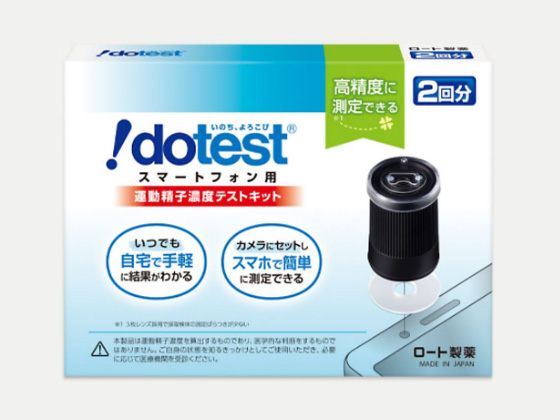
 Motile sperm concentration test kit
Based on the idea that "fertility treatment is something that couples must face together," we explored ways to provide testing that would help men understand their situation and take the first step.
That's where we focused on a simple sperm motile measurement that can be done at home using a smartphone. Even though it's not a pharmaceutical product, we made it our core principle to not compromise on scientific reliability.
This kit underwent accuracy evaluation in cooperation with university hospitals, and a high correlation with clinical tests (microscopy) was confirmed.
A correlation coefficient of 0.74 was observed in semen samples from healthy individuals, and a high correlation was confirmed regardless of whether a smartphone was used, even at around 6.7 million/mL of motile sperm concentration, which is considered the minimum level for natural conception.
Return to the list of case studies
Development and manufacturing of infectious disease kits
In 2020, the COVID-19 pandemic occurred. At the time, PCR testing was the gold standard for COVID-19 testing, but the low number of tests performed was a major challenge.
Japan has limited experience with outbreaks of unknown infectious diseases, and delays in developing testing systems have been pointed out. While PCR is highly sensitive, it has the drawback of being time-consuming and not being able to provide quick results.
In contrast, antigen tests using immunochromatography, while less sensitive, have the advantage of not requiring large-scale equipment and allowing for rapid results.
We have been involved in the development and manufacturing of immunochromatographic products, such as pregnancy tests, ovulation tests, and rapid influenza antigen tests, for many years. Through this process, we have accumulated technology and know-how related to immunochromatography from development to manufacturing, and our development and manufacturing departments have always worked closely together in the manufacturing process.
Leveraging this background, we have begun developing a rapid antigen test for COVID-19.
By simultaneously pursuing industrialization studies alongside development and establishing a system that allows for swift sales after regulatory approval, we were able to launch the product in less than a year from the start of development. We believe this is an example of the unique strength of our company, where development and manufacturing are integrated into a single process.
Return to the list of case studies