Since the launch of Mentholatum in 1975, we have made a full-scale entry into the field of topical pharmaceuticals, and have been working to provide fundamental skin care while addressing our customers' skin concerns. Our research and development, aimed at drawing out the skin's natural power, has extended beyond pharmaceuticals to include the development of cosmetics for those seeking healthy and ideal skin.
In 1995, we established the Dermatology Laboratory and began evidence-based skin research, leveraging the knowledge we had cultivated regarding the eyes. Since then, we have continued to collaborate with partners both domestically and internationally, and currently, we continue to challenge ourselves in the pursuit of cutting-edge science, working in cooperation with various institutions.
At its core is a strong desire to deliver new value, starting with customer feedback, and working diligently and with a sense of excitement ourselves.
Moving forward, we will continue to deepen our research and development based on scientific evidence, and engage in science-based manufacturing that accurately captures the skin's natural functions. By accumulating solid knowledge and technology, we will continue to create solutions that realize healthy skin for our customers.
[Case Study]
Product development that addresses our customers' skin concerns.
Basic research exploring what works and why it works
Research and development of techniques for effectively utilizing materials
We are attentive to our customers' skin concerns.
Completely comforting itchiness and dryness.
Rohto's skin research was born from the desires of the employees' families.
Since starting its skin medication business in 1975, Rohto Pharmaceutical has been sincerely addressing the problems of itchy and dry skin for over 50 years. Itching is a symptom that not only affects appearance but also significantly impacts quality of life (QOL), affecting sleep and concentration.
To address this common yet profound concern, we are pursuing new approaches from both scientific and pharmaceutical technology perspectives.
This journey began with an incident where a family member of one of our employees was suffering from itching so severe that they couldn't sleep at night.
This desire sparked research into addressing consumers' desire to "quickly stop itching," and the challenge of finding the optimal combination of dermatological knowledge and medicinal ingredients continued.
This is how the "Mentholatum® AD series," which addresses both itching and dryness simultaneously, was born.
Driven by a desire to alleviate xerosis in the elderly, we combined an "antipruritic topical agent" and a "cutaneous softening agent," creating a unique and groundbreaking formula that combined antihistamine and moisturizing ingredients, which was first introduced at the time. The effectiveness of this formula was confirmed through clinical trials.
Subsequently, a combination of heparinoid and antihistamine components was used to obtain a new efficacy claim for "itchy dry skin (senile and adult xerosis, dry skin in children)." This addresses the concerns of people of all ages, from the elderly to children.
In recent years, we have also taken on the challenge of creating new containers that are easy for the elderly to use. We aim to create products that are not only highly effective but also easy for everyone to use.
Furthermore, we also focus on itching of the scalp, nose, and ears, addressing a wide range of customer needs.
Furthermore, we have also advanced our research on itching, and in a joint study with Osaka University, we discovered that cholesterol also has anti-inflammatory effects.
Return to the list of case studies
Offering support with science and kindness for those struggling with problems they find difficult to discuss with others.
Rohto's Feminine Care research focuses on women's bodies and minds.
Rohto Pharmaceutical has been quick to focus on women's health and has been attentive to even the "deepest concerns" that are difficult to discuss with others. In particular, vaginal candidiasis, which is said to affect one in five women, is a disease that is often triggered by stress, fatigue, and irregular lifestyles, and frequently recurs.
Recognizing that frequent hospital visits and treatments can be an additional burden, we developed Mentholatum® Freddy® CC1A (originally a prescription-only drug, now a Class 1 drug) as the first over-the-counter (OTC) medication, which is effective with just one tablet per Flady and features an applicator that makes it easy to insert correctly, so that busy modern women can use it safely at home. *1
Furthermore, in order to address the new concerns faced by modern women, we launched "LABiOME," Feminine Care brand based on the concept of lactic acid bacteria barrier care. *2
We offer a new type of care that addresses the changing needs of women's bodies as they progress through life stages, such as skin problems after VIO hair removal, increased menstrual frequency, and dryness associated with menopause. This care protects moisture while keeping the skin clean and supple.
Rohto Pharmaceutical will continue to strive to create a society where women can live healthy and fulfilling lives, using the power of science and kindness.
Return to the list of case studies
Exploring what works and why it works
Unraveling the "Skin's Cycle" Through Science
Rohto's new aging research that doesn't rely on animal testing
Based on the knowledge cultivated through its previous research in anti-glycation and elastin, Rohto Pharmaceutical is advancing research aimed at "unraveling the mechanisms of aging through science."
In a joint research project with Osaka University, we discovered a new factor that promotes skin aging, "thrombospongin-1 (THBS1)," using data science methods that combine multifaceted omics analysis with next-generation sequencers and simulations using mathematical models. *3
Furthermore, we confirmed that vitamin C (L-ascorbic acid) promotes the proliferation of epidermal cells through DNA "demethylation," thereby increasing skin thickness. *4
These studies are conducted through human cell trials and human-based research, in accordance with a policy of not conducting animal testing in the development of cosmetics (including medicated cosmetics). Through data-driven analysis and simulation, we aim to deliver new value not only in skin aging but also in previously unexplored areas.
Furthermore, these results are leading to a new approach that fundamentally re-examines skin changes such as aging and a decline in barrier function.
Return to the list of case studies
Research on "tension" that controls the structure and function of the skin
The skin, which protects our internal organs, is constantly being pulled and compressed by external forces and gravity. While it has been discovered that these forces acting on cells are actually important for skin development and regeneration, and medical applications are progressing, its connection to and potential applications in skincare have not been sufficiently explored.
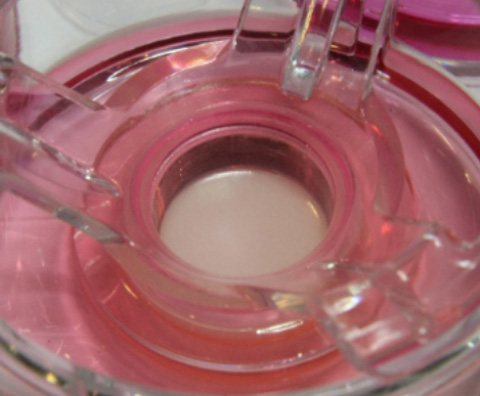
Artificial skin model that replicates tension equilibrium (the white area in the center)
Therefore, we developed artificial skin that replicates the "tension equilibrium" environment in living skin, where cells pull against each other.
The research revealed that tension equilibrium, via a mechanosensor (needle command center) called MRTF-A, plays a role not only in promoting collagen synthesis and cell turnover, thereby developing skin tissue, but also in improving responsiveness to drugs such as retinoic acid. This result suggests that the condition of the skin may improve or worsen depending on the state of the force applied to it, suggesting the potential of skincare using physical force.
Furthermore, we discovered that peony extract activates MRTF-A from among approximately 500 different materials.
Return to the list of case studies
Focusing on the "vascular regeneration ability" of adipose stem cells
Up until now, our research has primarily focused on the superficial layers of the skin, such as the epidermis and dermis. In recent years, we have broadened our scope and expanded our research area to include deeper tissues closely related to the skin, such as subcutaneous fat, blood vessels, and muscles.
We believe that viewing the skin not as a standalone organ, but in the context of its connection to the entire body, will lead to the creation of new value in skincare.
Our bodies are crisscrossed with approximately 100,000 kilometers of capillaries, but the number of blood vessels decreases with age, and it is estimated that the area of capillaries in the skin of the face decreases by about 43% after the age of 40. As the number of capillaries decreases, blood flow slows down, making it easier for a condition called ischemia to occur, in which nutrients and oxygen cannot be delivered sufficiently.
In ischemia, not only is there insufficient blood flow due to vascular damage, but the capillaries themselves may disappear, and if it progresses further, it can lead to skin atrophy and necrosis. It is also known that as we age, the number of capillaries decreases, which can cause the skin to thin.
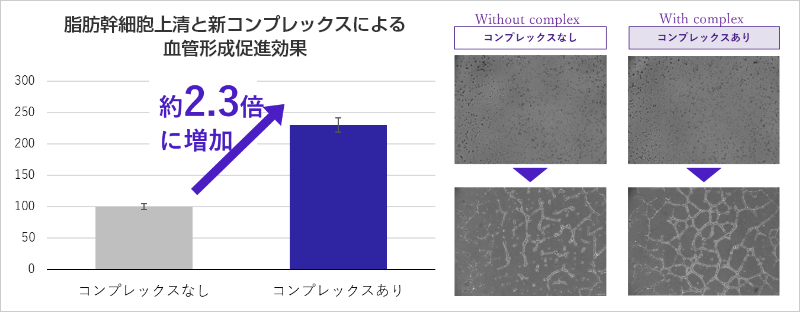
In the field of Regenerative medicine, the regeneration of capillaries by stem cells is attracting attention. Focusing on the vascular regeneration ability of adipose-derived stem cells that exist in our own bodies, we screened numerous cosmetic ingredients and found that a complex of bilberry leaf extract, royal jelly extract, and sodium dextran sulfate has the effect of promoting angiogenesis and suppressing the reduction of blood vessels.
Return to the list of case studies
An approach to the orbicularis oculi muscle that changes the appearance around the eyes.
Leveraging our experience in developing eye drops, we are also engaged in research on the orbicularis oculi muscle, which plays a crucial role in the appearance of the eye area.
-
Inhibitory effect of a complex consisting of indigo leaf/stem extract and phellodendron bark extract on the production of myostatin, a skeletal muscle growth inhibitor.
-
Inhibitory effect of a complex consisting of indigo leaf/stem extract and phellodendron bark extract on the production of the muscle atrophy factor Atrogin-1.
The orbicularis oculi muscle is involved in blinking and eyelid closing, and also affects the shape and appearance of the eyes. We searched for materials that act on muscle satellite cells necessary for maintaining and regenerating the orbicularis oculi muscle, and after screening hundreds of materials, we found a plant extract that is optimal for promoting proliferation.
The skin around the eyes is thin, and the effects of aging are easily visible in this area. By focusing on the "internal structure" of the muscles, we aim to create value in new skincare that goes beyond just the surface, and in addressing frailty related to the eyes.
Return to the list of case studies
Untangling frizzy hair with "science"
Discovering the potential of new materials from the internal structure of hair
As we age, our hair texture changes, and we become concerned about frizz and volume... Many women experience this problem, and it's related to a "distortion" in the internal structure of the hair. To scientifically elucidate the cause of this frizz, Rohto Pharmaceutical focused on "Intermediate Filament (IF)," the fine fibers that make up hair.
Using the large synchrotron radiation facility SPring-8, we conducted micro-level analysis of hair with strong waves and hair treated with Tostea (diammonium aminoethylthiosuccinate). We confirmed that the treatment reduced twisting and disorder in the IF (internal fiber). In other words, we elucidated part of the mechanism by which Tostea directly acts on distortions within the hair, thereby smoothing out waves.
Furthermore, we compared hair before and after treatment using a microscope and confirmed that the waviness was improved even at a macroscopic level, such as the appearance of the hair surface.
This research represents a first step in opening up new possibilities in hair care, not only improving the appearance of hair but also controlling its shape from within. Rohto Pharmaceutical will continue to scientifically analyze the functions of materials and conduct research to address hair aging concerns.
Return to the list of case studies
Development of techniques for effectively utilizing materials
We continue to explore the potential of hyaluronic acid in skincare.
Since launching "Hada Labo®" in 2004, Rohto Pharmaceutical has been exploring the potential of hyaluronic acid from both a raw material and formulation perspective. Hyaluronic acid comes in a variety of raw materials with differences in molecular weight and chemical modification, and we carefully assess their characteristics to design formulations that maximize moisture through the optimal combination.
Furthermore, we have developed our own unique materials, such as the ultra-low molecular weight oligo-hyaluronic acid tetrasaccharide "HA4" and "lactic acid fermented hyaluronic acid (lactic acid bacteria/hyaluronic acid fermentation liquid)" obtained by fermentation with lactic acid bacteria, in collaboration with universities and material manufacturers, and have discovered unique functions such as anti-photoaging and antibacterial properties.
By handling everything from material development and functional analysis to product application, we continue to expand the value of hyaluronic acid.
Return to the list of case studies
Exploring the reasons why hyaluronic acid lotions feel "comfortable"
"Gokujun Hyaluronic Acid Lotion" has been popular for its pleasant feel, but the reasons for this could not be fully captured by surveys alone. Therefore, we divided users into groups that felt positively about the product and those that did not, and evaluated potential changes in their perceptions during use using electroencephalography, cerebral blood flow, and heart rate.
The results showed that in the group that preferred the product, beta waves in the brain decreased during application, indicating a state close to relaxation, and increased cerebral blood flow suggested that they were able to concentrate on the product's feel.
Furthermore, the parasympathetic nervous system index HF increased in the latter half of the application process, suggesting that a feeling of comfort may be generated as the product absorbs into the skin. The value of skincare lies not only in its effectiveness but also in the experience that makes you want to continue using it.
We scientifically visualize "comfort" and use that to create products that balance effectiveness and usability.
Return to the list of case studies
A technology that delivers unstable pure vitamin C stably deep into the skin.
Pure vitamin C (L-ascorbic acid) is an essential component for collagen production and possesses diverse effects such as anti-inflammatory, anti-aging, and antioxidant properties, with its effects known to increase in a concentration-dependent manner. However, it is sensitive to light, heat, and air, making it difficult to incorporate at high concentrations in a stable manner.
Rohto Pharmaceutical has developed its own unique formulation technology to deliver more of this difficult-to-handle pure vitamin C to the skin. After successfully stabilizing a high concentration of ascorbic acid at 25%, they continued their research and discovered a combination of dimethyl isosorbide, a solvent that stably dissolves ascorbic acid at high concentrations and spreads its penetration into the skin over a wide area, and a specific ascorbic acid derivative.
Furthermore, it has been revealed that iris root extract enhances the intracellular uptake of ascorbic acid.
Return to the list of case studies
To make retinol accessible to more people
Retinol is a fat-soluble vitamin A that has attracted attention in anti-aging care due to its high effectiveness. However, despite its high efficacy, it has had the drawback of causing irritation (the so-called "A reaction": redness, peeling, dryness, etc.).
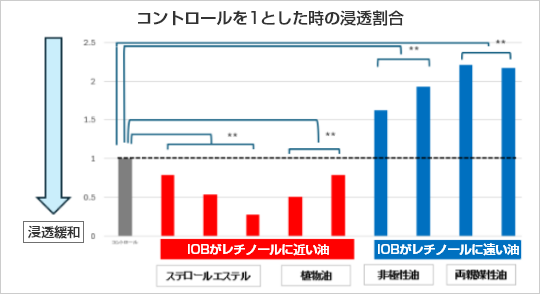
Evaluation results of the IOB of the ingredients and the penetration rate of retinol
To suppress the A reaction, we developed a technology to control the penetration of retinol. In our research, we confirmed using a three-dimensional artificial skin model that the penetration rate can be mitigated by combining retinol with oils that have a similar "IOB (Inorganic-Organic Balance)" value, which is calculated from the inorganic-organic ratio of oils. With formulations that controlled the penetration rate, improvement in wrinkles around the eyes was observed, and no major skin problems were observed during the period of use.
This technology has shown the potential to achieve both "effectiveness" and "safety for use" in retinol-containing formulations.
Return to the list of case studies
We are working to deepen our odor care.
As we listened to our customers' concerns, we realized that body odor associated with aging is a deep-seated problem for both men and women.
2-nonenal, the cause of age-related body odor, is difficult to wash off with water alone and has the characteristic of being strongly noticeable even in small amounts. Research has revealed that there are ingredients in shampoos and other hair washing products that suppress or promote the adsorption of 2-nonenal to the hair.
Based on the knowledge gained from previous odor research, we conducted further research on women and found that women in their teens and twenties have a strong sweet scent, and that this scent is due to a component called lactone C10/lactone C11, which is lost with age.
Furthermore, we discovered that prelactone (sodium 4-hydroxyundecanoate), an odorless precursor to lactone, transforms into lactone on human skin.
We discovered that this prelactone not only enhances "fragrance," but also significantly increases the amount of lactone by coexisting with the sour, pungent "unpleasant odors" that contribute to odor problems.
Return to the list of case studies