Our Approach to Human Rights
The Rohto Group aims to realize a well-being society, expanding its business not only in Japan but around the world. Respect for human rights is the foundation of all business activities. Recognizing that human rights may be directly or indirectly impacted in the course of its business, the Group supports and respects international human rights standards, such as the United Nations' International Bill of Human Rights and the International Labour Organization's (ILO) Declaration on Fundamental Principles and Rights at Work, as well as treaties on workers' rights, including those regarding wages and working hours, and the OECD Guidelines for Multinational Enterprises. In pharmaceutical research and development activities, the Group respects and protects the human rights of patients and research subjects in accordance with the Ethical Principles for Medical Research Involving Human Subjects (Declaration of Helsinki).
By establishing the Rohto Group Human Rights Policy and promoting human rights initiatives throughout the group, we will contribute to the realization of a sustainable, well-being society.
Human Rights Due Diligence
In 2022, the Group formulated its Human Rights Policy based on the United Nations Guiding Principles on Business and Human Rights (UNGPs). Based on this policy, we have established a human rights due diligence system to ensure respect for the human rights of all stakeholders. Since fiscal 2023, we have been conducting ongoing human rights risk assessments through supplier CSR surveys. Furthermore, in fiscal 2024, we led a due diligence survey targeting Rohto Pharmaceutical, domestic Group companies, and Group companies in priority regions overseas, using desktop surveys, questionnaires, and interviews to identify and prevent/mitigate adverse human rights impacts in the Group's business activities and value chain. Based on this survey, we created a human rights risk map (see "Human Rights Impact Assessment (FY2024)" below for details). Going forward, we will continue to promote human rights due diligence efforts and, based on our well-being management philosophy, strive to create a work environment where diverse human resources can maximize their potential.
Human Rights Due Diligence Promotion System and Process
Our group promotes sustainability-related initiatives, including respect for human rights, primarily through our Sustainability Committee. The overall plan regarding respect for human rights and identified significant human rights violation risks are reported to and discussed by the Sustainability Committee, which is the decision-making body for sustainability management issues, and the results are then reported to the Board of Directors.
The process begins with identifying and assessing human rights risks. This is done through risk extraction and quantitative and qualitative analysis. The findings are shared with the Sustainability Committee and the Board of Directors to identify issues that require particular priority. For these priority issues, preventive and corrective measures are considered and implemented, and their progress is tracked and monitored.
From fiscal year 2024 to 2025, we conducted a human rights risk assessment covering the entire group, completing the assessment for approximately 99% of our sales and over 90% of our employees. As a result, we have identified human rights issues that our group should prioritize, and no new significant human rights risks have been identified at this time.
Currently, we are moving into a phase of addressing differences in the maturity of initiatives across companies and standardizing implementation. In particular, we are focusing on standardizing human rights due diligence in the supply chain, expanding its application to service suppliers, establishing external reporting channels, promoting diversity (SOGI and disability), and addressing human rights risks associated with the use of AI.
Furthermore, the progress of these activities will be regularly reviewed and discussed by the Sustainability Committee and the Board of Directors. Through this process, we will continue our efforts to further mitigate human rights risks and report and disclose our progress and results both internally and externally.
Details regarding the scope, methodology, and results of the human rights impact assessment conducted based on this process are described below in "Human Rights Impact Assessment".
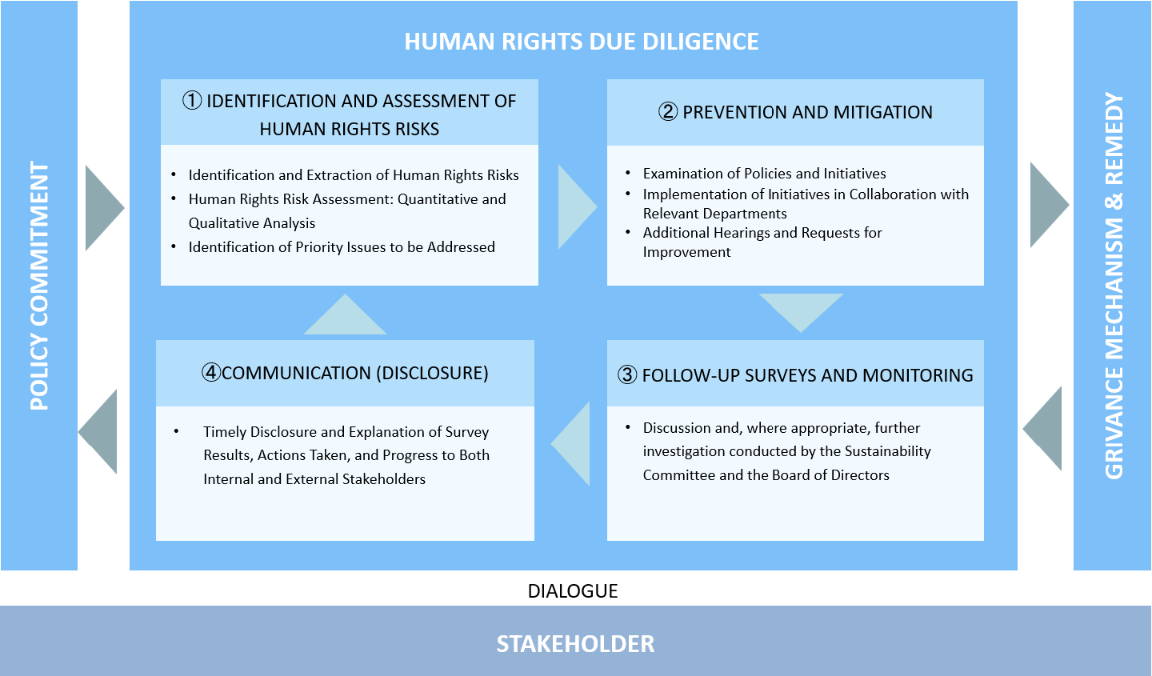
Human Rights Due Diligence Process
Assessment of impact on human rights (to be conducted in FY2024-2025)
1. Scope: Consideration of the overall picture and due diligence method
Based on various guidelines and desktop research, the Group has organized its business activities into the following four categories, considered how to proceed with identifying human rights risks for each category, and established the scope of the activities.
- (1) Our company alone, (2) Domestic Group: The survey covered the entire value chain, including research and development, procurement, manufacturing, logistics, sales (marketing), and consumption.
- 3) Overseas Group: Based on international reports and surveys on human rights, such as the CPI Corruption Perceptions Index and the U.S. Department of State Country Reports on Human Rights Practices, we prioritized regions with high risks to our business activities.
- ④Suppliers (domestic): Starting in fiscal 2023, we will include a human rights item in the CSR questionnaire survey and conduct an annual review.
Supplier CSR Assessment
2. Identifying, extracting, and assessing human rights issues (risks) (quantitative and qualitative analysis)
To identify human rights risks, we conducted questionnaire surveys, interviews, and research using external reports, etc.
The next step was to carry out a risk assessment.
-
Desktop Survey
We conducted a wide-ranging survey of human rights issues both in Japan and overseas based on international norms, industry trends (manufacturing, pharmaceuticals, cosmetics), and regional human rights risk indexes.In Japan, we identified human rights issues in light of international human rights standards and considered specific cases that may arise within the company.
-
Conducting surveys and interviews
- Japan (1, 2): We conducted a human rights risk survey and interviews with all division heads and managers, as well as 13 domestic group companies.
- Overseas (3): Based on the information obtained from the desktop survey, we selected regions considered to be high risk (Asia, Africa, Brazil, etc.) and grasped the actual situation through interviews with local managers.
3. Identifying and analyzing issues
Based on these survey results, we identified human rights issues that could affect rights holders. We created a risk map by checking the "impact (severity) on human rights" and the likelihood of occurrence of the issues identified for each rights holder. We are considering initiatives and implementing measures for the priority issues (risks) identified from these surveys.
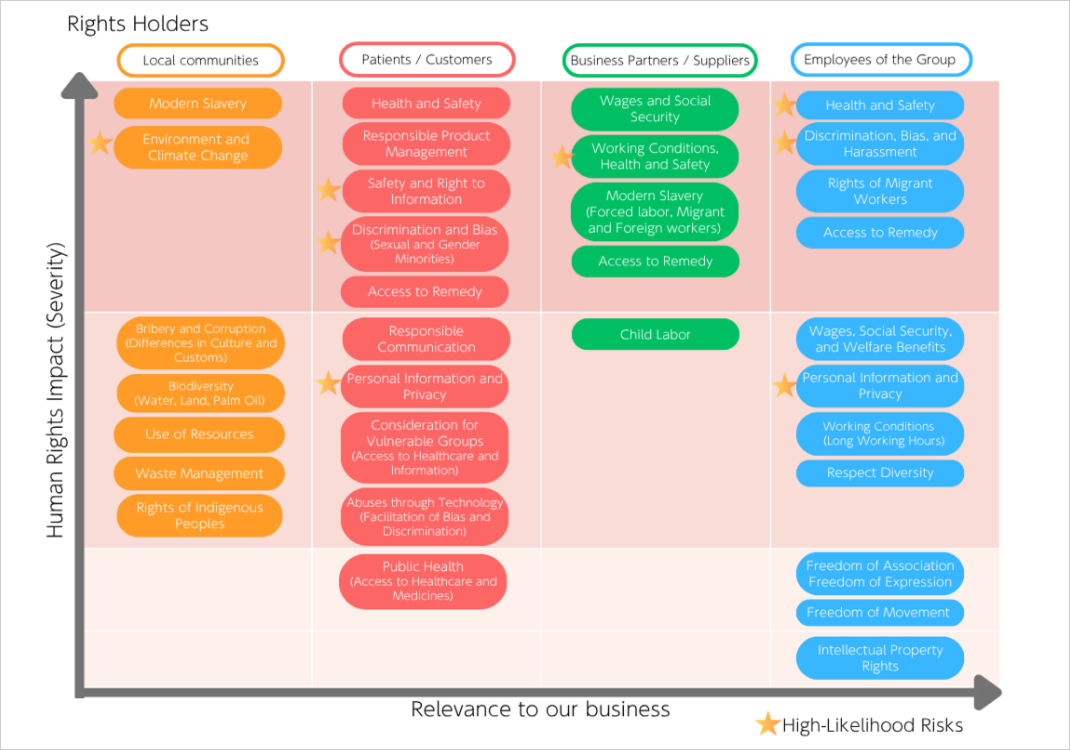
Human Rights Risk Map
4. Evaluation results and future actions
In fiscal year 2025, based on the evaluation results to date, we expanded the scope of our human rights risk assessment and enhanced its capabilities. As a result, we have completed the assessment covering approximately 99% of the group's total sales and over 90% of its employees.
Based on this assessment, we have identified human rights issues that our group should prioritize addressing, and no new significant human rights risks have been identified at this time.
On the other hand, it has been confirmed that there are differences in the maturity of the initiatives among the group companies, and we are now moving into a phase of resolving these differences and standardizing implementation.
Specifically, we are focusing on standardizing human rights due diligence in the supply chain, expanding its application to service suppliers, developing redress mechanisms available to external stakeholders, promoting diversity, and addressing human rights risks associated with the use of AI.
Addressing priority issues (risks)
Based on the results of the human rights impact assessment, we have identified the following human rights issues that our group should prioritize. Based on the survey results, and referring to international human rights standards (UNGPs), industry trends, and external research reports, we have categorized rights holders into four groups: "local communities," "customers and patients," "business partners and suppliers," and "our group employees." For each area, we re-evaluated the human rights issues extracted from three perspectives: "severity," "relevance to our group," and "likelihood of occurrence." As a result of mapping, we identified items that were high in all three of these elements as "priority issues." For the identified priority issues, we are verifying the effectiveness of existing initiatives and organizing themes that should be strengthened in the future.
As a result, the Group has identified the following seven priority issues, which have been organized into 11 issues by rights holder.
- The health and safety of our customers and patients
- Discrimination, Prejudice, and Gender Minorities
- Personal Information and Privacy
- Prevention of modern slavery and forced labor
- Environment and climate change (including human rights impacts)
- "Workstyle, Health, Safety and Hygiene" in the Group's Supply Chain
- Access to Remedies/Reporting Mechanisms
Furthermore, no new significant human rights risks were identified in this assessment.
On the other hand, a review of the progress each group company is making on these priority issues revealed that while some progress has been made, there are differences in the maturity level of implementation. Currently, we are promoting measures to eliminate these differences and standardize the efforts.
Based on this understanding of the challenges, we are focusing our efforts on themes of particular importance. For example, we recognize the prevention of modern slavery and forced labor as one of the most important human rights issues globally, and we are working to enhance risk assessment and management in our supply chains throughout our company and group companies both domestically and internationally. We have also formulated a group-wide "Statement on Modern Slavery" and are continuously promoting efforts to improve the effectiveness of our group-wide response, taking into account the results of surveys based on the actual situation at our locations in each country.
Furthermore, in terms of the health and safety of our group employees, in addition to Promotion of Chemical Safety, we are working to establish a safety culture throughout our business activities and strengthen the foundation for preventing occupational accidents. In addition, regarding access to remedies common to all rights holders, we are focusing on improving the effectiveness and thorough dissemination of our reporting system and are working to improve it throughout the group.
For these initiatives, we have clearly defined the implementing body, responsible department, and KPIs, and we continuously monitor their progress. Furthermore, in our business activities in each region, we also consider local employment and coexistence with local communities.
Furthermore, we are enhancing our efforts by continuing dialogue with stakeholders, regularly reviewing our policies, systems, and training, and operating a continuous improvement cycle (Plan-Do-Check-Act) based on frameworks such as UNGPs and GRI Standards. Our group is committed to promoting consistent respect for human rights throughout the company and is striving to strengthen mechanisms to prevent and mitigate negative impacts on human rights through our business activities.
*Please see the PDF for details.
Our System for Governance
Human rights initiatives are promoted under the oversight of the Sustainability Committee. Key human rights issues and the status of human rights due diligence are regularly reported to and discussed by the Committee, and the results are reported to and overseen by the Board of Directors.
Furthermore, headquarters functions work together to promote and monitor initiatives at each group company. Each location adapts its operations to its specific business and regional characteristics while striving to standardize operations based on group policies.
Stakeholder Engagement
Our group places great importance on dialogue with key stakeholders when addressing human rights issues.
- Employees: Implementation of human rights and harassment training (100% participation rate)
- Suppliers: Risk assessment through research and dialogue on CSR procurement.
- Local communities and external organizations: Involvement through social contribution activities and collaborative projects.
The insights gained through these dialogues are reflected in human rights risk assessments, the identification of priority issues, and the review of policies.
Complaint handling and relief
Our group has established reporting and consultation channels to promptly identify and appropriately address human rights concerns. These channels are available to employees as well as stakeholders such as business partners, and we strictly enforce anonymity, confidentiality of whistleblowers, and a prohibition against any adverse treatment of whistleblowers. Furthermore, these channels are accessible from outside the company through our website and other means.
Furthermore, we will work to improve accessibility by developing mechanisms that can be used by a wider range of external stakeholders, including local communities.
If negative impacts on human rights are identified, we will work to rectify and remedy them through dialogue and appropriate procedures.
Furthermore, we investigate and respond to reports based on appropriate procedures and utilize the information to make improvements to prevent recurrence.
While no cases constituting serious human rights violations were identified during the reporting period, we will continue to strive for early identification of risks and appropriate responses through our reporting and consultation services.
Education/penetration
Our group conducts compliance training for all employees with the aim of promoting respect for human rights, and this training covers topics related to human rights (prevention of Discrimination / Harassment, working environment, consideration of human rights in the supply chain, etc.).
This training program is conducted at different levels, aiming to foster a sense of responsibility and values appropriate to the roles of managers and general employees. In addition, we continuously provide education to all employees through training and testing to deepen their understanding of the importance of legal compliance and our company's systems.
Furthermore, with the aim of promoting understanding of compliance and raising awareness of consultation and reporting channels, we distribute the "ROHTO Group Compliance Code of Conduct" to all employees and strive to increase awareness of the reporting system.
Furthermore, drug-induced harm education, which was previously conducted mainly by relevant departments, has now been expanded to include all employees as part of compliance training, and efforts are being made to promote understanding of human rights issues related to products and services.
Going forward, we will expand specialized training programs targeting specific departments and levels, such as procurement and management, and work to eliminate differences in the maturity of initiatives across group companies, aiming to further promote human rights respect.
Main initiatives related to human rights
Based on the "Rohto Group Human Rights Policy," our group places respect for human rights at the foundation of all our business activities. Furthermore, the "ROHTO Group Compliance Code of Conduct" stipulates that we respect the human rights of our employees and business partners and act responsibly as members of society.
In our supply chain, we promote sustainable procurement that respects human rights, based on the "Rohto Group CSR Procurement Guidelines." We are also a member of the RSPO (Roundtable on Sustainable Palm Oil) and are committed to procuring raw materials that respect human rights and the environment.
Preventing modern slavery and forced labor
Our group has formulated and published the "Rohto Group Statement on Modern Slavery," and our offices in each country also disclose Modern Slavery Statements in accordance with the law.