The Rohto Group recognizes that harmonizing global warming prevention with the natural environment is one of the important management challenges in achieving both business growth and the realization of a sustainable society. We support the Japanese government's goal of net-zero emissions by 2050 and the agreements of the Paris Agreement. In June 2021, we expressed our support for the recommendations of Task Force on Climate-related Financial Disclosures(TCFD) and are registered as a TCFD supporter. Furthermore, we are striving to actively participate in international climate-related initiatives, such as disclosing information on climate change through CDP. Moving forward, based on the TCFD recommendations, we will further promote information disclosure to stakeholders regarding the "risks" and "opportunities" that climate change presents to our business from four perspectives: "governance," "strategy," "risk management," and "indicators and targets."
In addition, we will establish a "Climate Change Policy" in 2025 and actively address climate change across the entire group.
Governance
We established a Sustainability Committee in September 2021 to discuss risks and opportunities related to climate change, decide on action policies, and deploy those policies throughout the Group. The Board of Directors receives reports on the details of these discussions and deliberations, and considers disclosure and dialogue with stakeholders, long-term capital expenditure plans, and other aspects of the Group's response to climate change, as well as overseeing their implementation.
The Sustainability Committee is composed of two directors and one Outside Audit & Supervisory Board Member as an advisor, and is chaired by the Executive Vice President Executive Vice President who also serves as the Group's Chief Financial Officer (CFO), and is responsible for evaluating and managing environmental issues as financial issues.
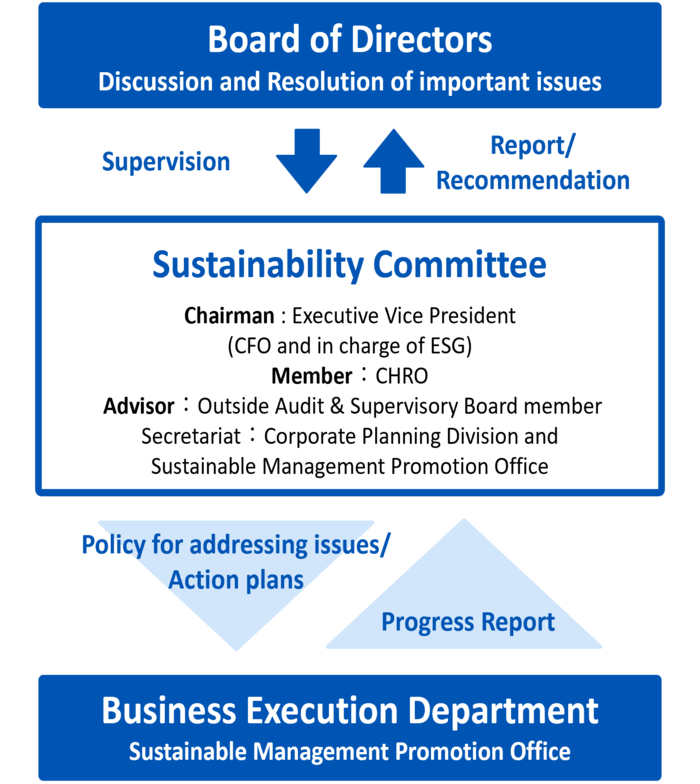
Strategy
We evaluated the impact of climate change-related risks and opportunities on our business, focusing primarily on financial impacts. We have local development and production bases in major countries where we do business, and have built a system that is resilient to value chain disruptions caused by climate change. In our scenario analysis, we considered the impact of both a 1.5°C/2°C scenario and a 4°C scenario, taking into account multiple scenarios published by the Intergovernmental Panel Intergovernmental Panel on Climate Change (IPCC), integrating our major global bases, including Japan, China, Vietnam, and the United States.
Based on the classification defined by the TCFD (transition risks, physical risks, and opportunities), we have considered the potential impact of climate change on our business and current responses. We will continue to conduct analysis and evaluation, consider countermeasures for a variety of scenarios, and increase our resilience in the face of an uncertain future.
Future Scenarios
| 1.5℃/2℃ scenario |
Increasing global demand for decarbonization has led to the introduction of a carbon tax and strengthened regulations on fossil fuel-derived materials, including plastics. This has led to a shift in corporate activities to be more environmentally conscious, such as sourcing raw materials and packaging produced through decarbonized processes and using renewable energy. |
| Changing consumer and retailer preferences are driving demand for the trading and sale of products produced using low-carbon manufacturing methods and sustainably sourced goods. |
| 4°C scenario |
As natural disasters such as typhoons caused by abnormal weather become more severe, the risk of damage caused by wind and floods that exceeds expectations increases. |
| Changes in the environment and ecosystems due to intensifying natural disasters and rising temperatures will increase the risk of reduced resource production and harvests, which will increase the risk of raw materials being depleted and infectious diseases being spread. |
| Increased UV rays and temperature changes are deteriorating QOL, increasing demand for healthcare products that meet QOL needs. |
*If the right edge of the table is cut off, please scroll horizontally to check.
Transition Risks and Opportunities in Decarbonized Society and Responses to Risks and Opportunities
| Risk Items |
Business Impact |
Impact |
Responding to risks and opportunities |
| Major classification |
Minor classification |
1.5℃ / 2℃ |
4℃ |
| policy/regulation |
Introduction of a carbon tax |
Risk of increased factory operating costs and transportation costs due to the introduction of carbon taxes in various countries around the world |
Medium |
- |
・We have set targets for reducing Scope 1 and 2 emissions and are promoting reduction activities. |
| Introduction of regulations limiting CO2 emissions (restrictions and taxes on the use of plastics and petroleum-derived materials, etc.) |
Risk of increased procurement costs due to regulations and mandates on the use of recycled materials |
Medium |
- |
・Reducing plastic usage and increasing the use of recycled materials
- Simplifying and lightening containers and packaging
・Change to containers made from recycled materials |
| Mandatory use of renewable energy and increased use |
Risk of rising energy procurement costs due to rising electricity prices associated with switching to renewable energy sources |
Medium |
Medium |
・Setting targets for reducing energy consumption and promoting reductions
・Promoting a switch to renewable energy and investment in environmentally friendly equipment |
| market |
Rising raw material prices |
Risk of rising raw material procurement prices due to a global shortage of environmentally friendly raw materials and the imposition of a carbon tax, which is passed on to raw material prices. |
Medium |
large |
- Consideration of decentralized procurement and alternative raw materials and assessment of their impact on quality |
*If the right edge of the table is cut off, please scroll horizontally to check.
Physical Risks, Opportunities, and Responses
| Risk Items |
Business Impact |
Impact |
Responding to risks and opportunities |
| Major classification |
Minor classification |
1.5℃ / 2℃ |
4℃ |
| chronic |
Rising average temperatures |
Risk of rising procurement costs due to factors such as shortages in the supply of natural raw materials |
Medium |
Medium |
- Consideration of decentralized procurement and alternative raw materials and assessment of their impact on quality |
| Growing needs for UV protection products such as sunscreen and anti-blemish products. Also, sales growth (opportunity) due to the prolonged peak demand period of the year. |
Medium |
large |
・Promoting technological development in sunscreen
・Consider developing countermeasure products, including cosmetics and oral medications |
| Rising sea levels |
Risk of flooding of factories and offices at low altitudes, including suppliers, resulting in severe impacts such as suspension of operations. |
small |
small |
・At present, there is no impact on our group's bases.
・Make efforts to understand the situation of business partners |
| Water shortages |
If groundwater depletion in production areas that use groundwater makes it difficult to use water, restrictions on water intake and discharge may be imposed and procurement costs may increase, resulting in production restrictions and increased costs (risk). |
Medium |
Medium |
・Promote quantitative understanding of water usage
- Promoting efficient use of water resources |
| acute |
Suspension of production and distribution functions due to natural disasters |
Risk of supply chain disruptions causing procurement and supply to stop, resulting in lost sales opportunities and reduced revenues |
large |
large |
・Reviewing BCP ・Promoting decentralized procurement and optimizing inventory levels
・Close cooperation with suppliers and distributors |
| market |
Changes in consumer needs and behavior |
Opportunities: Increased sales due to growing demand for environmentally friendly products and improved market recognition for a company's environmental friendliness |
Medium |
Medium |
・Developing products that take into consideration the impact on the environment and ecosystem
・Development of environmental impact assessment indicators in collaboration with external assessment organizations |
*If the right edge of the table is cut off, please scroll horizontally to check.
Risk Management
1) Process for identifying and assessing climate-related risks
In accordance with the framework proposed by the TCFD, we predict changes in the external environment and, taking into account our resources and the services we provide, identify the impact of climate change on our business through our Sustainability Committee.
2) Process for managing climate-related risks
The Sustainability Committee manages identified risks and discusses how to respond. If necessary, the committee convenes the responsible persons of the relevant departments to confirm and flexibly implement more specific measures.
3) A system for integrating the above processes into our comprehensive risk management
The Sustainability Committee will evaluate and manage all factors that comprehensively affect the continuity of our business, including risks other than environmental issues. Depending on the case, we will also consult with Risk and Compliance Committee, chaired by President and Representative Director, to formulate a Business Continuity Plan (BCP).
Metrics and targets
Our company has set a target of reducing Scope 1 and 2 CO2 emissions by -46% compared to FY2013 levels by 2030, and we are taking action to achieve this. In FY2025, CO2 emissions for Scope 1 and 2 combined amounted to 9,331 tons (- 41.0% reduction compared to FY2013), achieving our interim target of a 30.0% reduction. From FY2025, we began calculating CO₂ emissions (Scope 1 and 2) for the entire group, and the emissions for FY2025 amounted to 66,413 tons of CO₂. We will continue to aim for reductions across the entire group.