The Rohto Group conducts its business activities by utilizing the valuable natural resources that biodiversity provides. It is our important responsibility to conduct business activities in a way that ensures an environment where various living things can coexist.
Our group recognizes that our business activities depend on and impact biodiversity, and we are promoting risk management in water resource use and raw material procurement.
Under our biodiversity conservation policy, the entire group, in cooperation with all stakeholders, will fulfill its social responsibility regarding biodiversity and contribute to the realization of a sustainable society.
Biodiversity Conservation Policy
The Group recognizes that all of its business activities benefit from and have an impact on the natural environment, and will strive to live in harmony with the natural environment and to conserve biodiversity for a sustainable society.
- We will strive to understand how our business activities relate to and impact biodiversity, and work to avoid or minimize the impact.
- We will strive to conduct our business activities in a manner that takes into consideration the ecosystems of the regions in which we operate.
- We will strive to preserve the environment by promoting the development of products and technologies that take biodiversity into consideration.
- We will strive to raise employee awareness of biodiversity and support and promote environmental preservation activities through cooperation and partnerships with a variety of related stakeholders.
- We will comply with national and international agreements and laws regarding biodiversity.
Response based on Taskforce on Nature-related Financial Disclosures (TNFD)
The Group supports the "nature positive" approach based on the Kunming-Montreal Biodiversity Framework, a global goal for 2030 adopted at the 15th Conference of the Parties to the Convention on Biological Nature Positive) held in December 2022. In April 2025, we expressed our support for the final recommendations (v1.0) of Taskforce on Nature-related Financial Disclosures (TNFD) and registered as a TNFD Adopter.
Information disclosure and governance regarding natural capital and biodiversity
Based on the recommendations of Taskforce on Nature-related Financial Disclosures (TNFD), the Group has begun efforts to disclose information to stakeholders from the four perspectives of "governance," "strategy," "risk and impact management," and "metrics and targets." Aiming to live in harmony with the natural environment and to realize a sustainable society, the entire Group will continue to work on biodiversity conservation.
In addition, we established a Sustainability Committee in September 2021 to discuss risks and opportunities related to climate change and natural capital, decide on action policies, and put in place a system to roll out those policies throughout the Group. The Board of Directors receives reports on the details of these discussions and deliberations, discloses information to and engages with stakeholders regarding the Group's response to climate change and natural capital, considers capital expenditure plans from a long-term perspective, and has established a system to oversee the implementation stage.
Strategy (Implementation of evaluation based on the TNFD framework)
The Group considers the dependence and impact of its business activities on natural capital, as well as the risks and opportunities arising from them, while also considering their financial impact. Based on the concept of double materiality, the Group grasps both the impact of nature-related issues on the Group's business activities (financial materiality) and the impact of its business activities on the natural environment (impact materiality), and conducts systematic assessments in accordance with the scoping and LEAP approach recommended by the TNFD.
*LEAP approach: A method for systematically identifying and assessing nature-related risks and opportunities, consisting of four phases: Locate, Evaluate, Assess, and Prepare.
1. Scoping (clarification of the analysis target)
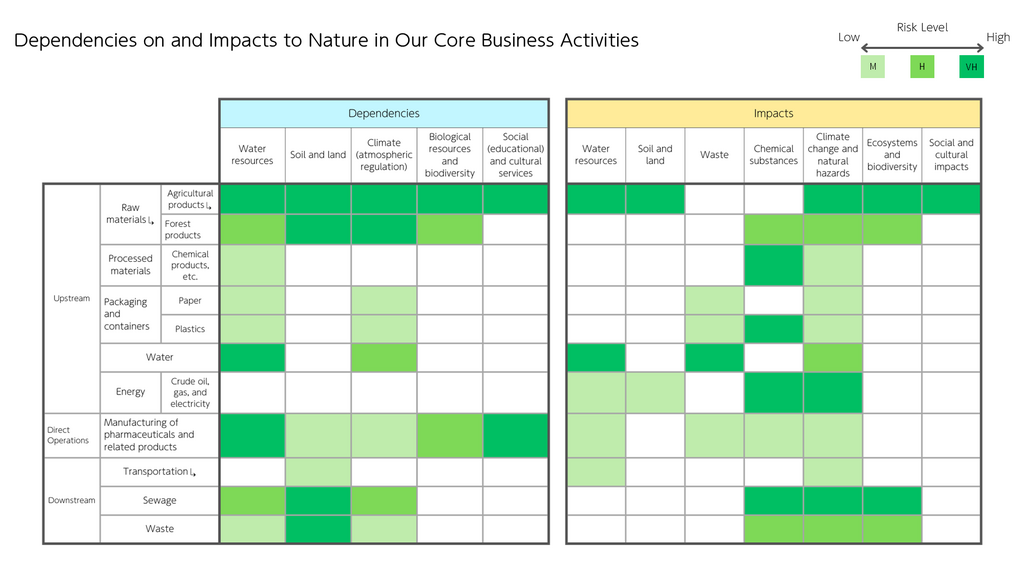
The Group recognizes that its business activities depend on and have an impact on natural capital throughout the entire supply chain. Using the risk assessment tool "ENCORE" recommended by the TNFD, the Group has analyzed the relationship with natural capital in each of the upstream (raw material procurement, etc.), direct operations, and downstream (disposal and distribution) stages of the value chain related to pharmaceuticals and cosmetics, which are its main businesses, and identified important elements in terms of both dependency on and impact on nature.

The analysis revealed that our upstream operations are highly dependent on plant-based raw materials (particularly paper and palm oil) and water resources, while our direct operations and downstream operations have relatively large dependence on and impacts on water resources. We focused on and prioritized our analysis on wastewater and waste management associated with our direct operations, which we believe has a significant impact on natural capital and is directly manageable and can be improved by us. We currently exclude downstream customer use and product disposal from our analysis due to data availability and manageability, and have positioned these as areas for future consideration in the monitoring and assessment phases. Furthermore, given the importance of palm oil to our upstream raw material procurement, given its significant impact on ecosystems and the social issues it poses, we are continuing to address this as a priority risk theme in our raw material procurement.
Through these assessments, the Group has positioned "Water Resources (Upstream, Direct Operations, Downstream)" and "Palm Oil (Upstream)" as the most important themes, and will continue to address them as the core of its future TNFD response and risk management policies.
2. LEAP:
Our group conducts a biodiversity dependency and impact assessment (LE) based on the TNFD's LEAP approach. Based on the results, we conduct a risk analysis regarding water resources and raw material procurement (palm oil, etc.), and are currently developing and implementing countermeasures (AP). In addition, we are considering setting key performance indicators (KPIs) and targets based on the assessment results, and will gradually expand disclosure in the future.
water resources
[Locate & Evaluate] Discover your connection with nature and assess your dependency and impact
The Group is highly dependent on water resources in its business activities, and is aware that operations and wastewater discharges may have a certain impact on the local water environment. Due to the nature of our business as a manufacturing company, water is an essential resource for processes such as production, cleaning, and cooling, and stable water use and harmony with the local community are among the most important factors for our business continuity. For this reason, we conducted an assessment taking into consideration both the financial impact (dependence) and the impact on the natural environment (impact).
The analysis used two international assessment tools, the WWF Water Risk Filter and the Integrated Biodiversity Assessment Tool (IBAT), to quantitatively assess all 27 of the Group's production sites from the perspectives of both water resource dependency and impact risk.
The target regions are diverse, mainly in Asia (Japan, China, Hong Kong, Vietnam, Malaysia, Indonesia), but also in Europe (Austria, Poland, UK), North and South America (USA, Brazil), Oceania, and Africa.
The analysis showed that the overall risk distribution was "Low to Medium," with no high-risk locations identified. However, eight locations (25% of the total) were classified as medium risk: Hong Kong, Tianjin, Brazil, Indonesia, Vietnam (two companies), Austria, and Japan (Mita).
Going forward, we will identify high-risk items such as floods, droughts, and water quality, focusing on medium-risk sites, and will improve the accuracy of risk assessments through on-site environmental surveys and interviews with local personnel. Based on the results of these on-site inspections, we will organize the impact on business and finances and the likelihood of occurrence, and use this to formulate risk management policies and improvement measures in the assess phase.
- Supplementary information: Analysis method and score calculation method
- The WWF Water Risk Filter uses the following two indicators for assessment:
・Basin score: Physical, regulatory and reputational risks in the basin (dependence risk)
・Scape score: Ecosystem, land use, and biodiversity risks (impact risks)
- The WWF overall score is calculated by combining Basin with a weighting of 0.6 and Scape with a weighting of 0.4.
- Complementary information on geographical risk, such as protected areas, Important Biodiversity Areas (KBAs), and endangered species distribution, is reflected in the Integrated Biodiversity Assessment Tool (IBAT).
- The final composite score is calculated by assigning a weight of 0.8 to the WWF overall score and a weight of 0.2 to the IBAT score.
- Integrated score classification: High (3.0 or above) / Medium (2.5-2.99) / Low (2.49 or below)
- Tools used
- WWF Water Risk Filter, WWF Bioddiversity Risk Filter
- IBAT
Palm oil
[Locate & Evaluate] Discover your connection with nature and assess your dependency and impact
Among the raw materials procured in the upstream value chain, the Group positions palm oil as a raw material that is highly dependent on natural capital and has a large impact.
Palm oil is used in many products, and while supply depends on the stability of raw material procurement, there are concerns about the impact on nature and society during the procurement process, including deforestation, loss of biodiversity, and human rights issues.For this reason, based on the TNFD's LEAP approach, we identified and assessed our contact points with nature and related risks from the perspectives of both dependency and impact.
First, in Locate (identifying points of contact with nature), we identified the country of origin and annual procurement volume of palm oil for Rohto Pharmaceutical itself.
The results confirmed that approximately 70% of the product comes from Malaysia, approximately 20% from Indonesia, and approximately 10% from other countries, indicating a high degree of dependence on both countries.
These regions are particularly important raw material supply areas for the Group in terms of forest resources and biodiversity.
Next, in the Evaluate (assessment of dependency and impact) stage, we used the WWF Water Risk Filter analytical tool to identify eight regions—four major regions each in Malaysia and Indonesia, major palm oil producing countries—based on official statistics and related reports, and analyzed nature-related risks in each region. Water resource risks (Basin Physical/Regulatory/Reputational) and forest/biodiversity risks (Scape Physical/Reputational) were combined to calculate an overall score for each region. As a result, seven of the eight target regions were judged to be at a "high risk" level (score of 3.0 or above). Complex nature-related risks, such as deforestation, peatland development, and water stress, were particularly prominent in Indonesia (Riau and Kalimantan provinces) and Malaysia (Johor and Sarawak states).
Our Group joined Roundtable on Sustainable Palm Oil (RSPO) in June 2024 and is working to procure sustainable palm oil in line with the RSPO philosophy. Going forward, we plan to conduct interviews with Group companies that use palm oil regarding their procurement practices and management systems, and to improve traceability at local suppliers and understand the actual environmental and human rights risks.
We have positioned Malaysia and Indonesia as priority regions, and through on-site surveys and dialogue, we aim to balance business activities with the conservation of local ecosystems. In addition, as our group has been doing business in Indonesia for nearly 30 years and has production bases there, we will work with our bases in the country to strengthen collaboration with local communities, producers, and governments, and promote sustainable raw material procurement throughout the entire supply chain.
- Supplement: Overview of analytical methods and evaluation
- Using the WWF Water Risk Filter, the analysis was conducted on four regions in each of the major producing countries (Malaysia and Indonesia).
- The overall score is calculated by combining five indicators: Basin Physical/Regulatory/Reputational and Scape Physical/Reputational.
- A score of 3.0 or higher is classified as high risk, and a score of 2.5 to 2.99 is classified as medium risk.
- Going forward, we will strengthen traceability and regional collaboration through interviews and on-site surveys of each group company.
- source:
Malaysian Palm Oil Board (MPOB) “Malaysian Oil Palm Statistics 2023”,
Badan Pusat Statistik (BPS) “Indonesian Oil Palm Statistics 2023”,
Gabungan Pengusaha Kelapa Sawit Indonesia (GAPKI) published materials,
WWF Water Risk Filter (Basin/Scape Indicators)
- Analysis tools
Biodiversity Initiatives
paper resources
We have established a policy to reduce the amount of paper resources we use and to use environmentally friendly paper such as forest-certified paper and recycled paper. We are gradually switching to paper that is considerate of forest conservation for product packaging, sales promotion tools, booklets such as company brochures, and paper used in offices.
Palm oil
Palm oil, a vegetable oil extracted from oil palms, is also used as a cosmetic ingredient (fatty acids and glycerin), but in recent years, various issues have arisen, such as the destruction of rainforests due to farm development and the human rights of farm workers. With the goal of selecting and procuring sustainable raw materials, we have joined the RSPO (Roundtable on Sustainable Palm Oil). We will continue to work towards this goal.
Response to microplastic beads
Microplastic beads are a raw material used in rinse-off products such as cleansers, but in recent years, concerns have been raised both domestically and internationally about their impact on the environment, including marine pollution. In 2010, we stopped adding microplastic beads to our cleansers, and in 2016 we completed the switch to microplastic bead-free products for our existing cleansers.
Coral Conservation
In recent years, concerns have arisen over the death of coral and the impact on marine life caused by certain ingredients in sunscreen formulations. We developed a sunscreen that does not contain ingredients that are feared to be a cause of marine pollution and coral death, and launched it in 2022. We also conducted awareness-raising activities, mainly in the Okinawa region.
Recognizing the issue of the lack of global standards for assessing the impact of actual cosmetic formulations on coral, we have established a new method for assessing the impact of formulations on the growth of the common coral and Acropora genus in collaboration with Inoka Co., Ltd. We hope that this method will be useful for assessing the impact of cosmetic formulations, not just sunscreens, and will lead to the development of more environmentally friendly products.